A jump kit is a backup for a weak 12-volt starting battery, not a cure for every no-start. Before buying anything, check the owner’s manual for the vehicle’s exact jump-start procedure. Some vehicles, especially hybrids and EVs, have manufacturer-specific instructions, and their high-voltage systems are not ordinary jumper-cable targets. If a battery is swollen, cracked, frozen, leaking, smells strongly of sulfur, or sits in an unsafe traffic location, do not attempt a jump. Call roadside assistance.
For most drivers, carry both a heavy-duty set of four-gauge, 16-foot jumper cables and a self-contained NOCO Boost Plus GB40 jump starter. Cables give you a simple backup when another suitable 12-volt vehicle is available. The GB40 is for a driver who may be alone; NOCO specifies it as a 12-volt, 1,000-amp lithium jump starter for lead-acid batteries down to two volts. A jump pack needs periodic charging and does not replace the owner’s manual or a battery test.
Quick picks
| Situation | Pick | Why it fits | Compromise |
|---|---|---|---|
| Most cars and light trucks with a helper nearby | 4-gauge, 16-foot jumper cables | Heavy enough for common 12-volt vehicles and long enough for practical positioning. | Requires a suitable donor vehicle and careful connection order. |
| Solo driver who wants a compact backup | NOCO Boost Plus GB40 | 1,000-amp 12-volt lithium unit with integrated clamps. | Must be kept charged; it is not for damaged or frozen batteries. |
| Larger 12-volt gas engines or more reserve | NOCO Boost XL GB50 | A higher-output 12-volt jump-pack class for buyers whose manual supports it. | Bulkier and more expensive than most commuters need. |
| Winter roadside kit | A simple roadside-safety kit | Eye protection, light, gloves, and visibility can matter before the jump gear. | Does not make an unsafe location safe to work in. |
Decide whether a jump is appropriate first
A dead battery can leave the lights dim and cause rapid clicks at the key or start button. It can also be the visible symptom of a failing alternator, corroded connection, bad starter, or old battery. Do not assume a jump will solve the underlying problem. If the vehicle starts after a boost and then stalls quickly, if a charging-system warning remains on, or if the same battery needs frequent jumps, arrange a test and repair rather than buying more jump equipment.
Look at the battery without touching anything. Stop if you see bulging sides, cracks, leaking fluid, low electrolyte in a serviceable battery, ice or signs of freezing, or a rotten-egg smell. Remove rings, watches, and loose metal jewelry before working near a battery. Wear eye protection. Keep sparks, flame, cigarettes, and tools away from the terminals. A lead-acid battery can vent flammable gas and contains corrosive acid.
Also assess the location. Do not try to jump a vehicle in an active traffic lane, where visibility is poor, or where the vehicles cannot be positioned safely. Roadside assistance is the right call when traffic, weather, darkness, or uncertainty changes a simple job into a risk.
Best cable set: four-gauge, 16-foot jumper cables
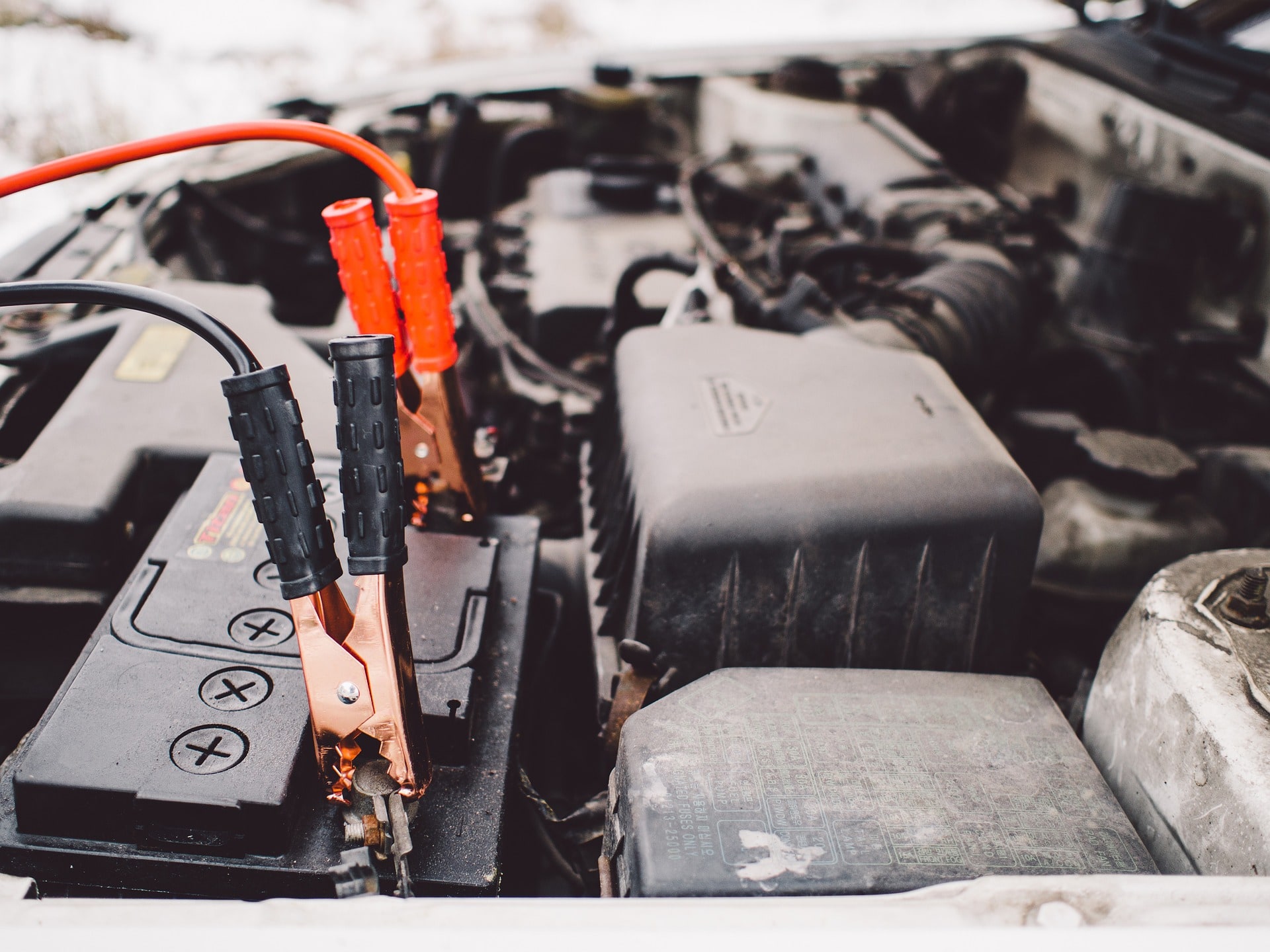
For a typical car or light truck, look for four-gauge, 16-foot cables with substantial insulated clamps. AAA identifies four gauge as a useful all-around compromise for most cars and light trucks and cautions that thinner eight- or ten-gauge cables can struggle, especially in cold weather. The extra length helps position vehicles without letting them touch, but inspect the cables before every use: a cracked jacket, loose clamp, exposed wire, or corroded jaw is a reason to replace them.
Cables are still the lowest-cost way to keep a jump option in a vehicle. Their limitation is obvious: another compatible 12-volt vehicle must be available, its battery must be healthy, and both drivers must know the correct procedure. Never use a 24-volt commercial system to jump a 12-volt passenger vehicle. Confirm the voltage printed on the battery and follow the owner’s manual.
Keep the cables coiled in a pouch, along with gloves, a small light, and eye protection. Do not store them where the clamps can rub directly against loose tools. A good cable set is about conductor size, clamp condition, and enough reach; vague “peak amp” marketing is less useful than those basics.
Best solo backup: NOCO Boost Plus GB40
The NOCO Boost Plus GB40 is the compact jump-pack choice for a driver who cannot count on a donor vehicle. NOCO lists it as a 12-volt, 1,000-amp lithium unit designed to jump-start lead-acid batteries down to two volts. It attaches directly to the vehicle battery through its included clamp assembly, so there is no second car and no need to coordinate two vehicles.
The trade-off is maintenance. A jump pack in a trunk is only useful if it has charge and its clamps, cable, and housing are intact. Check its charge indicator on a calendar schedule, recharge it according to its manual, and keep it within the manufacturer’s temperature and storage guidance. Do not use forced manual modes casually. NOCO warns that high-current override modes can create sparks; use only the instructions for your model.
The GB40 is not a reason to jump every vehicle blindly. It cannot repair a failed battery cell, replace a charging system, or make a damaged battery safe. If your vehicle has remote jump terminals, a battery in an unusual location, stop-start electronics, or hybrid/EV procedures, use the manual’s specified connection points and sequence.
How to connect cables when the manual permits it
First, set both vehicles to park or neutral, apply parking brakes, turn off ignitions and accessories, and make sure the vehicles do not touch. Confirm both systems are the correct voltage. Then follow the manual. The common sequence is red clamp to the positive terminal of the discharged battery, red clamp to the positive terminal of the good battery, black clamp to the negative terminal of the good battery, and the final black clamp to a clean unpainted metal ground on the disabled vehicle, away from the battery and moving parts.
Keep the clamps clear of belts, fans, and each other. Start the donor vehicle only if its manual allows it, then follow the manual’s charging and start sequence for the disabled vehicle. Do not keep cranking repeatedly. If it does not start after the allowed attempts, stop and seek help. Disconnect in the reverse order described by the vehicle instructions, beginning with the ground clamp on the jumped vehicle.
After a successful start, do not assume the problem is finished. Drive or arrange service according to the manual and situation, and have a recurring battery issue diagnosed. Our car GPS guide is useful for navigation preparedness, while a working roadside plan should also include contact information and location awareness, not just a jump kit.
When cables make more sense than a jump pack
Jumper cables are the sensible first purchase for a household with two vehicles, a garage, or a reliable neighbor nearby. A cable set has no battery to maintain, no internal electronics to age, and no question about whether it was left discharged after the last emergency. It is also the more economical way to help another driver. The drawback is logistical: the working vehicle has to be compatible, close enough to park safely, and available at the exact moment the battery fails.
A compact jump pack changes that equation for a person who drives alone, parks in a remote lot, or regularly makes early-morning trips. It is particularly useful when the disabled vehicle is positioned so that a second vehicle cannot safely get close. A pack does not make the situation automatically safe, though. It still connects to a 12-volt battery or approved remote terminals, and the vehicle manual still governs the procedure. If you can buy only one tool, choose the option that matches how help is likely to arrive. A suburban household may get more value from cables; a solo commuter may get more value from a maintained jump pack.
There is a good case for carrying both. The cable set covers a pack that was not recharged and lets you assist someone else. The pack covers the inconvenient moment when nobody else is around. Neither is an alternative to a healthy battery, tight clean connections, or a route-and-contact plan for a long trip.
Why the GB50 is the upgrade pick
The NOCO Boost XL GB50 is the upgrade for people whose vehicle and owner’s manual call for more reserve than the GB40 class. NOCO rates the GB50 at 1,500 amps for 12-volt gasoline engines up to seven liters and diesel engines up to 4.5 liters. Those limits are useful for narrowing the search, not permission to ignore the manual. A vehicle may have remote connection points, battery-monitoring hardware, or a manufacturer-specific method that matters more than a jump pack’s headline rating.
The GB50 is a better fit for a larger gas SUV, a light-duty truck, or a buyer who wants a bigger cushion without moving to a large shop-style booster. It is still small enough to keep in a cargo area, and NOCO lists an IP65-rated enclosure and a built-in LED light. Its cost and 2.7-pound weight make little sense for someone with a small commuter car and easy access to help. In that case, the GB40 is the more restrained purchase.
Do not choose a jump pack by a dramatic peak-amp claim alone. Start with the engine and battery type the maker explicitly supports, then look for protected clamps, an understandable charge display, a manual you can follow, and a storage routine you will actually keep. USB charging and an emergency light are useful extras, but they should not decide a purchase that has to work at the battery terminals.
Cable gauge, length, and clamps matter more than the package claims
Lower gauge numbers mean thicker cable. For most passenger cars and light trucks, four-gauge cable is a solid all-around choice because it carries current more readily than a thin set while remaining manageable in a trunk. Six-gauge cables can be reasonable for smaller cars and occasional use, but they leave less margin in cold weather or with a depleted battery. Two-gauge cable is the more heavy-duty option for larger engines, frequent assisting, or a vehicle fleet. It is heavier and takes more space, which is why four gauge is the better default for many drivers.
Length is a safety and usability decision, not an invitation to stretch cables across a dangerous space. A 16-foot set gives enough reach for ordinary parking situations without the awkward bulk of an extra-long coil. AAA considers roughly 10 to 20 feet practical for passenger vehicles. Before buying, picture where the battery sits in your vehicle and how close another vehicle can park without touching it. A cable that reaches only when it is taut is too short for real use.
Inspect the clamps rather than trusting a marketing word such as “heavy duty.” The jaws should grip firmly, the spring should close them decisively, and the insulation should cover the metal areas a hand could contact. Cables should have flexible, intact insulation with no flattened spots, cracked jacket, corrosion, or exposed conductor. A cheap set that lives loose under a pile of tools can fail long before its wire gauge becomes relevant. Store the cables in a pouch or case and replace them when the clamp action or insulation no longer inspires confidence.
Do not confuse cable thickness with permission to connect any two batteries. A passenger vehicle generally uses a 12-volt low-voltage starting system, but the label and the manual are the authority. Never use a 24-volt source on a 12-volt vehicle. In an EV or hybrid, the traction battery is not a jump-start target. NHTSA notes that many electrified vehicles do have a separate 12-volt battery that may be jump-started, but its location and procedure are vehicle-specific. Treat an unfamiliar battery compartment as a reason to read the manual, not to experiment.
A jump pack needs a maintenance routine
Portable jump starters have one maintenance burden that cables do not: they must hold enough charge when the car will not start. Put a reminder on your calendar to inspect the charge indicator every few months, and check it before a long road trip or the first cold spell. Recharge it as the manufacturer directs. Do not rely on a USB port in a parked vehicle as the sole plan; a vehicle with a weak battery may not be a dependable way to replenish the pack.
Open the pouch during each check. Look for swelling, cracking, damaged leads, corrosion on the clamp hardware, or an enclosure that has obviously been soaked. A lithium jump starter with physical damage is not roadside gear to gamble on. Follow its manual for temperature, charging, and storage guidance. Heat and a permanently neglected charge state are poor conditions for any battery-powered tool.
The safety electronics on a modern pack help prevent common connection mistakes, but they do not override a bad decision. Do not use a pack around a visibly damaged 12-volt battery, do not bridge terminals with tools, and do not trigger a manual or force-start mode simply because the normal indicator refuses to proceed. That feature can bypass safeguards and create a spark risk. Stop and get professional assistance when the normal procedure does not work.
What to do once the engine starts
A successful start only proves that the engine turned over with outside help. It does not tell you whether the battery has enough remaining capacity, the alternator is charging correctly, or a loose connection caused the no-start. Turn off nonessential electrical loads if the manual calls for it, leave the vehicle in a safe setting, and follow the manufacturer’s guidance for driving or service. A sustained drive can restore some charge, but it is not a diagnostic test and it cannot reverse a battery with a failed cell.
Pay attention to the charging-system warning light, repeated slow cranking, dimming lights, or an engine that stalls soon after the boost. Those are reasons to arrange a battery and charging-system check. A battery that needs a jump repeatedly is giving you a useful warning before it fails in a worse place. Replacing a worn battery or repairing a charging fault is cheaper and less stressful than accumulating larger jump packs in the trunk.
After disconnecting, let the clamps cool if they were warm, keep the metal jaws apart, and coil the cable loosely. A quick inspection after use can reveal a hot, loose, or corroded connection that needs attention. With a jump pack, recharge it promptly rather than returning it to the car partly depleted. The next failure may come in colder weather, when the reserve matters more.
Build a small roadside kit around the jump gear
Jump gear is most useful when it is part of a modest, organized kit. Add a charged flashlight or headlamp, work gloves, eye protection, a reflective vest, and a way to contact help. A paper card with roadside-assistance information is worthwhile when a phone is damaged or out of charge. In winter country, add an ice scraper, warm layers, water, and whatever local conditions call for. Keep the kit compact enough that it stays in the vehicle.
A roadside-safety kit can supply the basics, but check the individual contents. A vest and light can improve visibility; neither makes it wise to work beside fast traffic, on a blind corner, or in severe weather. Put the safety items where you can reach them before opening the hood. It is awkward to dig through a packed trunk while standing close to traffic.
For a broader list of supplies, see our emergency-preparedness guide. Keep the scope realistic. The goal is to make a short wait safer and a simple problem manageable, not to turn a passenger car into a repair shop. If you drive long distances, tell someone your route and keep your phone charged; if you are stranded in an unsafe place, move yourself to safety when possible and call for help.
Problems that jumper cables cannot solve
Jumper cables and jump packs provide a burst of electrical help. They cannot repair a starter motor, a corroded or loose terminal, a broken cable, a failed alternator, a blown fuse, a security-system issue, or a battery with a failed internal cell. The pattern of the failure matters. A rapid click may point toward low available battery power, while a single heavy click, no response, or a start followed by an immediate stall can have other causes. Do not treat those sounds as a diagnosis by themselves.
Do not keep trying to crank an engine that will not start. Repeated attempts can drain the donor source, overheat components, and make the situation less clear. If the vehicle does not start after the limited attempts permitted by its manual, or if cables and clamps become hot, disconnect safely and call for help. A technician can test the battery, charging system, and starting circuit instead of guessing from one roadside symptom.
The same restraint applies to physically compromised batteries. A swollen case, crack, electrolyte leak, frozen condition, or strong sulfur odor is not a cable-selection problem. Keep people away from the area, avoid sparks and flame, and contact roadside assistance or a qualified shop. There is no worthwhile product recommendation for a situation that has crossed into a safety concern.
How we researched this guide
We reviewed current battery-jump safety guidance from AAA and NHTSA, then checked current manufacturer specifications and manuals for the recommended NOCO jump packs. We prioritized 12-volt compatibility, engine-size guidance, cable gauge and length, clamp condition, and the safety limits that determine when a roadside jump should not be attempted. Product links lead only to Amazon and may earn SuperGrail a commission; that does not change the selection criteria.
Questions drivers ask about jumper cables and jump packs
Are four-gauge cables enough for a passenger car?
Usually, yes. Four-gauge cables are a practical all-around size for cars and light trucks because they move current more easily than thin eight- or 10-gauge sets. If you drive a larger truck, diesel vehicle, or expect to help other drivers often, consider two-gauge cable after checking your vehicle’s requirements. Cable condition and the correct connection sequence matter as much as the number on the package.
Can I use a jump pack on an EV or hybrid?
Never try to jump the high-voltage traction battery. Many EVs and hybrids have a separate 12-volt battery that can be jump-started, but its access points and procedure are specific to the vehicle. Read the owner’s manual before connecting anything. If the manual is unclear, call the manufacturer’s roadside service or a qualified technician.
How often should I charge a portable jump starter?
Follow the pack’s manual, then make the process easy to remember by checking the charge every few months and before long trips or winter travel. Recharge after using it. A stored jump pack is emergency equipment, so a regular inspection is more useful than waiting for its indicator to surprise you on a cold morning.
When should I skip the jump and call for help?
Call when the battery is swollen, cracked, leaking, frozen, or smells of sulfur; when the vehicle is in an unsafe location; when you do not know the approved connection points; or when the vehicle has failed to start after the attempts allowed by its manual. The right call also depends on your confidence. If you are unsure which terminal, voltage, or vehicle system you are looking at, stopping is the careful choice.
The right kit is the one you will maintain
For most people, that means four-gauge cables for a simple shared-car backup and a GB40 jump pack for solo driving. Step up to the GB50 only when your vehicle’s needs justify the added reserve. Keep either tool in good condition, read the vehicle manual before using it, and treat a recurring no-start as a repair question. The best outcome is a quick, safe start followed by a vehicle that does not need another one tomorrow.