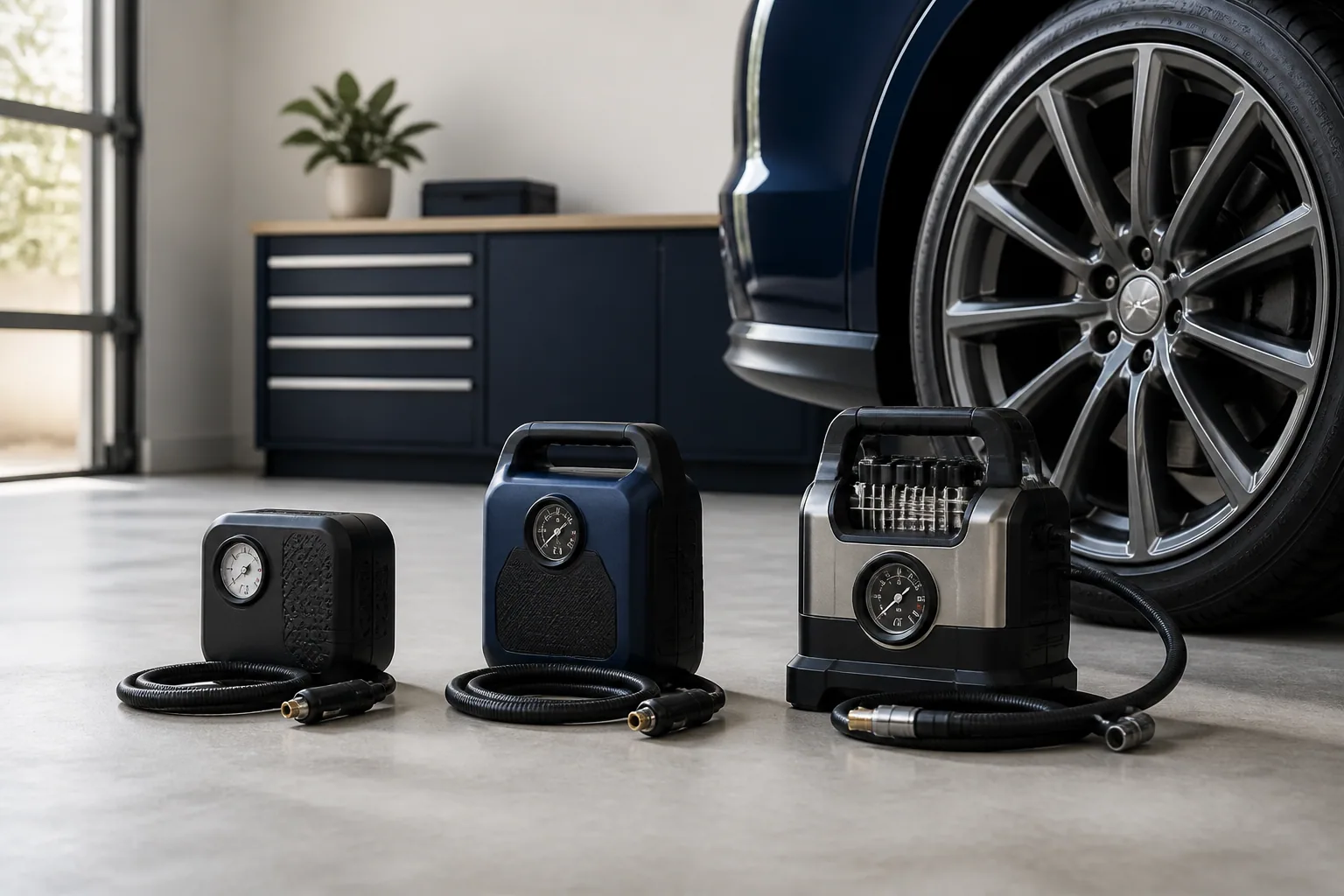
SuperGrail may earn a commission from qualifying Amazon purchases. Inflator picks use current power, hose, pressure, airflow, duty-cycle, and accessory specifications; we did not time tire fills.
The Milwaukee M18 Inflator (2848-20) is the best choice for drivers already invested in M18 batteries or willing to buy into that platform. Its strength is sustained airflow and quick top-offs on passenger vehicles, not a decorative 150-psi claim. Auto shutoff and a stable four-footed body make it straightforward at each wheel. The catch is cost and bulk once battery and charger are included.
For a trunk emergency kit that may sit untouched, the corded VIAIR 88P is often the wiser tool. It runs from the vehicle battery, so there is no lithium pack aging unnoticed in summer heat. It is slower and requires opening the hood, but a maintained car supplies its own power source.
Our five picks cover high-output cordless work, three-source versatility, compact rechargeable convenience, battery-clamp dependability, and a small 12-volt budget unit. None replaces a tire inspection. A tire that repeatedly loses pressure, has sidewall damage, or was driven flat needs professional evaluation.
Quick picks
- Best overall cordless inflator: Milwaukee M18 Inflator (2848-20) — our default when its power, size, or feel fits.
- Best multi-power tool-platform pick: DEWALT 20V MAX Inflator (DCC020IB).
- Best compact rechargeable inflator: Fanttik X8 Apex.
- Best corded inflator for trucks and SUVs: VIAIR 88P.
- Best budget emergency kit: EPAuto 12V DC Portable Air Compressor.
Inflator packages differ. Verify the battery, charger, AC adapter, hose, valve fittings, seller, and vehicle-power requirements before ordering.
Best overall cordless inflator: Milwaukee M18 Inflator (2848-20)
What it is. Milwaukee rates the 2848-20 for passenger, light-truck, and other tires, with an automatic shutoff, four selectable pressure memory slots, anti-vibration feet, and an M18 battery power source. It is sold as a bare tool in many listings, so battery and charger may not be included.
Why choose it. High airflow reduces the time spent kneeling at a roadside wheel, and the broad body stays planted instead of dancing on its hose. M18 owners can use packs they already maintain for tools. The memory settings are useful for households with a car, trailer, and recreational equipment at different pressures.
Tradeoffs and who should skip it. It is expensive as a first M18 purchase and too large for a glove box. Tool batteries should not live permanently in extreme cabin heat, and a missing charged pack makes the inflator useless. Skip it for an occasional bicycle-only kit or if you do not want another battery ecosystem.
Setup and ownership. Install a charged pack, compare the gauge with a trusted reference, and set pressure from the driver-door placard, not the tire sidewall maximum. Let hot tires cool before correcting them. Keep valve caps together and listen for leakage at the chuck before walking away.
Check current Amazon listings for Milwaukee M18 Inflator (2848-20).
Best multi-power tool-platform pick: DEWALT 20V MAX Inflator (DCC020IB)
What it is. The DCC020IB can run from a DEWALT 20V MAX battery, a vehicle 12-volt outlet, or an optional 120-volt adapter. It includes high-pressure inflation with automatic shutoff, a separate high-volume hose for inflatables, onboard accessory storage, threaded chuck, and work light.
Why choose it. Multiple power paths make sense for a garage tool that also travels. A DEWALT owner gets cordless convenience, while the 12-volt cord remains a backup if the pack is flat. High-volume deflate and inflate functions handle air mattresses without forcing the tire pump through a job it performs poorly.
Tradeoffs and who should skip it. The AC adapter is not always included, the body is bulky, and the high-volume hose is not for tire pressure. A threaded chuck takes longer to move between wheels than a lever chuck. Skip it if compact storage matters more than versatility or if you own no DEWALT batteries.
Setup and ownership. Store the 12-volt cord even when using batteries. Thread the chuck straight to protect the valve stem, set auto shutoff, and recheck pressure after removal because a small amount escapes. Never run a vehicle cord where it can wrap a wheel or hot exhaust.
Check current Amazon listings for DEWALT 20V MAX Inflator (DCC020IB).
Best compact rechargeable inflator: Fanttik X8 Apex
What it is. Fanttik’s X8 Apex combines an internal rechargeable battery, digital pressure display, presets, auto shutoff, integrated light, and a compact carry shape. It targets routine passenger-tire top-offs, bicycles, and sports equipment rather than repeated inflation of large truck tires from very low pressure.
Why choose it. There is no cord to route around the car, and the preset interface makes a two- or three-psi seasonal correction quick. It is small enough to move between a car and garage rather than becoming a permanent shop object.
Tradeoffs and who should skip it. Internal batteries age, especially in hot vehicles, and take time to recharge. Small cylinders heat up during long runs and may require a cool-down interval. Skip it as the only plan for remote travel, large LT tires, or a vehicle stored for months without checking the inflator’s charge.
Setup and ownership. Charge it on a schedule, not only after use, and inspect the cable and hose for heat damage. Test it quarterly on the actual car. After inflation, let the metal fitting cool before packing and keep the valve adapter from rubbing the display in storage.
Check current Amazon listings for Fanttik X8 Apex.
Best corded inflator for trucks and SUVs: VIAIR 88P
What it is. VIAIR rates the 88P as a 12-volt portable compressor for tires up to 33 inches, with battery clamps, a long power cord and air hose, inline gauge, LED work light, and a stated maximum working pressure of 120 psi. It draws directly from the vehicle battery rather than a cigarette-lighter socket.
Why choose it. Battery clamps provide a higher-current connection than many accessory outlets and avoid dependence on a proprietary pack. The longer hose reaches around larger vehicles, while the metal compressor construction is suited to occasional truck and trailer use.
Tradeoffs and who should skip it. Opening the hood and attaching clamps is slower and demands correct polarity. The analog inline gauge is less convenient than automatic shutoff, and duty-cycle limits still apply. Skip it if you are uncomfortable working near a battery, need indoor wall power, or want a tiny sedan kit.
Setup and ownership. Park safely, set the brake, identify battery terminals, and follow VIAIR’s engine-running guidance for the exact vehicle and manual. Keep the compressor on a stable surface away from dry grass, and never touch the hot cylinder or hose fitting immediately after a long fill.
Check current Amazon listings for VIAIR 88P.
Best budget emergency kit: EPAuto 12V DC Portable Air Compressor
What it is. The common EPAuto compact compressor runs from a 12-volt accessory socket and uses a digital gauge with preset shutoff, built-in light, and adapters for small inflatables. It is intended for passenger-car tire top-offs; listing revisions can differ, so check fuse rating, cord length, and manual.
Why choose it. For a small car with a healthy 12-volt socket, a corded unit can wait in the trunk without battery-charge anxiety. The preset is easier than watching an analog needle, and the low entry cost makes it plausible to equip a second vehicle.
Tradeoffs and who should skip it. Accessory sockets have limited current, the cord and hose are short on larger vehicles, and compact compressors heat quickly. It is not the choice for truck tires or repeated full inflations. Skip it if the vehicle socket is ignition-switched in an inconvenient way or has a lower fuse rating than the inflator requires.
Setup and ownership. Verify the socket rating before purchase, start the vehicle only where ventilation is safe, and uncoil the cord fully. Use short runs within the stated duty cycle. Check final pressure with a separate gauge until you trust the displayed offset.
Check current Amazon listings for EPAuto 12V DC Portable Air Compressor.
How to choose
Airflow matters more than maximum PSI
Passenger tires usually call for roughly 30 to 40 psi, far below a 120- or 150-psi headline. The hard job is moving enough air into a large tire without overheating. Published fill-time claims only compare cleanly when tire size, start pressure, target pressure, battery, and test temperature match.
Power source determines readiness
Tool batteries deliver strong cordless performance but require platform commitment. Internal rechargeable packs are compact but age in heat. A 12-volt plug is simple but limited by the outlet and fuse. Battery clamps support higher draw and work well for trucks, though hookup is more involved. Multi-source tools reduce one failure mode at the cost of bulk.
Duty cycle protects the compressor
Small compressors cannot run continuously. A duty-cycle statement tells you how long the pump may operate before cooling under stated conditions. Ignoring it overheats seals, hoses, and wiring. If filling several low truck tires, choose a larger compressor and pause as directed rather than treating a pocket inflator like shop equipment.
Use the vehicle placard pressure
The tire sidewall shows a maximum load/pressure specification, not the normal target for the vehicle. Use the cold pressure on the driver-door jamb or manual. Pressure rises as tires heat. Check before driving or after the vehicle has rested, and adjust for load only according to manufacturer guidance.
Gauge accuracy needs verification
Auto shutoff is convenient, but inexpensive sensors can have an offset. Compare the inflator with a trusted gauge across several tires. Consistency matters more than a display showing tenths. If the discrepancy changes with temperature or pressure, service or replace the tool.
An inflator is not a tire repair
Adding air can move a safely repairable slow leak to a service location. It cannot make sidewall damage, exposed cords, a separated tread, or a tire driven flat safe. Sealant kits can damage sensors or complicate repair and are vehicle-specific. When in doubt, use roadside assistance and keep people away from traffic.
Questions to settle before buying
How fast should an emergency inflator be?
Fast enough to restore a modest pressure loss without exceeding its duty cycle. A five-minute top-off is acceptable in a garage and feels long on a highway shoulder. If speed moves you closer to traffic, do not inflate there; call for assistance or move to a safer location only if the tire remains safe to roll. Compare published times only for the same tire size and pressure range.
Can one inflator serve cars and bicycles?
Sometimes, but check valve type, minimum pressure control, and airflow. A powerful car compressor can overshoot a small bicycle tire quickly, while a high-pressure road-bike pump may move too little air for a car. Presta valves need a suitable adapter or head. Tubeless bicycle seating requires a burst of volume that many portable compressors cannot provide even if their maximum pressure looks sufficient.
What if the compressor keeps blowing a fuse?
Stop using it until the power requirement and outlet rating are checked. Replacing a vehicle fuse with a larger one can overheat wiring and cause a fire. Uncoil the cord, inspect the plug, and try only an outlet identified by the vehicle manual as adequately rated. A high-draw compressor may require direct battery clamps. Repeated tool-side fuse failure can indicate a stalled or damaged compressor.
How do you inflate after using a puncture sealant?
Follow the vehicle kit’s instructions, because sealant systems specify valve position, compressor sequence, maximum driving distance, and speed. Tell the repair shop that sealant is inside; it can affect the tire-pressure sensor and repair process. Sealant is temporary and does not repair sidewalls or large damage. Many expired canisters must be replaced even if never opened.
What belongs in the same road kit?
Carry a separate gauge, work gloves, reflective vest or triangles where legal, flashlight, valve cores or caps, and the adapter required by the inflator. Include the wheel-lock key and roadside-assistance information. A jump pack can be valuable, but it does not automatically power a high-current 12-volt compressor. Test the actual combination before a trip instead of assuming matching connectors imply sufficient output.
Run a driveway drill before relying on the kit
Use the inflator on each corner of the actual vehicle in daylight. Confirm that the hose reaches every valve without pulling the unit into traffic, that the 12-volt cord reaches from the intended outlet, and that battery clamps can attach without contacting moving belts or hot parts. Practice entering a target pressure and canceling the pump. A manual in the box is less helpful on a wet shoulder at night.
Time a realistic top-off from several psi low and note how warm the fitting becomes. The purpose is not to benchmark the manufacturer; it is to learn the tool’s sounds, display behavior, pressure offset, and cool-down requirement. Compare the final reading with a separate gauge. If the pump walks across pavement, place it on its designed feet and straighten the hose rather than holding a vibrating hot body.
Then repack the kit in the sequence you will need it. Put gloves and reflective equipment above the compressor, not underneath it. Protect threaded adapters from dirt, secure the manual or a printed quick-reference card, and label the next battery-charge check. Drivers who cannot safely kneel or reach valves should add a compatible extension hose or arrange roadside service. Equipment is only useful when the person in that vehicle can connect it correctly under the conditions where it will be needed.
What else we considered
The Ryobi 18V ONE+ high-pressure inflator is attractive for owners already on that platform, but Milwaukee’s output and stable full-size body are better for repeated vehicle use. Makita and Bosch also make sound platform tools; battery ownership should break close ties. Bicycle riders need lower-volume control and valve compatibility, so consult our bike pump guide rather than assuming a car inflator is gentle enough for every tire.
How we researched portable tire inflators
We examined current manufacturer manuals and specifications for power inputs, hose and cord lengths, maximum working pressure, airflow where disclosed, duty cycle, automatic shutoff, included valve adapters, battery-platform requirements, and warranty coverage through August 10, 2026. Those facts informed our use-case judgments. We did not time tire fills, verify gauge accuracy, or run compressors to their thermal limits.
Inflator listings often omit the battery, charger, AC adapter, bag, or exact hose package shown in promotional images. Verify the complete SKU and included power accessories, then compare the tool’s draw with the vehicle outlet or battery system you will actually use. We kept tool-platform, internal-battery, accessory-socket, and direct-battery models separate because readiness and tire volume are more consequential than a high maximum-PSI label.
Care, safety, and a longer useful life
Store the hose without sharp bends, keep the chuck clean, and inspect 12-volt plugs and battery clamps for corrosion. Recharge internal and removable batteries on a calendar and keep lithium packs out of extreme cabin heat when possible. Run the inflator briefly every few months. A tire gauge, reflective vest, gloves, and light belong in the same kit. Our USB-C car charger guide can help reserve cabin power for phones; do not share an overloaded outlet with a compressor.
Bottom line
Milwaukee’s M18 is the strongest fit for quick vehicle top-offs when a charged platform battery is already part of the household. DEWALT offers better power-source flexibility, Fanttik is easier to carry for small corrections, and VIAIR avoids long-term lithium-charge anxiety in a truck or SUV kit. Test whichever compressor you buy on the actual vehicle, respect its duty cycle, and keep a separate gauge; an inflator is emergency support, not a remedy for structural tire damage or a repeated unexplained pressure loss.