SuperGrail may earn a commission from qualifying Amazon purchases. Dash-cam picks use current channel, sensor, storage, power, and parking specifications; we did not score recorded road footage.
The VIOFO A229 Pro 2CH is our default recommendation because it pairs a 4K front camera with a 2K rear camera, uses Sony Starvis 2 sensors on both channels, records to a removable microSD card, and runs on a supercapacitor. It asks more of the installer than a one-piece camera, but front and rear evidence is worth the cable routing for many drivers.
A dash cam cannot guarantee a readable plate. Distance, shutter speed, headlights, dirty glass, vibration, and relative motion can defeat even a high-resolution sensor. The useful buying question is whether the system gives a clear view of events, preserves the relevant clip, and can be operated safely without distracting the driver.
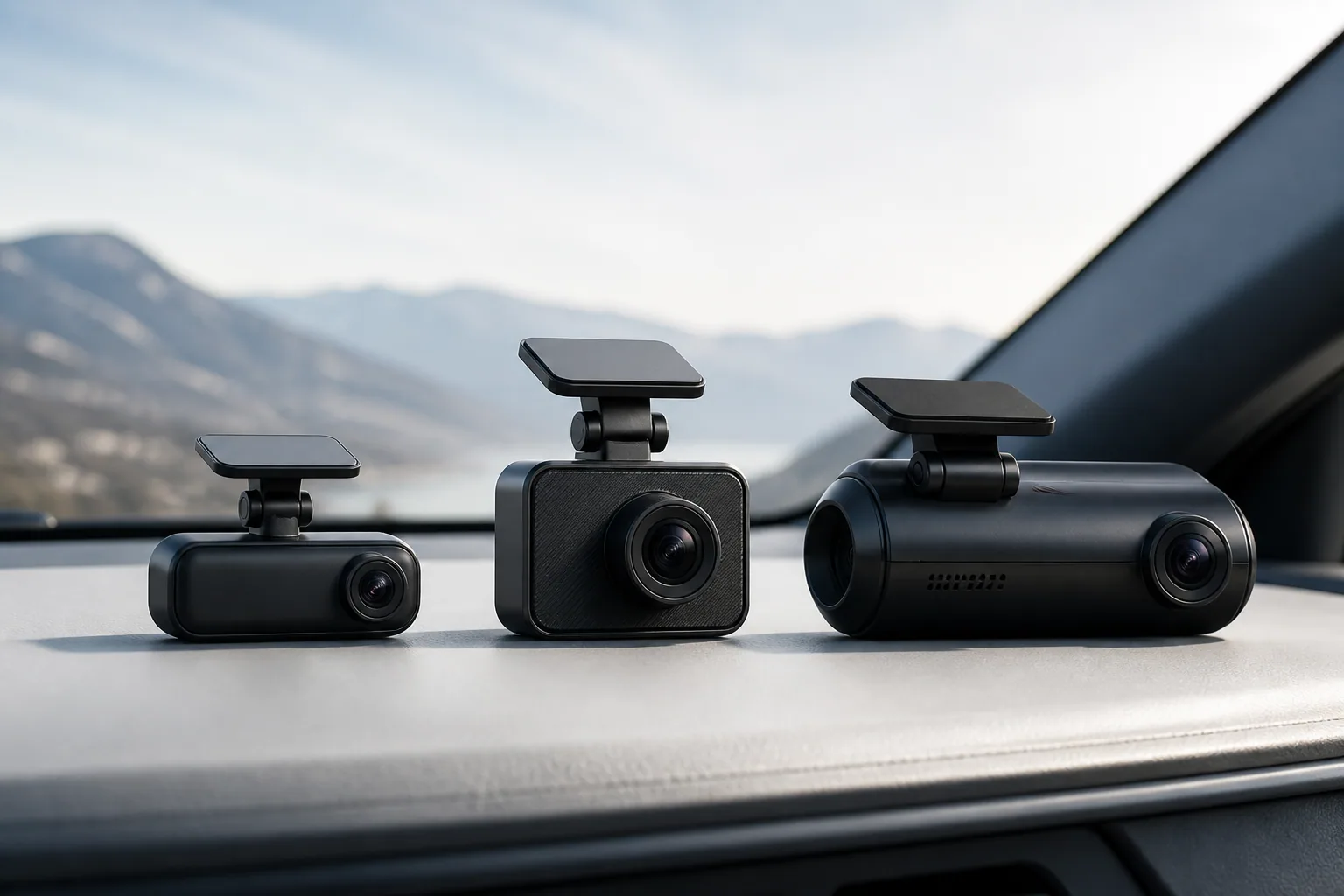
Our five picks cover dual-channel image quality, an almost invisible single camera, a three-channel rideshare layout, low-power parking surveillance, and an inexpensive front-only entry point. Before mounting anything, check local laws on windshield obstruction, audio recording, passenger notice, and video use.
Quick picks
- Best overall front-and-rear system: VIOFO A229 Pro 2CH — our default when its power, size, or feel fits.
- Best discreet front camera: Garmin Dash Cam Mini 3.
- Best three-channel rideshare system: Vantrue N4 Pro.
- Best parking-surveillance upgrade: Thinkware U3000 2CH.
- Best budget compact 2K camera: VIOFO VS1 Mini.
Dash-cam kits vary. Match the front and rear module numbers, card, cable length, parking-power hardware, seller, and regional warranty before checkout.
Best overall front-and-rear system: VIOFO A229 Pro 2CH
What it is. VIOFO specifies 4K at 30 fps from an 8-megapixel Sony Starvis 2 IMX678 front sensor and 2K at 30 fps from a 5-megapixel IMX675 rear sensor. It includes dual-band Wi-Fi, GPS, a 2.4-inch display, HDR on both channels, voice controls, and support for microSD cards up to 512 GB. The camera uses a supercapacitor.
Why choose it. The rear camera is meaningfully sharper than the 1080p rear modules bundled with many systems. Local storage avoids a required subscription, while 5 GHz Wi-Fi speeds clip transfer when removing the card is inconvenient. A screen helps verify aim without turning the phone into an installation tool.
Tradeoffs and who should skip it. The front unit is larger than screenless cameras, the rear cable must cross trim safely, and parking recording requires a compatible hardwire kit. Files are large, so a high-endurance card is essential. Skip it if you will not route the rear cable carefully or if you need cloud alerts without using a phone hotspot.
Setup and ownership. Mount high behind the mirror within the wiper sweep, clean both glass surfaces, and leave slack at liftgate hinges. Format the card in the camera, set the time zone, and verify front and rear files on a computer. Do not tuck wire across an airbag deployment path.
Check current Amazon listings for VIOFO A229 Pro 2CH.
Best discreet front camera: Garmin Dash Cam Mini 3
What it is. Garmin’s Mini 3 records 1080p through a 140-degree field of view and integrates a Clarity polarizer to reduce windshield reflections. The body is extremely small and has no display; setup and review use the Garmin Drive app. Optional constant-power or parking cables expand parked coverage.
Why choose it. A tiny camera placed behind the mirror is less distracting and less tempting to touch while driving. The integrated polarizer is useful on sloped dashboards that reflect strongly in the windshield. It suits a driver who values a tidy front-only record over maximum plate detail.
Tradeoffs and who should skip it. 1080p provides less cropping latitude than 4K, there is no rear view, and reliance on an app complicates troubleshooting. Some remote features depend on power and connectivity choices. Skip it if reading distant details is the priority or if you dislike phone-based configuration.
Setup and ownership. Pair and update it before final cable routing. Use live view only while parked to set a level horizon with enough hood for context and enough sky to avoid wasting the frame. Confirm voice save commands and audible status indications before relying on them.
Check current Amazon listings for Garmin Dash Cam Mini 3.
Best three-channel rideshare system: Vantrue N4 Pro
What it is. The N4 Pro combines a 4K-capable front camera with separate cabin and rear channels. The cabin camera uses infrared illumination for dark interiors, while GPS, Wi-Fi, voice control, parking modes, and supercapacitor power support commercial-driver use. Recording settings change when all three channels are active, so confirm the selected mode.
Why choose it. Rideshare and taxi disputes can occur inside as well as outside the vehicle. A dedicated infrared cabin channel records occupants in darkness without asking the rear camera to cover two jobs. Physical event controls and local storage also let a driver preserve a clip without starting a cloud workflow.
Tradeoffs and who should skip it. Three cameras mean more wiring, more storage consumption, and much more privacy responsibility. Infrared cabin video is usually monochrome at night. Skip it for a private family car if cabin recording would remain disabled, or where audio/video consent rules make the intended use inappropriate.
Setup and ownership. Post any legally required notice, aim the cabin lens to cover passenger seating without excessive window, and disable audio if law or policy requires. Review night clips before the first working shift. Use a high-endurance card sized for three channels and replace it proactively.
Check current Amazon listings for Vantrue N4 Pro.
Best parking-surveillance upgrade: Thinkware U3000 2CH
What it is. Thinkware specifies a 4K 30 fps front channel using the Sony Starvis 2 IMX678 and an optional 2K rear channel. The U3000 integrates radar for low-power parking detection, GPS, thermal protection, supercapacitor power, and microSD support up to 256 GB. Parking modes require hardwiring or compatible OBD power.
Why choose it. Radar can let the camera wait in a lower-power state and wake around motion, extending parking coverage compared with continuous full recording. That is valuable for a car left at an apartment lot or commuter station, provided installation includes battery protection and the radar field fits the parking space.
Tradeoffs and who should skip it. It is expensive, its app and connected features add setup layers, and radar does not record everything that happened before an event in every mode. Remote functions may need a hotspot. Skip it if overnight parking is not important or if you cannot install a protected power connection.
Setup and ownership. Have hardwiring performed by someone who understands the vehicle’s fuse system and airbags. Set a conservative low-voltage cutoff, test parked wake behavior from different approaches, and inspect the car battery’s condition. Parking surveillance should never strand the vehicle.
Check current Amazon listings for Thinkware U3000 2CH.
Best budget compact 2K camera: VIOFO VS1 Mini
What it is. The VS1 is a small screenless front camera that records 2K video with a Sony Starvis 2 sensor, GPS, dual-band Wi-Fi, voice notifications, and supercapacitor power. It accepts removable microSD storage and supports optional parking hardware.
Why choose it. It preserves the two fundamentals we want in a hot windshield device: a modern sensor and a supercapacitor. The compact body and local card make it a sensible first dash cam for a second car, student driver, or buyer who does not need a rear channel.
Tradeoffs and who should skip it. There is no display, no rear view, and fewer physical controls than on a larger camera. App preview is part of installation, and 2K footage cannot create detail that distance or motion erased. Skip it if you know you need rear evidence; adding a second system later is messier than buying dual-channel now.
Setup and ownership. Install and update the app first, use it to frame the camera, then turn Wi-Fi off when not transferring files. Practice the event-save action. Check recordings monthly and after any card warning rather than assuming a status light means every file is healthy.
Check current Amazon listings for VIOFO VS1 Mini.
How to choose
Coverage beats headline resolution
A sharp front view cannot show a rear impact or cabin dispute. Front-and-rear is the best general configuration; three-channel makes sense for passenger service. Higher resolution helps when the subject occupies enough pixels, but lens focus, exposure, compression, and motion determine what survives.
Supercapacitors suit windshield heat
Lithium batteries dislike prolonged heat. A supercapacitor stores enough energy to close the current file safely and tolerates temperature swings better, though it does not power recording with the car off. Parking mode still needs a hardwire kit, OBD cable, or external battery designed for the system.
Storage is a consumable
Dash cams overwrite cards continuously, a harsher workload than occasional photography. Use a manufacturer-approved high-endurance card, format it in the camera, and inspect files periodically. A 4K dual system fills storage quickly. Larger capacity extends history but does not replace card health checks.
Parking mode needs battery protection
Buffered event recording can preserve seconds before impact; time lapse covers longer periods with less detail; radar lowers standby draw. Each mode has blind spots. Set an appropriate voltage cutoff, especially in winter or on a lightly driven car. An old starter battery should not become the power source for ambitious surveillance.
Mounting affects evidence and safety
Place the lens inside the swept area without obstructing the driver. A high central mount sees both sides evenly and hides wiring. Keep cables away from curtain airbags and moving pedals. Rear-camera wire needs a flexible loop at a hatch, not a taut run that eventually breaks.
Privacy and law are part of ownership
Windshield placement rules vary, and audio consent can differ from video rules. Rideshare platforms and jurisdictions may require notice. Secure footage that contains faces, homes, or conversations. Share only the portion needed for insurance or legal purposes, and preserve the original file with time and GPS metadata.
Questions to settle before buying
How much storage history do you need?
Estimate from the actual bitrate and channel count, not resolution alone. A dual 4K/2K system can overwrite a modest card within hours, while a front-only 1080p camera retains much more history. Most collisions are saved immediately, but delayed discovery of parking damage benefits from a larger card. Choose capacity from the camera’s approved list and keep enough free overwrite cycles rather than buying an unverified maximum-size card.
Does HDR guarantee readable plates at night?
No. HDR can balance bright headlights and dark surroundings, but a plate moving quickly across the frame may blur or reflect into a blank patch. A clean windshield, correct exposure, a well-focused lens, and a favorable angle matter. Preserve surrounding context such as vehicle shape, lane position, and signal phase even when the plate is unreadable. Evidence is the sequence, not one zoomed frame.
Should GPS speed be displayed on video?
GPS supplies location, route, time synchronization, and speed, but stamping speed onto exported video is a policy choice. It can support an accurate account and can also expose irrelevant private travel. Learn whether the camera can record GPS metadata while hiding the visible stamp. Do not disable accurate time: a correct timestamp makes clips far easier to match with reports and other cameras.
What happens after windshield replacement?
Adhesive mounts are often lost with the old glass, cable placement shifts, and advanced driver-assistance camera zones may be recalibrated. Remove the dash cam before service if instructed, obtain a fresh genuine adhesive pad, and remount only after the windshield work is complete. Never place the camera inside a sensor or frit area that the vehicle or glass installer says must remain clear.
How should incident footage be preserved?
Stop normal overwrite as soon as it is safe. Use the event button, power down correctly, and copy the original file without editing it. Preserve the files immediately before and after the event from every channel because timing and reactions matter. Make a working copy for sharing, retain the card or checksum of originals when a serious claim is possible, and provide footage through the insurer’s or authority’s secure process.
Plan the complete installation before ordering
List every component: front camera, rear or cabin module, correct-length cables, adhesive pads, approved memory card, polarizing filter, hardwire or OBD power kit, fuse taps where applicable, and a card reader your phone or computer can use. Bundles with the same camera name can omit the card or include a different rear module. Match part numbers, not just listing photos.
Trace a safe cable route in the parked vehicle. A rear cable for a sedan can pass along headliner edges and door seals, while a hatchback needs a flexible transition through or beside the factory rubber boot. Curtain airbags generally occupy pillars and roof edges. A wire laid across the airbag path can become a hazard, so use vehicle service information or a qualified installer when trim removal is unclear. Do not route a power lead where it can fall into pedals.
Decide how the camera should behave when the ignition turns off. A plug-in installation is easiest and may stop recording immediately. Parking mode needs protected constant power and appropriate settings. Some vehicles keep accessory sockets live; others switch them off after a delay. Test rather than assume. After installation, record a daylight drive, a dark drive, rain if available, and a parked event. View the actual files on a larger screen, verify audio and timestamps, and correct aim before the adhesive has spent weeks curing in one position.
What else we considered
Nextbase cameras offer polished screens and safety extras, but some features depend on accessories or subscriptions and the product line is less compelling than VIOFO for removable local storage value. BlackVue remains attractive for cloud-centered fleet or owner monitoring, though ongoing connectivity and cost are harder to justify for a typical driver. For power planning, our USB-C car charger guide explains why port power and cable quality matter even when the dash cam uses its own adapter.
How we researched dash cams
We verified current channel layouts, sensor models, recording resolutions and frame rates, fields of view, card-capacity limits, supercapacitor use, parking-power requirements, and manufacturer operating-temperature ranges through August 10, 2026. Those facts informed our comparison of evidence coverage and installation burden. We did not road-test footage, score license-plate readability, or evaluate long-term card and adhesive reliability.
Dash-cam bundles can vary by rear module, memory card, hardwire kit, and regional model even when the front camera name is unchanged. Match every included part number and confirm whether parking features need an additional cable, battery, subscription, or phone hotspot. We favored distinct front-only, dual-channel, cabin, and radar-parking configurations because coverage and power behavior matter more than collecting several cameras with the same resolution badge.
Care, safety, and a longer useful life
Wipe the lens and windshield, especially after dashboard cleaning creates film. Review footage after firmware updates, card changes, windshield replacement, or a camera bump. Keep a spare card and the correct reader in the glove box. At an incident, save the event, stop the camera before removing power, photograph the scene, and avoid narrating blame into the cabin microphone. The compact-carry priorities in our carry-on luggage guide also apply here: organized cables and documented accessories are easier to replace than a mystery bundle.
Bottom line
The VIOFO A229 Pro 2CH offers the most balanced evidence package for a driver prepared to route a rear cable and maintain high-endurance storage. Garmin Mini 3 is the tidier front-only choice, Vantrue N4 Pro earns its extra wiring in a rideshare vehicle, and Thinkware U3000 justifies its premium mainly when parked coverage is central. Plan power, airbags, card capacity, and privacy before mounting adhesive; the sharpest camera cannot recover a view that was never covered or a clip that was overwritten.