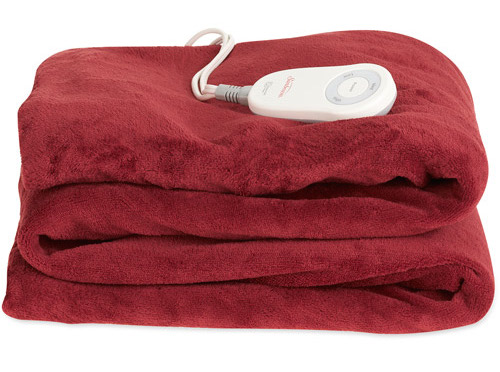
A heated blanket can be useful if your bedroom is cold and you want to warm the bed before getting in. It is not a casual throw to leave bunched beneath bedding or an appliance to buy from an unknown seller because the listing has a long feature list. Start with a current Beautyrest Plush Heated Blanket if you want an adjustable bed blanket from an established bedding brand, or a Biddeford Microplush Heated Throw for couch use. In either case, buy only the exact size and model whose listing shows a recognized safety certification, an automatic shutoff, a clear manual, and a return path. Inspect it before every season and follow its own care label.
The important trade-off is that electrical heat adds a cord, controller, heating elements, and a set of rules to an otherwise simple piece of bedding. A heavier duvet or a warmer sheet setup is the lower-maintenance answer if you only feel cool on a few nights each year. A heated blanket makes more sense when you can use it carefully and consistently, especially for short preheating sessions.
Our picks at a glance
| Pick | Choose it for | What to watch |
|---|---|---|
| Bed blanket: Beautyrest Plush Heated Blanket | Many heat settings, a timer, and a blanket designed for bed use. | Confirm the exact size, controller count, certification mark, and current washing instructions. |
| Couch throw: Biddeford Microplush Heated Throw | A smaller blanket for sitting on a sofa or chair. | A throw is not automatically suitable as overnight bedding. |
| Lower-complexity option: A non-electric fleece blanket | You mainly need another insulating layer, without cords or heating wires. | It cannot actively warm a cold bed. |
The first decision: bed blanket, throw, or no electricity
A bed blanket is made to lie flat across a mattress and is usually sold in mattress sizes. Larger sizes may have two controls so each side can be adjusted separately. A heated throw is smaller and intended for a couch, chair, or reading nook. The distinction is more than marketing. A throw’s cord placement, controller, dimensions, and instructions may not be suitable for sleeping in bed. Never assume the use case from the fabric alone; read the manual for that exact model.
If your goal is to take the edge off cold sheets, preheating is the easiest and most conservative routine. Lay the blanket flat as instructed, set a low or moderate heat level, turn it on long enough to warm the bed, then switch it off and unplug it before getting in if the manual calls for that practice. This avoids treating a heated blanket like a permanent overnight heater. The heat it supplies is local and personal; it does not replace proper room heating or solve a bedroom that is cold for health or building reasons.
A non-electric blanket is the better purchase for many households. It has no controller to lose, can be layered and tucked as its fabric allows, and can be washed according to its ordinary care label. For cold sleepers who need warmth every night, begin with warmer sheets, a duvet or comforter with the appropriate fill, and fewer drafts. Add electrical heat only if its benefit outweighs the additional care and safety burden.
The bed-blanket pick: Beautyrest Plush Heated Blanket
Beautyrest Plush Heated Blanket is the bed-blanket option to look for when available in your size and color. The current product information for the Plush line describes 20 heat settings and a timer that can be set from one to 10 hours, with a 10-hour auto shutoff. Twin and full versions typically use one controller; queen and king versions are commonly sold with two. Those are useful features because they let you choose a modest setting and a defined run time instead of running a blanket at high heat by default.
The many settings are not a reason to buy more heat than you need. Start low, let the bed warm, and increase only if the manual permits and the lower setting does not work. The higher setting on any electric blanket should not be a substitute for inspecting the product, keeping it flat, and making sure cords are undamaged. A timer helps limit a session; it does not make misuse safe.
Beautyrest describes the blanket as machine washable, but washing instructions are model-specific. Disconnect the controller only as directed, check that the electrical connector is completely dry before reconnecting it, and do not improvise a drying method. Do not replace a lost controller with one from another heated product, even if a plug appears to fit. Electrical controls and blankets are matched components.
The drawback is complexity. A large bed blanket has more wire area, more bedding layers around it, and sometimes two controls to keep track of. It may also be more heat than one person needs. Buy this category only from a listing that identifies the manufacturer, the model, and its safety mark, such as UL or ETL. A vague claim of “safety certified” in an image is not enough; the product and its documentation should make the claim clear.
The couch pick: Biddeford Microplush Heated Throw
Biddeford Microplush Heated Throw makes more sense for a person who wants warmth while sitting still, reading, or watching a movie. The current Microplush line includes machine-washable throws with a digital controller, adjustable heat settings, and an automatic shutoff timer. A smaller throw keeps the electrical appliance in the use case where it is most helpful: a localized layer over a person sitting on a sofa, rather than a large blanket repeatedly folded around a bed.
Check the exact product page rather than relying on one version’s specifications. Biddeford listings include throws with different controls and settings. The color, size, and retailer can change the exact model. Select a current listing with its maker named, the user manual available, and a legitimate safety certification for your market. If the listing cannot answer what happens when the timer ends, how the blanket is cleaned, or who supports the product, move on.
Do not drape a heated throw over a recliner mechanism, pinch its lead under a cushion, or pile other blankets and pets on it while it is powered. These uses can trap heat or strain the cord. A throw is also not a heating pad. Avoid sitting directly on it unless the manufacturer specifically says that position is allowed; internal wiring can be stressed by pressure and bunching.
Safety features to require before you buy
Look for an independently recognized safety certification appropriate to where you live. In the United States, a mark from a nationally recognized testing laboratory such as UL or ETL is a practical buying requirement. In Canada, plugged-in electrical products should be certified by an accredited body for the Canadian market. Certification is one useful signal, not a promise that every product will remain safe after damage, misuse, or age.
An automatic shutoff is also essential. The Beautyrest bed blanket’s adjustable one- to 10-hour timer gives the buyer control over the run time; other products use fixed shutoffs. A timer does not excuse an unsafe setup, but it is preferable to a blanket that stays energized indefinitely. Look for a controller that is readable enough for the person using it, with a clear power button and a manual that explains every setting.
Skip listings that hide the maker, use generic product images for several unrelated models, or offer only a seller name with no manual, model number, or support contact. The US Consumer Product Safety Commission issued a stop-use warning for Melinora electric heated blankets in July 2026 after reports of overheating, melting, burning, and a burn injury. That warning is a reminder to check the CPSC recall and warning database before buying or unpacking an electric blanket, and to stop using a product if it shows damage or is subject to a safety notice.
Use an electric blanket in a flat, open setup
Lay the blanket flat while it is powered. Do not use it folded, tightly tucked, rolled, bunched, or under a heavy pile of bedding unless its manual expressly allows the arrangement. The Consumer Product Safety Commission warns that folded blankets can overheat and that covering an operating blanket can trap heat. Wires should not be bent sharply around mattress corners or pinched between a mattress and box spring.
Keep the lead and plug where you can see them. Do not run them under rugs, staple them to a wall, trap them in a bed frame, or route them where a reclining mechanism can crush them. Plug directly into a properly functioning wall outlet when the manual requires it; do not overload an extension lead or power strip with other high-draw devices. If an outlet, cord, control, or plug feels unusually hot, turn the product off, unplug it, and stop using it until the manufacturer can advise you.
Before first use each season, inspect both sides of the blanket and all connections. Discard and replace a blanket with cracked or broken wiring, a loose plug, scorched or dark spots, frayed fabric around a wire, an intermittent controller, a burning smell, or a damaged connector. Do not try to tape, sew, splice, or repair an electrical heated blanket at home. A fabric repair that crosses a wire is not a safe repair.
Who should ask a clinician before using one
Electric blankets can cause burns if a person cannot sense or respond to heat. UL’s safety guidance specifically cautions against use by infants, young children, people who are paralyzed, and people who cannot safely operate the controls. It also notes added burn risk for people with reduced sensation, including some people with diabetes, and warns against use by people with urinary incontinence. Those are not edge cases to wave away with a low setting.
If you have reduced sensitivity to heat, limited mobility, a medical device, a health condition that affects circulation or skin, or any uncertainty about nighttime electric heat, ask a clinician familiar with your situation before using one. Do not use an electric blanket to treat pain, chills, or a health problem without medical advice. A regular insulated blanket, room-temperature adjustment, or a different bedding layer may be the safer answer.
Cleaning and storage are part of owning one
“Machine washable” is not a universal instruction. It means the specific manufacturer has provided a method for that model. Follow its temperature, detergent, spin, drying, controller-removal, and reconnection instructions exactly. Never wash or dry-clean a heated blanket if its label does not say it can be laundered. Make sure all electrical components are dry before reconnection; water, a damaged connector, and electricity are an unacceptable combination.
When the cold season ends, unplug the blanket, allow it to cool, and store it as its manual directs. UL advises rolling rather than sharply folding a blanket. Do not put heavy boxes on it, wedge it in a drawer where cords kink, or let pets chew the cable. Avoid using an old blanket that has spent years in a damp attic or has missing directions. The cheapest replacement can become expensive if it has no usable documentation.
What a heated blanket cannot fix
It cannot safely compensate for a defective outlet, an unheated bedroom in severe weather, or a person whose body cannot safely sense heat. It is also a poor substitute for addressing a persistent sleep problem. For a quieter, darker, and more comfortable bedroom without plugging another device into the wall, see our guides to white-noise machines and sleep masks. If you are considering a portable heat source instead, read the safety-first guidance in our space-heater guide; a space heater brings different and significant fire risks.
Pick the right size and controller layout
Measure the mattress before ordering. “Queen” and “king” tell you where a product is supposed to fit, but the listing should still state the blanket dimensions. A blanket that hangs far past the foot of the bed creates extra fabric to manage; one that is too small can leave a cold edge and encourage awkward tucking. Do not buy a larger size to make it warmer. Buy the size the maker specifies for the mattress and use it flat.
For two people, separate controls can be genuinely useful. One sleeper may want a short preheat while the other wants no electrical heat at all. Two controllers are also another point to inspect, label, and keep dry. Check where the controller cords leave the blanket. You want them to reach an outlet without crossing a walkway, being pulled taut, or disappearing under the mattress. A long controller lead is only helpful when it can be routed safely.
Do not decide by the number of heat levels alone. Three or five useful settings can be easier to operate than 20 poorly marked ones. More settings matter only if the controls are clear, the display is readable in low light, and the timer is easy to set. A blanket that defaults to a long run time deserves particular attention: read the start-up behavior before using it in bed.
Why we do not recommend an unknown marketplace blanket
Marketplace search results can make every heated blanket look interchangeable. They are not. A very low price may reflect a smaller blanket, thinner fabric, a less useful controller, weaker support, or missing documentation. More seriously, an electrical item with no identifiable manufacturer leaves the buyer with no reliable way to find a manual, check a recall, request a compatible replacement part, or report a failure. The July 2026 CPSC warning about Melinora shows why that matters.
Choose an established manufacturer with a visible model number and instructions even if another listing promises a higher heat level or a softer fabric. Read the most recent listing description for the exact size, not a product-review roundup from a previous winter. If certification, controller model, or care information varies between the product photos and the description, treat that conflict as a reason not to buy until the seller can clarify it. Electrical bedding needs a clear paper trail.
A conservative first-night routine
Read the manual while the blanket is still in its packaging. Put it on the bed in the orientation shown, connect only the supplied controls, and check that the fabric lies smoothly. Before using it overnight, try a short supervised preheating session at a low setting. Confirm that the controller behaves as described and that no wire, connector, or fabric section becomes unusually hot. If anything smells hot, scorches, sparks, or acts erratically, unplug it immediately and use the seller or manufacturer’s return process.
Once that check is complete, resist the urge to add your heaviest comforter and turn the controller to maximum. Use the lowest setting that gives you the result you wanted. Unplug the blanket when it is not in use. An electric blanket is a device that happens to be soft, so treat it with the same caution you would give any other device used around bedding.
How we made these choices
We checked current product documentation and listings for the feature sets, timers, care instructions, and models described here, then compared those details with current CPSC and UL safety guidance. We did not treat a safety mark, a timer, or a brand name as proof that an individual blanket is safe after purchase. Every buyer should inspect the delivered product, read the manual before use, and check current recalls or warnings by the exact brand and model.
For a bed, choose a documented Beautyrest Plush Heated Blanket only if the exact listing meets the safety checks above. For a sofa, choose a documented Biddeford Microplush Heated Throw. If either feels like too much apparatus for the benefit, a non-electric blanket is the better product. With electrical bedding, restraint is part of the recommendation.