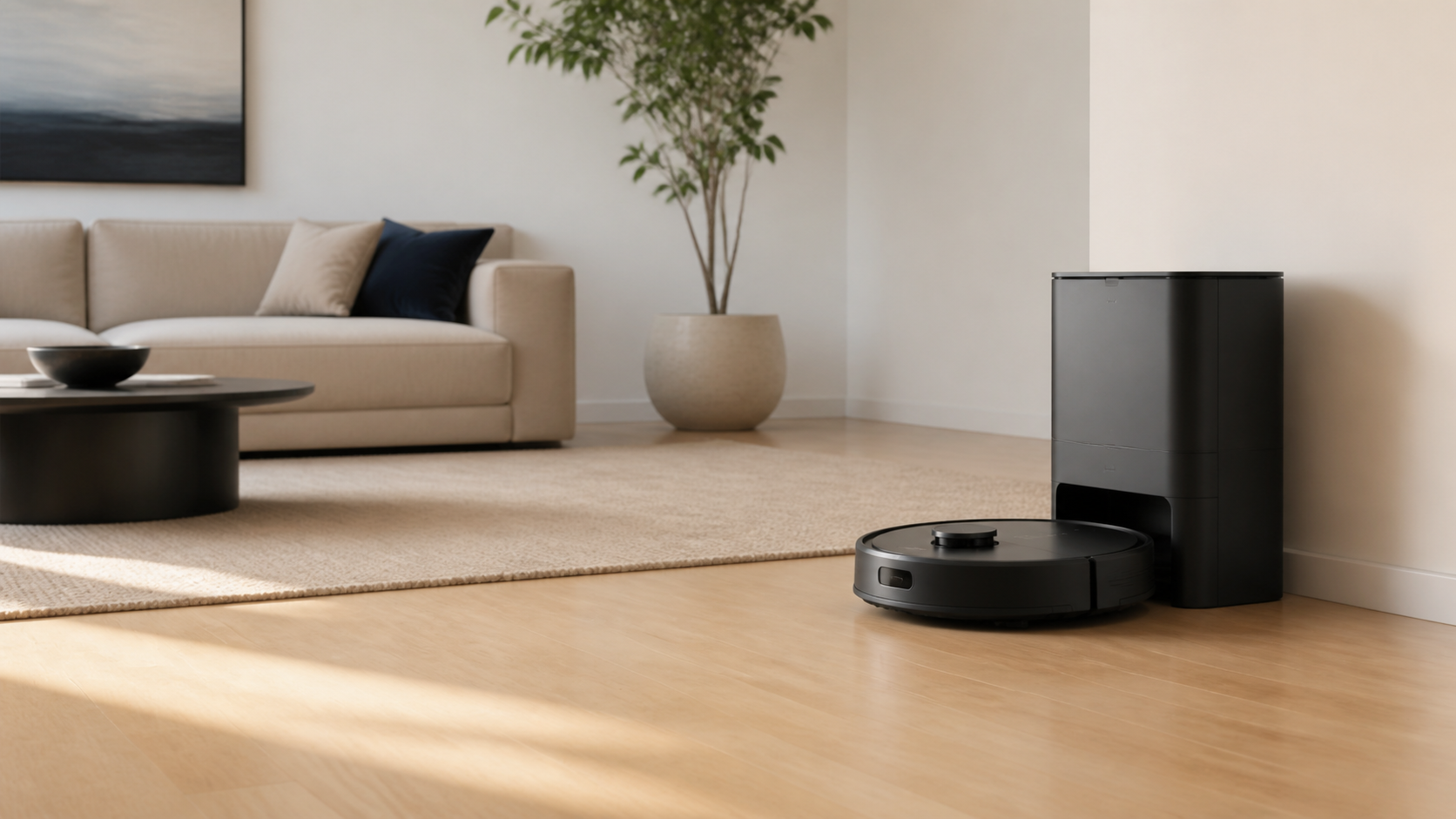
A robot vacuum is worth buying when it can run often enough to reduce the everyday grit, crumbs, and pet hair that build up between proper cleans. For most homes with hard floors and at least some rugs, the Roborock Qrevo S5V makes the most complete case. Its dock empties the dustbin, refills the robot’s water tank, washes its spinning mops, and dries them with warm air. The robot has LiDAR navigation, a 12,000Pa advertised suction specification, mop lifting, and a tangle-focused brush system. That level of automation is convenient, but it comes with a large dock, water tanks to maintain, and a 2.4GHz Wi-Fi requirement.
For a lower-cost vacuum-only approach, the Shark Matrix Self-Empty Robot Vacuum is the simpler choice. Its bagless base stores up to 45 days of debris, it maps with LiDAR, and it avoids the water tanks, mop pads, and wash tray that come with an all-in-one station. It cannot replace a mop. If low furniture is the main challenge and a premium dock is acceptable, the Roborock Qrevo Slim has a notably low 3.23-inch robot body plus hot-water mop washing, dust emptying, and tank refilling. Its price and feature set make sense only when that clearance solves a real problem in your home.
Quick picks
| Pick | Why it fits | Know before you buy |
|---|---|---|
| Roborock Qrevo S5V Best for most mop-and-vacuum homes | LiDAR mapping, spinning mops, mop lifting, anti-tangle brush design, and a dock that empties, refills, washes, and warm-air dries. | The dock needs space, fresh water, dirty-water emptying, and periodic tray cleaning. It connects on 2.4GHz Wi-Fi, not 5GHz. |
| Shark Matrix Self-Empty Robot Vacuum Best vacuum-only option | LiDAR mapping, a self-emptying bagless base, a self-cleaning brushroll, and a simpler routine for homes that already mop by hand. | No water station and no mopping. You still empty and clean the base rather than replacing a disposable bag. |
| Roborock Qrevo Slim Best for low furniture clearance | An 8.2 cm / 3.23-inch robot body, advanced obstacle recognition, dual spinning mops, and a multifunction dock with hot-water washing. | It is an expensive way to solve a clearance issue. Measure the underside of your furniture first. |
For most homes, buy the Qrevo S5V for its dock—not its headline number
Robot-vacuum marketing tends to lead with suction figures. They are easy to print on a box and hard to compare across brands, floor types, brushes, and cleaning modes. The Qrevo S5V’s published 12,000Pa figure is one specification, but the more consequential detail is the dock. It auto-empties the robot’s dustbin, refills its water tank, washes the mop pads, and dries them with warm air. That turns a machine that needs daily attention into one that mostly needs a scheduled check-in.
The S5V also has PreciSense LiDAR navigation, Reactive Tech obstacle avoidance, dual spinning mops, auto mop lifting, an all-rubber brush, and a Triple Anti-Tangle system. The combination has a clear purpose. LiDAR helps the robot build and follow a floor map; obstacle avoidance gives it a better chance of dealing with the normal messiness of a lived-in room; lifted mops help it move over low-pile carpet without dragging a wet pad; and an all-rubber brush is easier to pull hair from than a dense bristle brush. None of those features mean you can leave charging cables, socks, or a pet accident on the floor and expect a perfect outcome. They make routine cleanup more forgiving.
Choose the Qrevo S5V if you have mostly hard flooring, want mopping to happen regularly, and are willing to give a dock permanent space. Roborock lists both the robot and dock dimensions, and the station is not a small charging puck. It needs a stable floor, room around it, an outlet, and enough access for you to lift water tanks and reach the detachable dock base. The dirty-water tank is not a magical disposal system. It needs to be emptied and rinsed. The wash tray needs attention, too. The right expectation is less daily work, not no maintenance.
The S5V is a poor fit for a person who dislikes apps, has no practical spot for a water dock, or mainly wants a machine to collect dry debris from carpet. In those homes, a vacuum-only model can be more useful because it has fewer parts, fewer fluids, and fewer chores attached to the purchase. The model also supports only 2.4GHz Wi-Fi. Many home routers combine their bands automatically, but that detail is worth checking before you discover it during setup.
Choose the Shark Matrix when you want less system to manage
The Shark Matrix Self-Empty Robot Vacuum is the sensible alternative for a home that needs scheduled vacuuming but does not need a robot mop. It uses 360-degree LiDAR for Precision Home Mapping and returns to a bagless self-emptying base that Shark says can hold up to 45 days of dirt and debris. The Matrix cleaning pattern takes multiple passes over an area, while its self-cleaning brushroll is meant to reduce hair wrap. The appeal here is not that it does everything. It is that it avoids the parts you may not want.
A vacuum-only robot has practical advantages. There are no fresh- and dirty-water tanks to lift, no damp mop pads to dry, and no wash tray to scrub. You can still use a normal mop when a floor needs it, but the robot takes care of the frequent dry maintenance that makes the most visible difference: crumbs under a table, grit near an entrance, and the hair that appears again after a conventional vacuum has been put away.
The bagless base is also a real trade-off, not a universal advantage. It removes the cost and supply issue of disposable bags. It asks you to empty the base into a trash bin and clean its filter as part of the routine. Pick this Shark if that sounds more reasonable than owning another set of bags and water tanks. Skip it if you specifically want regular mopping or if your home has many delicate objects, cords, or cluttered areas that demand more sophisticated avoidance and a willingness to prepare the floor first.
Shark’s mapping lets you set up rooms and schedules, but a map is not a substitute for a walk-through. Close doors to rooms you do not want cleaned, define no-go zones where the app permits them, and keep the first few runs supervised. A good map becomes useful when it reflects the real boundaries of your home. It does not make a robot capable of navigating every oddly shaped chair leg or eating a charging cable safely.
The Qrevo Slim earns its price only when furniture height is the constraint
The Qrevo Slim is the premium choice for a very specific layout problem: important floor area is hiding under furniture that a typical round robot cannot reach. Roborock lists the robot body at 8.2 cm, or 3.23 inches, tall. It pairs that low profile with a StarSight autonomous system, obstacle recognition, 11,000Pa advertised suction, a DuoRoller brush, a separate anti-tangle main brush, and dual spinning mops. Its dock adds hot-water mop washing, warm-air drying, dust emptying, tank refilling, and dock self-cleaning.
Those features make a compelling spec sheet, but the buying decision should be much plainer: measure your furniture. Use a ruler at the lowest point of the sofa, bed, cabinet, and media unit that matter to you. If there is at least a little more clearance than the robot’s body height and there is a meaningful area under those pieces, the Slim can reach a part of the floor that other robots leave alone. If your furniture sits lower than that, or the gap is only in one insignificant corner, a less expensive machine makes more sense.
The Qrevo Slim also asks for the same level of dock care as other mop-washing robots. You will add clean water, empty dirty water, inspect the wash tray, clean brushes and sensors, and replace consumables on the maker’s schedule. The advanced hardware can make regular cleaning more capable, but it does not erase ownership. Consider it if under-furniture coverage is a regular source of frustration and you are already comfortable with a fully featured dock. Do not choose it just because a premium robot has more sensors or a larger suction figure.
Pick the kind of automation you will actually maintain
There are three broad robot-vacuum setups. A basic robot returns to a charging pad and asks you to empty its small dustbin. A self-emptying vacuum returns to a dry base that holds debris for longer. A full service mop-and-vacuum station adds water tanks, mop washing, and drying. Each step removes a little daily work and adds size, cost, and maintenance.
A simple robot is enough for a small apartment with bare floors and a person who does not mind emptying a bin. A dry self-emptying base is a practical middle ground for homes with more hair and regular vacuuming needs. A washing dock is worthwhile when mopping is part of the plan and the station will be in a place where its tanks and tray can be serviced without annoyance. Buying more automation than you are willing to maintain is an expensive way to end up with a dormant appliance.
Consider the robot’s route to the dock as well. It needs a direct, consistently clear path. Do not hide the station behind a dining chair, under a low cabinet, or on an unstable mat. A robot that cannot dock reliably will spend more time asking for help than it saves. Leave the surrounding floor clear and follow the manufacturer’s placement guidance rather than treating the dock like a small decorative charging stand.
Navigation matters more than an enormous suction claim
LiDAR is useful because it helps a robot build a repeatable map of rooms, walls, and furniture. That supports room-specific scheduling, no-go zones, and a more orderly route. Camera and light-based obstacle detection can add another layer for objects on the floor, although no navigation system is a promise that the robot will identify every cable, sock, or spill correctly. The cleaner the floor is before a run, the better any robot’s odds.
For a household with pets, this is especially important. Pet hair is a normal robot-vacuum job. Water bowls, feeding mats, toys, and accidents are not things to leave to chance. Set a no-go area around feeding stations if your model supports it and pick up toys before scheduling a run. A stable pet feeding mat can help contain splashes and crumbs, but it is still better to keep a robot from pushing into a bowl.
Suction ratings are measured under manufacturer-defined conditions and should not be treated as a universal cleaning score. Brush design, airflow, floor material, a bin’s fullness, and whether a machine is in a quiet or maximum mode all change the result. Look for a combination that matches the home: a rubber brush and anti-tangle design for frequent hair, mopping support for sealed hard floors, a low body for furniture clearance, and a dock routine you can live with.
Mopping is useful, but it is not a substitute for cleaning a floor
Spinning mop pads can handle frequent light maintenance on sealed hard floors. They are good at keeping an already reasonably clean kitchen or entryway from looking neglected. They are not the answer to a sticky spill, a heavily soiled grout line, or a floor that needs a careful manual clean. A robot should not spread a fresh food spill across a room, and it should not be sent through a wet accident or an area with harsh chemicals.
A mop-washing dock reduces the number of times you touch the pads, but the tray and tanks are part of the cleaning loop. Empty dirty water promptly, rinse the tray, and use only approved cleaning solution if the manufacturer permits one. When you need to wash pads, clean a messy base, or handle a floor-level spill, a good dish soap and a manual rinse are more useful than hoping the dock can deal with every kind of residue.
Pay attention to carpet. Mop-lifting systems can help a robot move over low-pile carpet without dragging wet pads, but their lift height has limits. High-pile rugs, thick bath mats, tassels, and layered runners can all become trouble. Mark no-mop zones for rugs that should remain dry, and use the first few cleaning runs to see what the machine can cross safely.
A robot vacuum complements a handheld, not every other tool
Robots handle open floor area well. They do not replace a tool for stairs, upholstery, car seats, tight corners, shelves, or a sudden spill. Keep a conventional vacuum or a compact model for those jobs. Our handheld vacuum guide is a useful next read if the gaps around furniture and quick messes are what frustrate you most.
This division of labor makes the robot more satisfying. Schedule it for a time when the floor has been picked up, then use the handheld or upright vacuum for the areas it cannot touch. Let a mop-capable robot handle regular light maintenance while you still deal with deep cleaning on your own schedule. That is a realistic setup, and it prevents the disappointment that follows buying a robot as if it were a full household-cleaning service.
Setup and maintenance determine whether the robot keeps running
Start with one mapped floor and a few supervised runs. Name rooms, set no-go zones, check which thresholds it crosses, and see where it catches a rug edge or chair base. Keep cords tucked away. Pick up shoelaces, small toys, and anything that could wrap around a brush. Once the map works, schedule short, frequent cleans instead of waiting for one massive run after the floors already look bad.
Set a recurring reminder to empty the dirty-water tank on a wet-dock model, wipe sensors, inspect wheels, remove hair from brushes, and wash the dock tray. On a dry self-emptying model, empty the base and clean filters as the manual directs. These are not glamorous jobs, but they are the difference between a robot that becomes a background habit and one that starts emitting error messages from a corner.
Replacement pads, filters, brushes, bags, and cleaning solution should be considered before purchase. A model is not a bargain if its consumables are difficult to find or you dislike its maintenance pattern. Add a spare filter or set of mop pads when it is convenient, but do not stockpile accessories you may never use. The first priority is choosing a machine whose ordinary upkeep fits your household.
When to skip a robot vacuum
Skip a robot if the floor is routinely cluttered, if there is no accessible place for a dock, if multiple thick rugs block the route, or if you need cleaning power primarily for stairs and upholstery. A conventional vacuum may solve the actual problem more directly. Skip a water dock if dealing with tanks and a wash tray already sounds like a chore you will postpone. The vacuum-only Shark is a better answer than an unused full-service station.
Robot vacuums are also a poor answer to a one-time deep-cleaning problem. They work through repetition. If you want a machine to maintain a floor several times a week, they can be valuable. If you need to remove embedded grime from a neglected carpet once, rent or use a more appropriate tool and decide about automation afterward.
How we researched this guide
We compared current manufacturer specifications, manual requirements, dock functions, stated navigation systems, published dimensions, compatibility notes, maintenance needs, warranty information, and Amazon availability. We did not conduct hands-on testing or make a claim about cleaning performance beyond the maker’s documented features. The picks are organized by the problem they solve: full-service mop maintenance, straightforward dry debris collection, and low-furniture clearance.
Our recommendation
Buy the Roborock Qrevo S5V if you want vacuuming and mopping to happen regularly and have room to maintain a wet dock. Buy the Shark Matrix if a bagless self-emptying vacuum is enough and a simpler ownership routine matters more than mopping. Choose the Roborock Qrevo Slim only when its low 3.23-inch body reaches important floor space under your furniture. The right robot is the one whose dock, map, and maintenance routine fit the way your home actually works.