SuperGrail may earn a commission from qualifying Amazon purchases. Dehumidifier recommendations use current capacity, drainage, operating-range, and warranty documentation; we did not run extraction tests.
For most persistently damp basements, the Midea 50-pint Cube with pump (MAD50PS1QWT-A) is the most useful starting point. Its 50-pint daily rating, built-in lift pump, smart controls, and unusual extendable bucket solve the two problems that make dehumidifiers annoying: moving a lot of water and finding a gravity drain below the machine. It is heavy at about 42 pounds and the Cube shape is less convenient to carry up stairs than a narrow conventional cabinet. Buy it for a basement or garage where it can stay put; do not buy it as a quiet little bedroom appliance.
A dehumidifier is not an air conditioner and it does not remove mold, repair leaks, or make a cold basement warm. It condenses water from moving air and releases some heat into the room. The right capacity is therefore tied to moisture load, temperature, airflow, and drainage more than to a marketing square-foot number. If water enters through a foundation wall or a sump is failing, spend on that repair first.
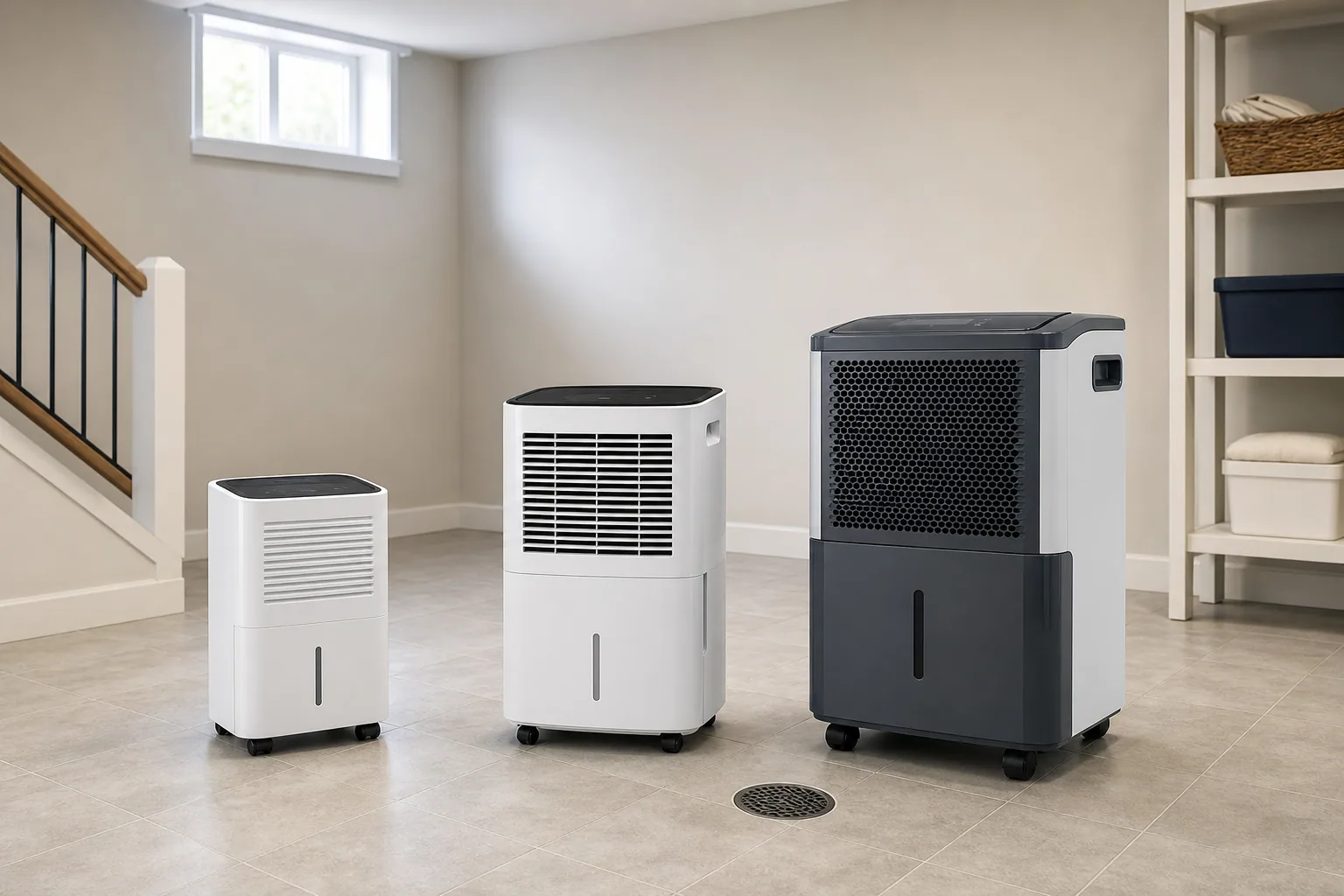
Our five picks cover a pumped 50-pint workhorse, a straightforward 50-pint value model, a quieter 35-pint room unit, a compact 22-pint option, and a crawl-space specialist. That separation matters. A machine sized for a laundry-room corner should not be judged by the same criteria as a ductable unit expected to run for years under a house.
Quick picks
- Best overall for a wet basement: Midea 50-pint Cube with pump (MAD50PS1QWT-A) — our default when its power, size, or feel fits.
- Best conventional 50-pint cabinet: Frigidaire Gallery 50-pint dehumidifier (FGAC5045W1).
- Best for a medium room: GE 35-pint portable dehumidifier (ADHL35LA).
- Best compact option: Midea 22-pint EasyDry (MAD22C1AWS).
- Best crawl-space specialist: Aprilaire E070 crawl-space dehumidifier.
Dehumidifier variants change. Verify the full model suffix, rated pint capacity, pump inclusion, drain hardware, seller, and warranty before ordering.
Best overall for a wet basement: Midea 50-pint Cube with pump (MAD50PS1QWT-A)
What it is. Midea lists 50 pints per day, coverage up to 4,500 square feet, a built-in pump, app control, wheels, dimensions near 14.5 inches on each side, and a weight of 41.54 pounds. The lift-and-twist body can run nested or extended, giving its bucket more usable depth than the compact stored shape suggests.
Why choose it. The pump changes placement options: the hose can rise to a sink or window instead of needing a floor drain below the outlet. The large bucket remains useful during setup or if the drain hose is temporarily disconnected. A 50-pint rating also gives meaningful headroom in a damp basement where laundry, open masonry, and humid outdoor air combine.
Tradeoffs and who should skip it. Its shape makes the full bucket awkward, the compressor and fan are audible, and app setup adds complexity without improving basic moisture removal. The pump is another component that may eventually need service. Skip it for a lightly humid bedroom, for frequent stair carrying, or if a simple gravity hose already reaches a reliable drain.
Setup and ownership. Place it with clearance around the intake and exhaust, route the hose so it cannot kink, and set a realistic target around 45 to 50 percent relative humidity. Confirm that pumped water reaches the drain before leaving it unattended. Clean the washable filter on schedule and inspect the hose after moving the unit.
Check current Amazon listings for Midea 50-pint Cube with pump (MAD50PS1QWT-A).
Best conventional 50-pint cabinet: Frigidaire Gallery 50-pint dehumidifier (FGAC5045W1)
What it is. This is the conventional alternative for buyers who do not want the Cube design. Frigidaire specifies a 50-pint class machine with an adjustable humidistat, continuous-drain capability, washable filter, auto shutoff, and Wi-Fi controls on the Gallery version. The front bucket and tall cabinet are familiar and easier to understand at a glance.
Why choose it. A conventional cabinet rolls neatly against a wall and is simpler to empty at waist height than a deep cube. It is a sensible choice when a nearby floor drain allows gravity drainage or when someone is willing to empty the bucket. The controls expose the functions most owners need without making the phone app mandatory.
Tradeoffs and who should skip it. There is no reason to pay extra for connectivity if you will leave one humidity target set all season. Gravity drainage stops working if the hose rises, sags, or ends under water. Skip this model if the only drain is above the unit, and verify the exact suffix before ordering because Frigidaire sells closely related 50-pint variants with different feature sets.
Setup and ownership. Level the cabinet, keep the drain run continuously downhill, and test bucket-full shutoff once. If the display and a separate hygrometer disagree, allow several hours for room air to mix before assuming a faulty sensor. Doors to adjacent damp rooms can stay open only when the unit has enough capacity for the combined area.
Check current Amazon listings for Frigidaire Gallery 50-pint dehumidifier (FGAC5045W1).
Best for a medium room: GE 35-pint portable dehumidifier (ADHL35LA)
What it is. GE rates this model at 35 pints per day and lists an 8.5-pint bucket, three fan speeds, continuous-drain connector, adjustable 30-to-70-percent humidistat, auto defrost, and maximum sound around 50 dBA. Its published dimensions are 19.5 by 13.25 by 10 inches and its net weight is 36 pounds.
Why choose it. The narrower capacity is a better match for a very damp laundry room, finished basement zone, or large bedroom than a 50-pint machine cycling close to a bed. Three fan speeds let an owner trade faster air movement for less fan noise, while auto defrost matters in cool shoulder-season rooms.
Tradeoffs and who should skip it. GE says this exact model ended manufacture in June 2026, so remaining inventory deserves a careful warranty and return-policy check. That makes it a secondary pick, not our default. Skip it if stock looks like an unsupported marketplace listing, if the room routinely falls below the manual’s operating range, or if you need a built-in pump.
Setup and ownership. Treat a clearance price as useful only if the seller is authorized and the serial label is intact. Use gravity drainage when possible because the small bucket can fill repeatedly during humid weather. Keep the filter accessible; pushing the 10-inch-deep cabinet tightly into a niche can undermine airflow.
Check current Amazon listings for GE 35-pint portable dehumidifier (ADHL35LA).
Best compact option: Midea 22-pint EasyDry (MAD22C1AWS)
What it is. The 22-pint EasyDry is the small-room member of Midea’s conventional line, with casters, bucket-full protection, timer, washable filter, and continuous-drain support. The lower extraction rating is the point: it uses less physical space and avoids buying a basement-scale appliance for a modest room.
Why choose it. Choose it for a bathroom-adjacent hall, small finished room, seasonal apartment humidity, or storage room that is damp rather than wet. Its lighter water-removal load makes more sense where doors stay closed and the source is ordinary summer humidity, not seepage or frequent indoor clothes drying.
Tradeoffs and who should skip it. A 22-pint model will run longer when the moisture load rises. The bucket is correspondingly smaller, and recovery after a door or window has been open can be slow. Skip it for standing-water history, broad unfinished basements, or any space where the humidity remains above 60 percent despite continuous operation.
Setup and ownership. Start with the room closed and set the target near 50 percent. Watch a separate hygrometer for several days, including a rainy day. If the unit runs continuously yet the room remains damp, improve drainage and airflow or step up in capacity instead of forcing a very low set point.
Check current Amazon listings for Midea 22-pint EasyDry (MAD22C1AWS).
Best crawl-space specialist: Aprilaire E070 crawl-space dehumidifier
What it is. The E070 is a purpose-built, low-profile dehumidifier rated around 70 pints per day under its specified test conditions. It supports ducting and continuous drainage and is designed for installation in crawl spaces and basements rather than being rolled from room to room.
Why choose it. A sealed crawl space needs dependable continuous operation, service access, and controlled airflow. The Aprilaire’s cabinet and duct options suit that job better than balancing a portable unit on blocks. It is also easier to integrate with a professional encapsulation plan when humidity must be managed across separated bays.
Tradeoffs and who should skip it. It costs much more than a portable machine and usually needs planned drainage, electrical access, and installation work. It has no bucket for casual use. Skip it for an open vented crawl space that has not been evaluated, for a rental, or when bulk water and ground vapor have not first been addressed.
Setup and ownership. Have the space inspected for drainage, vapor barrier continuity, pests, and safe electrical service. Suspend or level the unit according to its manual, preserve filter access, and route condensate to an approved termination. A remote humidity sensor can help, but its reading is only useful when placed away from the dry discharge air.
Check current Amazon listings for Aprilaire E070 crawl-space dehumidifier.
How to choose
Start with pints, not square feet
The federal test rating describes water removed under standardized conditions; it is more comparable than a large coverage claim. A 50-pint portable unit is the practical default for a broadly damp basement. A 20- to 35-pint model suits a smaller, enclosed room with a moderate load. Cold air holds less moisture, so extraction drops in cool spaces and defrost cycles become more frequent.
Drainage determines whether the machine helps
Buckets are useful as a fallback, but a busy dehumidifier can fill one several times a day. Gravity drainage is quiet and simple when the hose descends continuously to a floor drain. A pump is justified when water must travel upward. No method is maintenance-free: hoses clog, pumps fail, and poorly placed drain ends can siphon water back.
Humidity targets should be realistic
A target around 45 to 50 percent balances comfort and mold control in many homes. Setting 30 percent does not make a portable unit more powerful; it mostly makes it run longer. Compare the machine with a separate hygrometer positioned across the room. Short spikes after a shower or open door matter less than humidity that stays high for many hours.
Noise and heat belong in the decision
Every compressor dehumidifier adds fan noise and rejects heat. That is welcome in a cool basement and less welcome beside a bed in summer. Published sound figures are useful only when the fan setting and measurement method match, so treat them as directional. A larger unit farther from the sleeping area can be more tolerable than a small unit running beside the pillow all night.
Fix liquid water first
Efflorescence, damp foundation edges, plumbing leaks, failed gutters, or sump problems point to water management. A dehumidifier can control vapor left in the air after repairs; it should not be used to conceal active intrusion. Dry wet materials promptly and seek qualified remediation when mold or contaminated water is involved.
Energy use follows runtime
Capacity alone does not predict the electric bill. A properly sized efficient unit may reach the target and cycle, while an undersized unit runs without catching up. Keep doors and windows closed, clean the filter, and do not block airflow. Compare current Energy Star information for the exact model number, not a family name reused across revisions.
Questions to settle before buying
How can you tell whether a 50-pint model is oversized?
Oversizing is less damaging than undersizing in a very wet basement, but it can be wasteful in one closed bedroom. Watch behavior after the initial drying period. A correctly placed unit should bring the room near target, then cycle while humidity remains reasonably stable. A large machine that starts and stops every few minutes may have poor sensor placement, blocked airflow, or much more capacity than the room needs. Before replacing it, move it away from its own dry exhaust, open interior doors only if those rooms need treatment, and verify readings with a separate hygrometer.
What if the display says 50 percent but the room feels damp?
The sensor reads air at the appliance, often close to a cool floor or the unit’s dry discharge. A hygrometer across the room may read differently. Damp concrete, rugs, cardboard, and framing also release stored moisture slowly after the air reaches target. Give the room several days, move wet storage off the floor, and check surfaces for liquid water. If two calibrated meters remain far apart, use their locations to diagnose air circulation instead of continually lowering the set point.
When should you use a condensate pump?
Use a pump only when gravity cannot deliver water to an approved drain. A short downhill hose has fewer failure points and uses no extra pump energy. An integrated pump is tidy, while a separate condensate pump can be replaced independently and may accept water from another appliance. In either case, secure the discharge, provide an air gap where plumbing rules require one, and test overflow protection. Never assume a hose placed in a sink will remain there after vibration, pets, or cleaning.
Will one machine dry several rooms?
It can, but only if air moves between them and the combined moisture load stays within capacity. Closed bedroom doors create separate zones. A central hall is not automatically the best location because the unit may satisfy its sensor before damp corner air reaches it. Start in the wettest room, then measure adjacent rooms. A small circulation fan and open door can help, but long duct runs on a portable dehumidifier are usually unsupported and can choke airflow.
What does frost or constant defrost mean?
Some frost in a cool room triggers the automatic defrost cycle described in most compressor-unit manuals. Frequent defrost means less time removing water. Check the rated operating temperature, clean the filter, and make sure the coil is not blocked. Ice that does not clear, unusual noise, refrigerant-oil residue, or a fan that has stopped warrants service or replacement. Do not chip ice from the coil; thin aluminum fins and refrigerant tubing are easily damaged.
What else we considered
We considered many inexpensive 4,000- to 5,000-square-foot marketplace units, but a coverage headline without a clearly stated pint rating, manual, and service path is not enough. We also excluded tiny thermoelectric boxes as a primary room solution. They can collect a little water in a closet, yet they do not substitute for a compressor machine in a damp living space. If humidity problems accompany settled dust, a handheld vacuum removes debris from surfaces; a dehumidifier addresses water vapor.
How we researched dehumidifiers
We checked current dehumidifier capacity ratings, drainage diagrams, bucket sizes, operating-temperature guidance, dimensions, sound specifications, and warranty terms available from manufacturers through August 10, 2026. Model suffixes mattered because pump, Wi-Fi, and capacity options can share nearly identical cabinets. Our judgments concern which moisture problem each design suits; we did not perform extraction-rate, sound-level, or energy-use testing.
Portable dehumidifier lines change frequently, and remaining stock can outlive a manufacturer’s production run. Confirm the complete model number, rated pints per day, pump inclusion, hose requirements, seller, and warranty path before ordering. We excluded vague coverage-only listings and separated crawl-space equipment from portable room machines because their installation and service obligations are fundamentally different.
Care, safety, and a longer useful life
Let a newly transported compressor unit stand upright for the period required by its manual before starting it. Vacuum the intake grille, wash and fully dry reusable filters, and disinfect the bucket without soaking controls. At season’s end, drain the unit, dry the bucket and hose, and store it upright. If moving air between rooms is the real problem, the airflow and maintenance discussion in our robot vacuum guide offers a useful reminder: automation only works when routes and routine care are planned.
Bottom line
Choose the Midea 50-pint Cube with pump when a persistently damp basement needs high capacity and condensate must travel upward to a sink or window. Choose the conventional Frigidaire when gravity drainage is available, the smaller Midea for an enclosed modest room, and the Aprilaire only as part of a planned crawl-space moisture system. Capacity cannot compensate for active leaks, blocked drains, or poor water management, so resolve those failures before paying for smarter controls or a larger compressor.