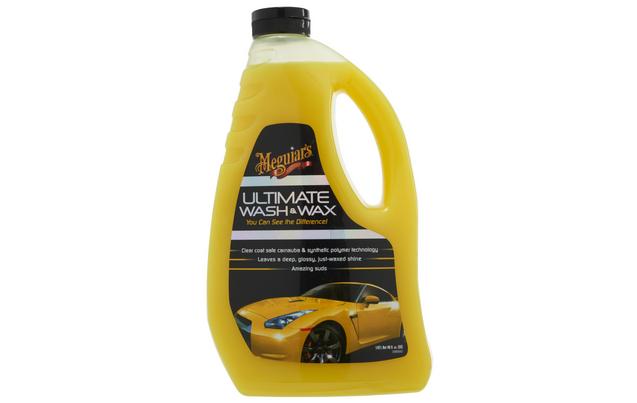
For a regular driveway wash, buy Meguiar’s Gold Class Car Wash Shampoo & Conditioner. It is made for a conventional hose, bucket, wash mitt, and rinse, and Meguiar’s states that it is safe for clear coats and preserves wax protection. Choose Griot’s Garage Brilliant Finish Car Wash if you want a pH-balanced, high-sudsing shampoo with a simple 128:1 dilution. If the car has a ceramic coating and you want a maintenance shampoo without gloss enhancers, use CARPRO Reset. For an apartment, winter, water restriction, or a lightly soiled vehicle, choose Optimum No Rinse Wash & Shine Version 6, but do not use a rinseless wash as a shortcut on a car covered in gritty mud.
Soap is only one part of washing paint safely. The real job is to remove grit before a mitt or towel drags it across the finish. A good product gives the wash media lubrication and helps lift ordinary road film, but it cannot make a dirty sponge safe or turn a hot, dusty car into a five-minute wash. Use the method that matches the dirt level, water access, and protection already on the paint.
Quick picks
- For most hose-and-bucket washes: Meguiar’s Gold Class Car Wash Shampoo & Conditioner. A familiar, high-sudsing shampoo that Meguiar’s says is safe for all paint types and clear coats and will preserve wax protection. Check Meguiar’s Gold Class on Amazon.
- For a concentrated pH-balanced bucket wash: Griot’s Garage Brilliant Finish Car Wash. A 128:1 wash with high suds; Griot’s lists 32 washes from its 64-ounce bottle when used as directed. Check Griot’s Brilliant Finish on Amazon.
- For coated cars: CARPRO Reset. A high-foaming, 500:1 shampoo designed for maintaining CQUARTZ coatings, with no added gloss enhancers. It still needs a careful contact wash and rinse. Check CARPRO Reset on Amazon.
- For a low-water rinseless wash: Optimum No Rinse Wash & Shine Version 6. A polymer-based wash that can be used with less than two gallons of water and no final hose rinse on a lightly to moderately soiled vehicle. Check Optimum No Rinse Version 6 on Amazon.
Use Meguiar’s Gold Class for the ordinary weekly or monthly wash
Meguiar’s Gold Class is the uncomplicated choice for a car that can be rinsed properly outside. The manufacturer describes it as a shampoo and conditioner that foams away dirt, road grime, and contaminants while remaining safe for paint and clear coats and preserving wax protection. That makes it a sensible default for a vehicle with conventional wax or sealant, or a vehicle whose paint protection is unknown. You do not need a specialty formula to wash a normally dirty daily driver well.
The value of a traditional car shampoo is the workflow it supports. Rinse loose debris first. Mix the product according to its label in a clean wash bucket. Use a clean microfiber mitt or multiple clean microfiber towels, work from the top panels downward, and rinse the media frequently. Then rinse the vehicle thoroughly and dry it with dedicated drying towels or forced air. The soap provides slip during that process, but it cannot compensate for a mitt full of grit.
Gold Class is a good answer when you have a hose, shade, enough time, and a car with ordinary road film. It is not a wheel cleaner, bug remover, iron remover, water-spot remover, or scratch repair product. Treating a single shampoo as all of those things is how people scrub too hard. If a panel has baked-on bugs or mud, soften and rinse as much of the contamination away as possible before touching it with a mitt. If a scratch has cut below the clear coat, washing will clean its edges but will not restore the paint; use our guide to car scratch removers to understand what can and cannot be corrected at home.
Skip a traditional hose wash when water access is genuinely limited or when temperatures make a final rinse and dry impractical. A standard shampoo expects a rinse. Leaving shampoo residue because a panel dried before you could rinse it is not a better outcome than postponing the wash. Work one section at a time on a cool surface, and do not let product dry on the paint. Those basic habits matter more than choosing between two similarly capable bottles.
Choose Griot’s Brilliant Finish for a concentrated, pH-balanced bucket wash
Griot’s Garage Brilliant Finish Car Wash is another straightforward hose-and-bucket option, but its stated dilution and use case make the choice especially clear. Griot’s lists it as pH balanced, high sudsing, and 128:1, with its 64-ounce bottle making 32 washes at the recommended mix. It is intended for driveway or outdoor use where water is available and the car ranges from mildly to heavily dirty. The point is not that more foam cleans the paint by itself. The product fits a conventional wash process and is concentrated enough that measuring the dilution matters.
Choose it when you want a dedicated wash soap without adding wax or a coating topper at every wash. The formula includes gloss enhancers, which can make a freshly washed finish look more lively, but a shampoo is still not durable paint protection. If the car needs a sealant, wax, ceramic-maintenance product, or polishing, make that separate decision. Blurring cleaning and protection is how owners end up applying layers they did not intend to use or assuming a wash has fixed a surface problem.
Accurate dilution helps. Use a measuring cup or bottle cap with marked volume, not a long free-pour into a bucket. Too much product wastes shampoo and makes rinsing take longer. Too little may reduce the lubrication and cleaning performance you expected. Start with the maker’s direction, adjust only when the label permits it, and keep the bottle sealed between washes. A clean bucket, fresh water, and clean media are a better investment than mixing a stronger solution.
Brilliant Finish makes sense for someone who washes outside regularly and values a repeatable routine. It is not a rinseless formula for a garage or parking structure. It also is not a substitute for a prewash when a vehicle is packed with winter grit or thick mud. In that situation, hose off as much debris as possible before beginning a contact wash. The less contamination under the mitt, the less chance of adding fine scratches during cleaning.
CARPRO Reset is for coating maintenance, not a universal upgrade
CARPRO Reset is designed around a specific need: maintaining a CQUARTZ coating or a similar paint-protection system without adding gloss enhancers to the surface. CARPRO describes Reset as a pH-neutral-in-solution shampoo with strong cleaning surfactants, dense foam, residue-free rinsing, and a 500:1 dilution. The company says it was developed for nanotechnology sealants and coatings and uses no gloss enhancers. That makes it a sensible choice when you want to see the coating’s current behavior rather than cover it with wash additives.
The dilution is one of its strengths and one of its traps. At 500:1, CARPRO’s instructions call for 40 mL per 20 liters of water, or about 1.35 fluid ounces per five gallons. A highly concentrated product asks for a measured dose. Treating it like an inexpensive, loose-pour shampoo wastes product and makes it hard to judge the wash. Use a marked bottle or measuring cup, then mix it with water in a clean bucket.
Reset does not let you skip the fundamentals of a coating-safe wash. Rinse loose soil, clean the wheels and lower panels carefully, use fresh wash media, rinse thoroughly, and dry before water spots form. A ceramic coating can make cleaning easier when it is healthy, but it does not make paint immune to abrasion. The same gritty towel that can mar uncoated paint can mar coated paint. The coating should guide the product choice, not lower the standard of technique.
Do not buy Reset merely because “ceramic” sounds better than an ordinary shampoo. If the vehicle has no coating, or the owner does not know what protection is on it, Gold Class or Griot’s Brilliant Finish is simpler. If the car’s hydrophobic behavior has changed, the cause could be accumulated contamination, water spots, or a worn protection layer; shampoo alone is not a diagnosis. Avoid strong decontamination chemicals unless the vehicle’s protection maker allows them and the surface problem calls for them.
Use Optimum No Rinse Version 6 when a hose wash is not practical
Optimum No Rinse Wash & Shine Version 6, often called ONR, is a different kind of product. It is a polymer-based rinseless wash designed to clean a vehicle without a final hose rinse. Optimum says a full wash can use less than two gallons of water. The process is simple in principle: add the product to a bucket of water at the label dilution, wash one small section with clean microfiber or a suitable wash media, then dry that section immediately with a clean microfiber towel.
This approach is genuinely useful for apartment dwellers, garages, winter weather, water-restricted areas, and maintenance cleaning where the car has light road film rather than chunky soil. It reduces the need for a hose and prevents a vehicle from sitting wet while you run back and forth to a bucket. It also demands restraint. Rinseless washing is not the right way to remove thick mud, caked sand, road-salt crust, or a vehicle that has been off-road. When there is visible grit that cannot be safely lifted with a wet towel, use a proper pre-rinse or postpone the wash.
Work panel by panel and turn towels often. A common rinseless mistake is trying to finish the entire vehicle with a single damp towel. Use multiple clean microfiber towels or clean one wash mitt section at a time, then reserve separate drying towels. The towels need to be clean before the wash starts and washed after it ends. A rinseless formula improves lubrication, but it cannot turn dirty media into safe media.
ONR Version 6 is stated to be compatible with paint, ceramic coatings, paint-protection film, matte finishes, glass, trim, and several interior surfaces. That range is useful, but do not treat one bottle as permission to use the same towel everywhere. Keep paint towels separate from wheel and interior towels. Follow the product label on dilution and surface use, test an inconspicuous area when the finish is unusual, and do not spray or wipe infotainment screens without checking the vehicle maker’s instructions.
Choose the wash method before choosing the soap
Use a hose-and-bucket wash for moderate or heavy dirt
When a car has visible dirt, road salt, pollen buildup, or wet grit, a pre-rinse is the safer starting point. A conventional shampoo such as Gold Class or Brilliant Finish belongs here. Rinse loose contamination from the roof, glass, upper panels, lower doors, and wheel arches before using a mitt. Wash the cleaner areas first and leave the dirtiest lower panels for last. Rinse frequently, and do not reuse wheel brushes or wheel towels on paint.
Use rinseless washing for light soil and restricted water access
Rinseless washing makes sense when the finish is dusty or lightly dirty and a hose is unavailable. It is a method, not a magic formula. The car should be cool, the paint should not have heavy grit, and you need enough clean towels to change them often. Dry each section as you go. If the towel starts dragging, looks dirty, or feels gritty, stop and switch it out rather than pressing harder.
Do not confuse waterless with rinseless
A waterless spray is usually intended for very light dust, fingerprints, or spot cleaning. A rinseless wash begins with a bucket of diluted solution and more wash media. Neither is a substitute for a thorough rinse on a dirty vehicle. If you can write your name in the dirt on the hood, start with water. If the car has mud packed behind wheels, use a hose or a self-service wash bay before you touch the paint.
Foam is a delivery method, not a scratch-prevention system
A foam cannon or foaming prewash can help wet and soften grime before contact, especially when a car is very dirty. It does not remove every abrasive particle on its own, and it does not mean the next step can be careless. Let the product dwell only as directed, keep it off hot panels, never let it dry, and rinse it thoroughly. Then use clean wash media and a suitable shampoo for the contact wash.
Build a safer wash routine
Start in shade or at a time when the panels are cool. Gather two clean buckets or several clean wash towels, a dedicated mitt or soft wash media, a wheel brush that will never touch the paint, clean microfiber drying towels, and the chosen product. Pre-rinse the vehicle. Clean wheels, tires, and the lowest dirty areas using separate tools. Then wash the paint from top to bottom, one section at a time, using gentle straight passes rather than aggressive scrubbing.
Rinse thoroughly after a traditional soap wash, then dry before mineral-heavy water can spot. Blot or pull a drying towel gently instead of grinding it into the panel. For rinseless washing, clean and dry each small panel before moving on. Inspect the paint in normal light as you work. If you find a sticky contaminant, do not keep rubbing; use the correct dedicated product or seek professional help if the surface is unfamiliar.
Wash glass and paint with clean, separate towels, then examine the wiper blades and windshield. Dirty or damaged wipers can undo a clean windshield in one rainy drive. Our guide to windshield wipers explains what to replace when streaks persist after the glass is clean.
Care for wash media and products
Rinse wash mitts and towels as soon as the job is finished. Launder microfiber separately from cotton towels, use a detergent intended for microfiber or a mild residue-free detergent, and skip fabric softener and high heat. Fabric softener can reduce absorbency, while dirt left in a towel can create the very scratching you are trying to avoid next wash. Store dry towels in a clean bin rather than returning them to the bucket or trunk.
Keep car-care chemicals sealed, labeled, and away from children, pets, heat, and direct sunlight. Read the product’s safety information. Wash hands after use, avoid getting product in eyes, and do not mix cleaners. A car shampoo, wheel cleaner, acidic water-spot product, and interior cleaner have different safety profiles. More chemical is not a replacement for proper agitation, rinsing, or clean tools.
How we researched
We compared current manufacturer documentation for intended wash method, dilution, stated paint and coating compatibility, water requirements, finish additives, and handling instructions. We treated traditional shampoos, coating-maintenance shampoos, and rinseless formulas as separate categories because each assumes a different cleaning process. We did not present product marketing claims as independent paint testing. Product formulas, labels, and local water restrictions can change, so check the current directions and your vehicle maker’s care guidance before use.
Car wash soap questions answered
Can I use dish soap to wash a car?
Use a car shampoo instead. Dish soap is formulated for dishes, not automotive paint, and it is not the right product to use repeatedly when the car has wax, sealant, or other paint protection. A dedicated car shampoo gives you a product with instructions for automotive surfaces and a process designed around rinse water and wash media.
How often should I wash my car?
Wash it when accumulated dirt, road film, salt, bird droppings, or tree residue need removal, and sooner when contamination is fresh. The exact schedule depends on climate, parking, miles driven, and access to washing. A careful wash when needed is better than frequent rushed scrubbing with dirty tools.
Is rinseless wash safe for a dirty car?
It is appropriate for light to moderate soil when used with enough clean wash media and the maker’s dilution. It is not the right method for caked mud, visible sand, heavy salt, or thick grime. Use a pre-rinse or hose wash first when the contamination could scratch the paint during wiping.
Does car wash soap remove scratches?
No. Soap removes surface dirt and road film. It cannot repair a scratch through clear coat or paint. Cleaning first helps you judge the damage accurately, then you can decide whether a polishing product, touch-up, or professional repair is appropriate.