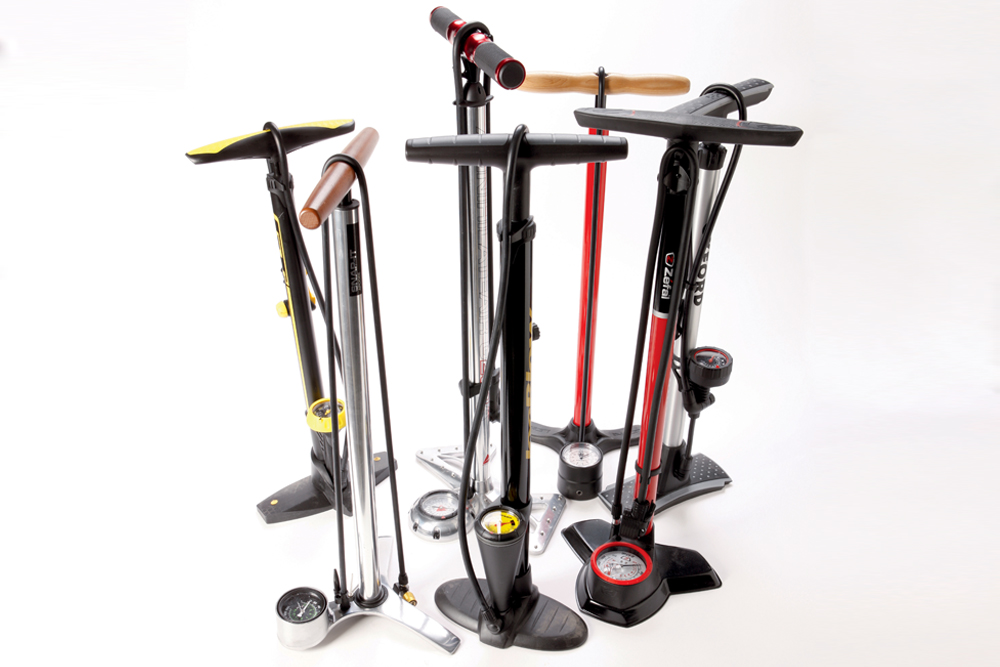
Buy the Topeak JoeBlow Sport III if you need one dependable floor pump at home. Its steel barrel and base, 72-centimeter hose, large analog gauge, and head that accepts Presta, Schrader, and Dunlop valves make routine tire checks simple. Add the Lezyne Pressure Drive to the bike for a real roadside tool: it is compact, comes with a flexible hose, and works with Presta and Schrader valves. Road riders who want the smallest possible high-pressure pump should consider the Topeak Roadie 2Stage, while people who regularly install tubeless tires should buy a reservoir pump such as the Topeak JoeBlow Booster instead of hoping an ordinary floor pump can deliver the same burst of air.
A pump is a pressure tool, so the right choice depends on the tire, valve, and place it will be used. A floor pump is for routine inflation at home. A small hand pump is for getting back after a flat. A shock pump is for suspension, and a tubeless reservoir pump is for seating a tire bead. None of those tools replaces all the others. Start with a floor pump and a portable pump; add the specialized tool only when the bike setup calls for it.
Quick picks
- For most home workshops: Topeak JoeBlow Sport III. A sturdy floor pump with a 3-inch analog gauge, 160 psi rating, 72-centimeter hose, steel barrel and base, and a TwinHead DX head for Presta, Schrader, and Dunlop valves. Check the Topeak JoeBlow Sport III on Amazon.
- For a higher-end home floor pump: Lezyne Classic Floor Drive 3.5. A steel-barrel floor pump with a 3.5-inch analog gauge, aluminum base, extra-long hose, and a screw-on Presta/Schrader chuck. Its 220 psi ceiling is more than most tires need. Check the Lezyne Classic Floor Drive 3.5 on Amazon.
- For commuting, gravel, and mixed-valve bikes: Lezyne Pressure Drive. A CNC-machined aluminum hand pump with a flexible Presta/Schrader hose, frame mount, and a 120 psi maximum. It is compact but still takes work to use. Check the Lezyne Pressure Drive on Amazon.
- For a pocketable road-bike backup: Topeak Roadie 2Stage. A Presta-only, 89-gram mini pump with a high-volume stage to 75 psi and a high-pressure stage to 160 psi. It is focused and does not suit a Schrader-valve bike. Check the Topeak Roadie 2Stage on Amazon.
- For tubeless tire installation: Topeak JoeBlow Booster. A 6.4-pound floor pump with a one-liter air chamber that stores up to 160 psi before releasing it into the tire. It is a workshop tool, not a pump to carry. Check the Topeak JoeBlow Booster on Amazon.
Start with the Topeak JoeBlow Sport III at home
The JoeBlow Sport III covers the job most riders actually need: checking and adjusting tire pressure before a ride without fighting the pump head or crouching over a tiny gauge. Topeak lists a painted steel barrel, hardened steel base, 3-inch mid-mount analog gauge, 72-centimeter hose, and 317.5 cc of air per stroke. It is rated to 160 psi and weighs 3.7 pounds. The gauge is larger and easier to read than the small dial on a compact pump, and the hose reaches a valve more comfortably when the bike is in a stand or leaning against a wall.
The key feature is the TwinHead DX pump head. It accepts Presta, Schrader, and Dunlop valves, so one pump can handle a road bike, a mountain bike, a kid’s bike, a trailer, or a car-adjacent utility tire with the appropriate valve. The head has a longer lever, and the hose connection rotates to reduce tangling. Topeak also includes ball and bladder needles. Those accessories are useful if you need them, but they should not decide the purchase; the pump’s main job is to make tire pressure repeatable.
Its 160 psi maximum does not mean every tire should be pumped near 160 psi. Follow the tire and rim maker’s guidance, and choose a pressure appropriate for rider weight, terrain, tire width, and load. Modern wider road, gravel, and mountain-bike tires are commonly run well below that ceiling. A gauge helps with consistency, but floor-pump gauges are best treated as a practical reference. If you need a specific low-pressure tubeless setup repeated exactly, confirm it with a separate quality gauge and use the same reference point each time.
This is the floor pump for a home that has more than one bike or more than one valve type. It is not especially compact, and it is not a replacement for a portable repair pump. Store it where you check tires: beside the bikes, near the garage door, or next to the work stand. A pump hidden in a closet is less useful than a modest one you use every week. Pair it with a pressure routine after long storage, temperature swings, or a slow leak. That small habit does more for a ride than chasing the highest number printed on a pump.
Choose the Lezyne Classic Floor Drive 3.5 for a screw-on chuck and bigger gauge
The Lezyne Classic Floor Drive 3.5 is an upgrade for riders who prefer a threaded connection at the valve and want a larger dial. Lezyne lists a steel barrel and piston, CNC-machined aluminum base, varnished wood handle, high-strength hose, 3.5-inch analog gauge, and ABS-1 Pro chuck that works with Presta and Schrader valves. It is rated to 220 psi and weighs 1,885 grams. The pump is built around high-pressure use, though the point of the higher rating is operating headroom, not a recommendation to inflate ordinary tires that far.
The screw-on chuck is the reason to choose it. A threaded connection can feel more secure than a push-on head when working around a delicate Presta valve, particularly when you are taking repeated measurements. It also takes a few seconds more to attach and remove, and it is not a cure for a loose valve core, damaged threads, or a worn tube valve. Use the chuck gently. When disconnecting from a Presta valve, unthread it straight and support the valve stem instead of twisting the whole tube.
The larger gauge is helpful when you want to make small adjustments, but it should not be treated as a laboratory instrument. Consistency matters more than chasing a single magic reading across several different gauges. Pick a pressure that suits your tire’s permitted range and riding conditions, write it down if you are experimenting, and change one thing at a time. That approach is especially useful for a hybrid bike, which may see pavement, paths, groceries, and occasional rough ground in the same week.
The Classic Floor Drive is a better fit for a rider who values its construction and chuck than for somebody looking for the cheapest way to add air. It costs more, takes up the same sort of floor space as the Topeak, and its wood handle is an aesthetic preference as much as a performance feature. Get it if the threaded connection and larger gauge are worth it to you. The JoeBlow Sport III remains the straightforward choice for a mixed household.
Carry the Lezyne Pressure Drive when a flat needs a real plan
A hand pump has a less glamorous job: it gives you enough air to finish the ride or reach a safe place to make a better repair. The Lezyne Pressure Drive is a good all-around choice because it fits both Presta and Schrader valves and uses a flexible ABS hose rather than pushing the pump body directly against the stem. Lezyne offers it in small and medium sizes, lists a 120 psi maximum, and includes a Composite Matrix frame mount. The listed weights are 92 grams for the small version and 106 grams for the medium version.
The hose matters on a roadside repair. Direct-head mini pumps can flex a small Presta stem while you push and pull. A hose lets the pump move independently of the valve and also includes a valve-core tool. That does not make the pump effortless. A compact high-pressure pump still needs many strokes to bring a narrow road tire to a useful pressure, and a wide mountain-bike tire needs more air volume than a skinny barrel can move quickly. Carry it because it is reliable to pack, not because it performs like a floor pump.
Pick the small version if the pump must disappear beside a bottle cage, in a saddle bag, or in a jersey pocket. Pick the medium if you have frame space and would rather trade a little length and weight for a more manageable pumping session. Check the supplied mount against your cage bolts, bottle clearance, and any frame bag. A pump that rubs a tire or blocks a water bottle will be removed and forgotten. On a commuter bike, make sure the mount and pump do not interfere with a rack, lock, or fender.
A pump is only one part of a flat-repair kit. Carry the correct spare tube or plugs, tire levers that fit your rim, and a way to remove the wheel if the bike does not use quick release. Tubeless riders need a repair plan that matches their sealant and tire system. CO2 canisters can be fast, but they are finite and may not be suitable for every sealant or travel condition. A manual pump is slower and gives you a second chance after the first attempt.
The Topeak Roadie 2Stage is for Presta road tires, not every bike
The Roadie 2Stage solves the frustrating part of a small road pump: the early strokes need volume, while the last part of a high-pressure fill needs leverage. Its selector uses a high-volume setting from zero to 75 psi and a high-pressure setting from 75 to 160 psi. Topeak lists an aluminum handle and barrel, a Presta head with thumb lock and dust cap, an included side-mount bracket, a 6.4-inch length, and an 89-gram weight. It is small enough for a jersey pocket and is focused enough that it should not be the default choice for every rider.
Road and some gravel riders benefit from the two-stage approach because a narrow, high-pressure tire is hard work with a very short single-stage pump. Switching modes lets the rider fill the tire quickly at first and then work toward a firmer pressure with more control. The stated 160 psi ceiling is capacity, not a target. Stop at a pressure appropriate for the tire and rim, and remember that an un-gauged mini pump cannot tell you an exact number by itself.
The limitation is valve compatibility. The Roadie 2Stage is Presta-only. That is normal for a road-specific mini pump, but it makes the product a poor match for a Schrader-equipped hybrid, many kids’ bikes, utility bikes, and some mountain bikes. It also is not ideal for a large-volume mountain-bike tire, where a high-volume trail pump is more efficient. Buy this pump only after confirming the valves on the bikes it needs to support.
Mount it carefully with the bracket, or keep it in a pocket or bag protected from road grit. A dust cap on the pump head is helpful, but the valve connection still needs to be clean before use. Practice mounting the pump at home before a flat forces you to learn on a shoulder. If you ride at dusk, a compact rechargeable flashlight also makes a roadside repair less stressful. This is not glamorous advice, but it saves time when your hands are cold or the light is fading.
For tubeless installation, use the JoeBlow Booster’s air chamber
Inflating a tubeless tire after a normal puncture repair is not the same as seating a new tubeless tire. Seating the bead often calls for a fast rush of air to push the tire into place against the rim. The JoeBlow Booster adds an integrated one-liter aluminum air chamber that can be charged to up to 160 psi, then released in a burst by switching from Charge mode to Inflate mode. Once the bead is seated, it works as an ordinary floor pump. Topeak lists a 3-inch top-mounted gauge, extra-long hose, Presta/Schrader SmartHead DX3, air-release button, 303 cc per stroke, and a 6.4-pound weight.
This is the right kind of tool for a rider who mounts and reseats tubeless tires at home. It is not automatically necessary for everyone with tubeless tires. A shop compressor, a compatible high-volume pump, or a tire that seats easily may accomplish the job, while some stubborn combinations remain difficult even with a reservoir. Check that the tire and rim are compatible, inspect the bead, use the manufacturer’s allowed inflation limit, and follow sealant instructions. Never use a pressure beyond the stated limits to force a bead into place.
Do not buy the Booster as a substitute for a trailside pump. It is nearly twice the weight of a modest bike tool kit before you add anything else and belongs in a garage or work area. The right setup for a tubeless rider is often both: a reservoir floor pump at home and a compact hand pump or CO2 tool on the bike. Their jobs do not overlap much.
Choose by valve, tire volume, and where the pump will live
Identify the valve before ordering
Presta valves are narrow and common on road, gravel, and many higher-end mountain bikes. Schrader valves are wider and familiar from cars, and appear on many casual, youth, and utility bikes. Dunlop valves are less common in the United States. A compatible head is not enough if the connection is awkward, so check whether the pump uses a dedicated port, a reversible insert, or a threaded hose. If the household has mixed bikes, a floor pump that accepts both Presta and Schrader is simpler than a road-only head.
Match barrel volume to the tire
Wide tires move a lot of air. A mountain-bike, cargo-bike, or fat-bike tire is faster to inflate with a higher-volume pump even if it has a lower maximum psi. Narrow road tires need less volume but can need more pressure, which favors a high-pressure floor pump or a road-focused mini pump. Gravel bikes live in between. Maximum psi alone is a weak shopping spec; the air per stroke and the intended tire type explain much more.
Use pressure as a setup choice, not a contest
Check the tire and rim maker’s allowed range, then choose a starting point based on the bike, rider, load, and riding surface. More pressure is not always faster or safer. Overinflation can reduce grip and comfort, while too little pressure can damage a rim or cause tire problems. Make small changes and pay attention to the results. If you use a floor-pump gauge for all adjustments, its repeatability matters more than comparing it constantly with a different dial.
Reserve shock pumps for suspension
A suspension fork or rear shock requires a dedicated shock pump with a high-pressure gauge and appropriate Schrader shock chuck. A tire pump is not a substitute. For example, Lezyne’s Shock Drive is designed around a zero-loss shock chuck and a 400 psi ceiling. Do not connect a standard high-volume tire pump to a suspension component unless the component and the pump instructions expressly support it. Suspension settings affect handling and safety, so follow the bike or fork manufacturer’s setup guidance.
What else to consider
Digital gauges are useful if a floor-pump dial is hard to read at the pressures you use. Topeak’s Shuttle Gauge Digital 2.0 works alone or between a compatible pump and valve, has an air-release button, accepts several valve types, and reads to 160 psi. It adds another small item and a CR2032 battery, so it is most useful for a rider who is deliberately dialing in pressure rather than someone who simply needs a basic pump.
Electric inflators can be convenient for frequent car and bike use, but they introduce charging, heat, and run-time concerns. CO2 inflators are compact and fast but need cartridges and practice. A big floor pump is excellent at home and absurd in a saddle bag. There is no single bike pump that wins everywhere. For most riders, a sturdy floor pump plus a small manual pump is the sensible two-tool setup.
How we researched
We compared current manufacturer documentation for valve compatibility, maximum pressure, barrel and base materials, hose design, gauge position, stated weight, dimensions, air volume per stroke, and intended use. We kept home floor pumps, portable hand pumps, shock pumps, and tubeless reservoir pumps separate because they solve different problems. We have not presented manufacturer pressure ratings or product descriptions as independent laboratory testing. Availability, colors, and prices can change, so verify the current listing and your bike’s valve type before ordering.
Bike pump questions answered
Do I need a floor pump and a mini pump?
For most riders, yes. A floor pump makes regular pressure checks and full inflation much easier. A mini pump is emergency equipment carried on the bike. A floor pump will not help on the roadside, and a mini pump is a frustrating way to maintain tires every week.
Can a hand pump inflate a road-bike tire?
Yes, but it takes time and effort. A road-specific high-pressure pump such as the Roadie 2Stage makes the job more manageable, while a larger hand pump with a hose is more flexible across valve types. The goal on the roadside is a safe, rideable pressure, not necessarily the exact number used at home.
What pump do I need for tubeless tires?
For routine top-ups, use a normal floor pump or portable pump that fits your valve. For seating a new tire bead, a reservoir pump or compressor can provide the rapid airflow that a standard pump may not. Follow the tire and rim maker’s installation instructions and maximum pressure limits.
Why does my pump gauge not match another gauge?
Small differences between gauges are common. Use the same reliable gauge as your reference when testing pressures, and make changes in small increments. If a reading looks wildly wrong, inspect the pump head, valve core, and gauge before assuming the tire needs a dramatic adjustment.