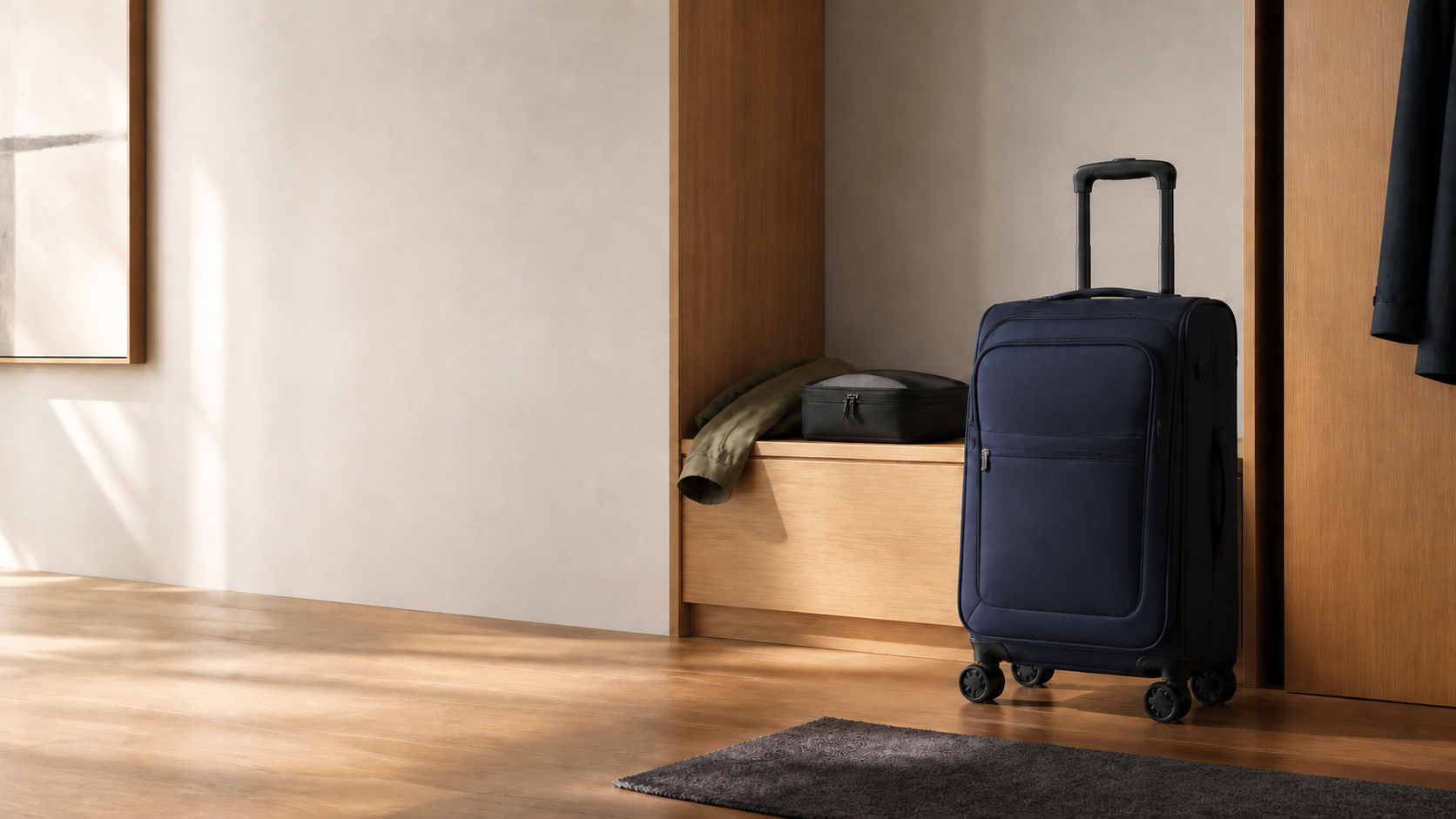
Carry-on luggage is most useful when it fits the flights you actually take, rolls without demanding attention, and holds enough for a short trip without tempting you to overpack. For most travelers, the Travelpro Maxlite 5 Compact Carry-On Spinner is the sensible first choice. At 22 by 14 by 9 inches including wheels and handles, it is designed around the common domestic size limit, weighs 5.1 pounds, and has 38 liters of capacity. It is a soft-sided spinner, so it gives up the rigid shell and glossy appearance some people prefer. In return, it keeps its own weight low and gives you exterior pockets that are genuinely useful in transit.
For travelers who regularly move between airlines with different cabin rules, the Travelpro Maxlite 5 International Carry-On Spinner makes a better case. Its 21.75 by 15.75 by 7.75-inch exterior is designed for a wider range of international limits, though every airline publishes its own rules and the expanded bag can exceed them. If you travel often enough to care about repair support, flat packing space, and a lifetime repair promise, the Briggs & Riley Baseline Global 21-inch Carry-On Spinner is the premium soft-sided option. It is substantially heavier and far more expensive, so it only makes sense when those ownership details are worth paying for.
Quick picks
| Pick | Who it is for | What you give up |
|---|---|---|
| Travelpro Maxlite 5 Compact Carry-On Spinner Best for most travelers | People who want a light, soft-sided 22 x 14 x 9-inch bag with easy-access pockets and a common domestic carry-on shape. | A soft shell offers less structure than a hard case, and the two-inch expansion should stay closed when airline dimensions matter. |
| Travelpro Maxlite 5 International Carry-On Spinner Best for varied airline rules | Frequent international travelers who want a slimmer, 39-liter soft-sided spinner designed for many international allowances. | “International” is not universal. Verify the exact airline’s size and weight policy before every trip, especially on regional routes. |
| Briggs & Riley Baseline Global 21-inch Carry-On Spinner Best premium soft-sided bag | Frequent travelers who value an exterior-mounted handle, compression expansion, ballistic nylon, and a lifetime repair guarantee. | At 9.9 pounds before packing and in a much higher price tier, it asks a lot of anyone who flies only a few times a year. |
For most trips, a compact Travelpro is the right starting point
Carry-on shopping becomes much easier once you stop thinking in vague size labels. “Carry-on” is not a universal measurement. Wheels, handles, expansion zippers, and a strict gate agent all count. A bag with a large internal cavity is little comfort if it repeatedly gets tagged at the gate. The Maxlite 5 Compact is our first recommendation because Travelpro publishes its outside dimensions as 22 by 14 by 9 inches, including wheels and carry handles. That is the shape many domestic travelers should start from.
Travelpro lists the bag at 5.1 pounds with a 38-liter volume. That low starting weight matters on flights with a carry-on weight limit and whenever you need to lift the case into an overhead bin without help. The bag has four spinner wheels, a two-position telescoping handle, a full-length lid pocket, a side accessory pocket, adjustable hold-down straps, and exterior zip pockets. Those details sound ordinary, but they reflect the way a carry-on is used: documents, a sweater, and a charging cable are easier to reach from an exterior pocket than from under a compressed packing cube.
The soft-sided construction is part of the recommendation, not an omission. Soft luggage flexes a little, can have useful outside storage, and tends to weigh less than a similarly sized hard shell. The trade-off is that it does not provide the same rigid barrier around fragile contents. Put cameras, medication, and breakable items in a personal item or in a protected interior pouch. A soft shell is a particularly good fit for clothes, shoes, and the ordinary small items that make up most short-trip packing.
Travelpro gives this model up to two inches of expansion. Treat that feature as a way to manage a return trip when you are willing and able to check the bag, not as free extra room inside a strict cabin limit. Expanded luggage is still larger luggage. It is easy to forget this when the zipper closes cleanly at home and much harder to ignore at a gate sizer. Keep the expansion closed on the outbound trip, leave a little space inside, and use a packable bag for overflow if your itinerary allows it. Our guide to packable travel duffels explains when that approach makes more sense than forcing everything into one case.
Pick the international Travelpro when rules matter more than maximum depth
The Maxlite 5 International Carry-On Spinner has a narrower purpose. Travelpro lists it at 21.75 by 15.75 by 7.75 inches and 5.3 pounds, with 39 liters of volume. The shallow depth is the key difference. It is designed to work with a wider range of international carry-on restrictions than the larger domestic version. That makes it a better starting point for someone whose trips involve more than one airline or whose route is often served by smaller aircraft.
It also has an integrated TSA-accepted lock, four spinner wheels, exterior compartments, interior pockets, adjustable hold-down straps, and the same basic expandable soft-sided design. The lock is useful for keeping zipper pulls together during transit; it is not a guarantee against theft. Do not put irreplaceable documents, cash, medication, or valuables into any checked bag, and do not mistake a luggage lock for a reason to relax basic travel habits.
We like the international option for a traveler who would rather pack with a smaller outline than gamble on a larger domestic bag fitting every route. Its 7.75-inch depth leaves less room for bulky shoes and jackets, so packing discipline matters. Choose a few fabrics that layer, wear your largest shoes, and use one or two packing cubes instead of dividing every category into a separate organizer. A smaller case rewards editing. It is not an invitation to buy compression cubes merely to turn a compliant shape into an overstuffed one.
Do not read “international” as a promise. Airlines differ by route, fare class, aircraft, and even enforcement on a busy day. Some limits emphasize total dimensions; others use a maximum height, width, and depth; carry-on weight limits can be just as decisive. Check the airline’s published policy shortly before leaving. If you fly a route with particularly restrictive limits, use the exact dimensions—not a product category or a retailer’s “carry-on” label—as the deciding fact.
The Briggs & Riley is for people buying a long-term travel tool
The Briggs & Riley Baseline Global 21-inch Carry-On Spinner makes a different argument. Its exterior dimensions are 21 by 15 by 9 inches when not expanded. It has a published 37- to 49-liter capacity range, an exterior-mounted Outsider handle that leaves the packing floor flat, ballistic nylon construction, self-repairing YKK zippers, spinner wheels, and a compression-expansion system. Briggs & Riley also says it will repair a bag for life, even after airline damage, without requiring proof of purchase.
Those are meaningful ownership features, especially for someone who travels constantly. A handle that does not intrude into the main compartment makes folding and packing flatter. Compression expansion is more useful than a loose extra zipper when you need to fit a bag back into its normal profile. The lifetime repair promise can change the value calculation for a traveler who has worn through handles, wheels, or zipper pulls on cheaper luggage.
There is no point pretending the trade-off is small. This bag weighs 9.9 pounds before you add a shirt or a charger, and it sits in a premium price tier. The weight alone is enough reason to choose the Travelpro if you fly airlines with tight cabin weight limits, carry your bag up stairs, or want the easiest lift into a crowded bin. The Briggs & Riley is for the person who values its materials, repair program, and packing construction enough to accept that penalty. It is not a default upgrade for every occasional vacation.
Its expansion needs the same restraint as any other carry-on. The closed profile may work for a given flight; the expanded profile may not. Consider the extra space a return-trip convenience or a checking option, not a way to outsmart a published size allowance. The clearer a suitcase is about its dimensions, the easier it is to make a realistic decision before the airport.
Measure from wheel to handle, then check the airline
The single best carry-on habit is to compare the manufacturer’s exterior measurement with the allowance for the airline you are actually flying. Exterior means everything: wheels, protruding handles, and feet. Interior case dimensions are useful for comparing packing space but do not answer the question a gate sizer asks. When an airline lists 22 by 14 by 9 inches, a bag labelled “21-inch” can still be too large once wheels and handles are included.
Do that check again when a trip includes a connection on a different airline. The long-haul segment may allow a bag that a regional or international connector does not. Small regional jets, basic-economy rules, and full overhead bins can add another layer. A good carry-on reduces the chance of a surprise; no suitcase prevents a crew from checking bags when cabin space runs out. Pack medication, documents, a change of clothes, and anything truly essential in the personal item that stays with you.
Weight is a second measurement that people often ignore. A very light case gives you more flexibility where airlines weigh cabin baggage. It also changes how the luggage feels on stairs, public transit, and at the overhead bin. The best suitcase is not necessarily the one that holds the most. It is the one you can lift safely when it is full.
Soft-sided, hard-sided, spinner, or two-wheel?
Soft-sided luggage is the better default for a traveler who wants low weight, exterior pockets, and a little flexibility around clothing. It can look less pristine after hard use, and it does less to shield a fragile object, but it is practical. The Travelpro models in this guide show why soft-sided bags remain compelling: they put a lot of useful storage into a light package.
Hard-sided luggage works well for people who prefer a split-case layout and a firmer shell around their contents. A hard shell does not make a bag indestructible, and it can be less forgiving when you need to put a jacket in an exterior pocket at the last minute. Look past the marketing material to the exact exterior dimensions. Some hardside bags marketed as carry-ons are taller, wider, or deeper than the most common limits once their wheels are counted. That does not make them bad luggage; it means they are a bad match for travelers who need conservative cabin compliance.
Spinner wheels let a bag roll upright beside you, which is pleasant on smooth terminal floors and useful when you are balancing a coffee or another bag. Their housings take up some packing volume and sit at the corners where luggage gets knocked around. Two-wheel bags preserve a little more interior space and can be easier over cracked sidewalks, but they have to be tilted behind you. There is no winner in the abstract. Choose a spinner if maneuverability through terminals is the daily need. Choose two wheels if you regularly travel over rough ground or favor a simpler wheel layout.
Packing space comes from layout, not just liters
A 38-liter case can handle a surprising amount if the contents work together. Start with the trip, not the suitcase: how many days, what weather, what dress code, and whether laundry is available. Put shoes in a bag, roll or fold clothes consistently, and use one packing cube for smaller garments if it makes unpacking easier. Do not create an elaborate system that takes twenty minutes to repack on the morning of a flight.
Place a light jacket or the next item you will need near the top. Use exterior pockets for papers, a thin book, or a cable pouch rather than for anything you cannot afford to lose. The travel power and charging guide is a good companion here: batteries and charging gear should be packed with their airline and security rules in mind, and a small organized pouch is safer than loose cables at the bottom of a suitcase.
Leave a bit of empty space. It gives you a place for a souvenir, laundry, or an item that needs to come out of your personal bag at the airport. More importantly, it keeps the suitcase from becoming an inflexible block that is difficult to close, lift, and fit into the bin. The best carry-on packing job is tidy enough to find a sweater and loose enough to survive the return trip.
Locks, batteries, and labels are supporting details
An integrated TSA-compatible lock is convenient for keeping zipper pulls together, but it is not security theater worth paying a large premium for. Keep valuables with you. If a bag is checked unexpectedly at the gate, remove passports, medication, electronics, and spare lithium batteries before handing it over. Rules for batteries and power banks change by airline and route, so use the airline’s current policy before traveling rather than relying on a suitcase feature list.
A luggage tag is still useful, but it should reveal only enough information to help a lost bag return to you. A name, email address, or other contact method is usually more sensible than a home address displayed on the outside. Our luggage-tag guide explains the practical details, including how to keep the information readable without oversharing.
Do not buy a carry-on because it has a USB port. A suitcase port is only a pass-through for a battery pack, and battery rules still apply. It is better to carry a small power bank in a pouch you can remove quickly. That way the bag remains useful even when you change chargers or take a flight with different battery rules.
When a carry-on suitcase is the wrong answer
Skip a wheeled carry-on if your trips are mostly road travel, trains with stairs, cobblestones, or places where you need both hands free. A travel backpack or duffel can be more comfortable and less awkward in those situations. Skip it if you rarely take trips shorter than a week and usually check luggage anyway. A well-chosen personal item and a checked suitcase may be a more honest setup than trying to force every trip into a compact roller.
It can also be better to buy a smaller bag than a larger one. If you fly airlines with strict size or weight rules, a large domestic roller may create more anxiety than it saves. The international Travelpro is a useful example: it sacrifices some depth for a more conservative profile. That trade is often worthwhile for a person who cares more about avoiding a gate check than packing one more pair of shoes.
How we researched this guide
We compared current manufacturer dimensions, stated capacities, weight, materials, wheel and handle layouts, published warranty terms, and current Amazon availability. We also treated airline limits as a separate decision from a manufacturer’s carry-on label. We did not perform hands-on durability testing or claim personal travel experience with these bags. The recommendations favor options with a clear role: a light domestic soft-sided spinner, a more internationally oriented compact spinner, and a premium repair-focused option.
Our recommendation
Buy the Travelpro Maxlite 5 Compact Carry-On Spinner if your trips are mostly domestic and you want a light bag built around a 22 by 14 by 9-inch exterior. Buy the Maxlite 5 International Carry-On Spinner if your routes make a more conservative shape worth the packing compromise. Choose the Briggs & Riley Baseline Global 21-inch spinner only when its flat packing surface, compression system, and lifetime repair promise matter more than its added cost and weight. Before choosing any of them, compare its closed exterior dimensions and your fully packed weight to the airline you are flying next.