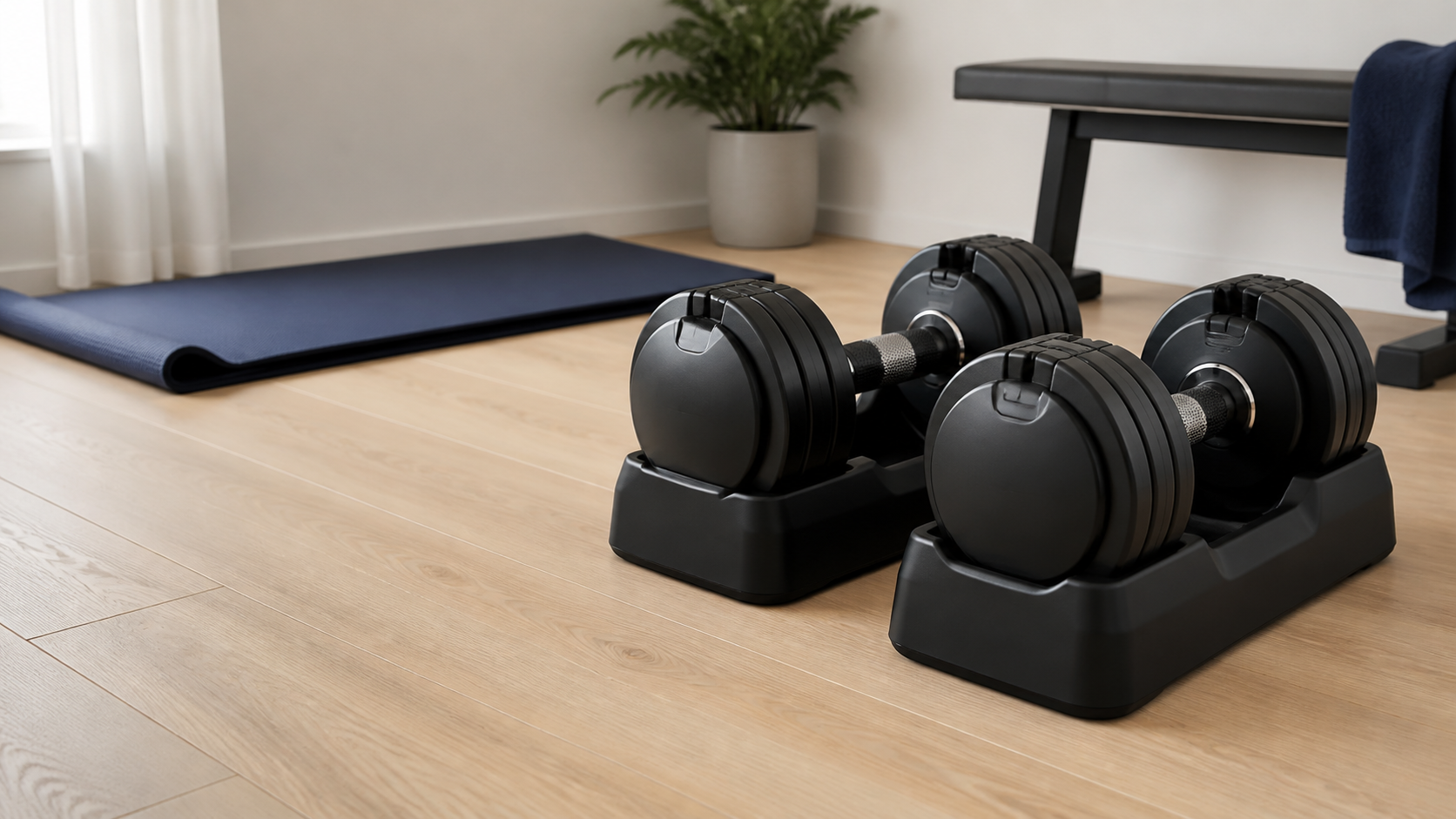
Adjustable dumbbells are most useful when they replace the fixed-weight rack you do not have room for without making every set feel like a mechanical puzzle. For most home workouts, the Core Home Fitness Adjustable Dumbbell Set is the straightforward choice. Each dumbbell adjusts from 5 to 50 pounds in 5-pound steps by twisting the handle in its cradle. The set is compact, includes aluminum cradles, and has a two-year parts warranty. Its limit is clear: 50 pounds per hand is enough for many general strength routines, but it will not carry every lifter through heavy rows, presses, or lower-body work forever.
If a 50-pound ceiling feels temporary, the PowerBlock Elite USA 90 is the better long-term system. You can begin at 5–50 pounds per hand and add the compatible Stage 2 and Stage 3 kits later to reach 70 and then 90 pounds. Its selector-pin layout is less conventional than a dial dumbbell, but it offers finer 2.5- and 5-pound adjustments and a five-year limited residential warranty on the handle assembly. For a premium pair with faster twist selection and an 80-pound ceiling, consider the SMRTFT NÜOBELL 80. It is costly, and its two-year standard warranty is shorter, so its appeal is the 5–80 pound range and the form factor—not a bargain story.
Quick picks
| Pick | Who it is for | What you give up |
|---|---|---|
| Core Home Fitness Adjustable Dumbbell Set Best for most home workouts | People who want a compact pair from 5 to 50 pounds, simple five-pound jumps, and an uncomplicated twist-handle adjustment. | It stops at 50 pounds per hand, and the dumbbell gets longer as more plates are selected. |
| PowerBlock Elite USA 90 Best expandable system | Lifters who want to start at 5–50 pounds and preserve a path to 70 and 90 pounds with compatible expansion kits. | The open block shape and selector pin take adjustment to get used to, and Elite USA expansions do not fit Elite EXP models. |
| SMRTFT NÜOBELL 80 Best premium high-range pair | People who value a 5–80 pound range, 5-pound increments, a compact 17-inch body, and fast twist-lock changes. | It is expensive, comes with a two-year standard warranty, and should be handled as a precision adjustable mechanism rather than dropped. |
For most people, a compact 5–50 pound dial set is enough
The Core Home Fitness set makes sense because its range and adjustment method are easy to understand. Each dumbbell starts at 5 pounds and reaches 50 pounds in 5-pound increments. You select the weight by twisting the handle while the dumbbell rests in its cradle, then lift the chosen plates away. There are no loose plates to thread onto a handle and no separate selector pin to move from side to side. That matters when a workout moves between a lighter warm-up, a pressing movement, and a heavier row.
Core lists the full 5–50 pound dumbbell at 14.5 by 7.9 by 7.5 inches. At the lightest setting, it is 9.3 inches long. The changing length is the practical compromise in this kind of dumbbell: a weight that starts compact grows as plates stay attached. That is usually fine for presses, rows, deadlifts, lunges, and many floor exercises. It can be a less natural fit for movements that need a very short dumbbell or have the weights close together. Buy according to the exercises you plan to repeat, not the broad promise of an all-in-one set.
The 50-pound maximum will serve a large group of people for years. It is enough for beginners learning controlled strength work, people doing general conditioning, and households where two users want a wide but not extreme range. It is also a reasonable ceiling for anyone whose workouts use slower tempos, unilateral movements, higher repetitions, or a bench and bodyweight work alongside dumbbells. Do not assume that a home gym needs 80 or 90 pounds simply because a product page makes the top number sound like the only measure of progress.
The Core set is not the right pick if you already know that 50-pound dumbbells will be limiting for your main lifts. It is also less appealing for someone who wants 2.5-pound increments. Five-pound jumps are normal for many upper- and lower-body movements, but they can feel large when you are making a small progression in a press, raise, or rehabilitative routine. The two-year parts warranty is straightforward, but it is another reason to use the cradles carefully and avoid treating the set like rugged fixed dumbbells.
Choose PowerBlock when you need a real growth path
The PowerBlock Elite USA 90 is the better buy for a person who wants adjustable dumbbells to remain useful as strength improves. Its starting configuration covers 5 to 50 pounds per hand. The matching Stage 2 kit takes the same pair to 70 pounds, and the matching Stage 3 kit takes it to 90. That lets you buy the 5–50 pound set when it fits the training plan and add weight later rather than replacing an entire pair.
The system uses a magnetic selector pin across nested weight blocks and a handle with a 32 mm stainless-steel knurled grip. The handle’s lower tubes allow micro-adjustments in 2.5- or 5-pound steps. That more granular setup is valuable for someone progressing gradually or sharing the pair with another lifter. It also makes the PowerBlock a little less intuitive on the first day. You need to learn the weight chart, set the pin correctly, and confirm that both sides are matched before lifting. Once that is familiar, the system has a clear logic. It is not a twist-and-go product.
The blocky open-handle shape is the major trade-off. It keeps the nested stack compact, but it does not look or feel exactly like a round-ended fixed dumbbell. Some movements will feel perfectly normal; others may make you more aware of the sides of the handle opening. Hand size, wrist position, and the exercise matter here. A sensible approach is to compare the shape to the movements you plan to do most often instead of assuming that the maximum weight settles the decision.
Compatibility is important. PowerBlock sells Elite USA 90 and Elite EXP products that look similar but use different expansion kits and accessories. The Elite USA Stage 2 and Stage 3 kits are not interchangeable with Elite EXP parts. Buy the exact model and the matching expansion path, then save the model details in your receipt or notes. That one bit of organization prevents a frustrating accessory purchase later.
PowerBlock lists a five-year limited residential warranty for the handle assembly. It is longer than Core’s stated two-year parts warranty and fits the idea of buying an expandable system. Warranty coverage is not permission to drop an adjustable dumbbell. Keep the set in its cradle when changing weight, inspect the selector pin and rails, and use a stable floor. Any adjustable system has more moving parts than a solid fixed dumbbell.
The NÜOBELL 80 is for a premium range and fast changes
The SMRTFT NÜOBELL 80 gives you a different balance of range and speed. Each dumbbell runs from 5 to 80 pounds in 5-pound increments across 16 settings. The company lists a 17 by 7.5 by 7.5-inch body, a 32 mm knurled aluminum handle, steel plates, and a twist-lock selection system. The selector is designed for fast changes, which is useful for paired exercises, circuits, and workouts where a long rest just to adjust weight breaks the rhythm.
The 80-pound ceiling is the main reason to consider this pair. It gives more room than a 50-pound dial set without requiring separate expansion purchases. That can be especially useful for heavier rows, split squats, loaded carries, and presses when the user already knows that a 50-pound limit will arrive quickly. The compact length remains the same at the top end, which is another advantage over designs that become longer as plates are added.
This is a premium choice, not the automatic winner. The standard warranty is two years, with an optional extended plan available from the maker. Its cost is high, and the twist-lock mechanism means the dumbbells should be returned cleanly to their cradles and handled with care. Do not buy an adjustable pair you plan to drop after every set. If your training style involves repeated dropping or the weights will be used in a commercial environment, fixed dumbbells or equipment specifically rated for that work is the safer direction.
Buy the NÜOBELL 80 if fast weight changes, a compact body, and a broad 5–80 pound range solve an actual training need. Skip it if 50 pounds is enough, if you would rather buy a system that expands in stages, or if the money belongs in a bench, a rack, or instruction first. Premium equipment should remove a specific obstacle. It should not become a substitute for a consistent plan.
Choose the maximum weight from your next two years, not today’s warm-up
Maximum weight per hand is the first filter. Look at the movements you want to keep progressing: rows, presses, split squats, Romanian deadlifts, loaded carries, and floor work can all require different loads. A 5–50 pound pair is versatile. A 5–80 or 5–90 pound pair gives more headroom. The right range depends on training history, body size, exercise selection, and whether dumbbells are the main resistance tool or one piece of a larger setup.
Do not confuse a heavier maximum with a better first purchase. A beginner who has not yet learned controlled form may get more from a manageable pair, a stable bench, and a repeatable routine than from chasing the heaviest available adjustment. Conversely, someone who has already outgrown 50-pound dumbbells should not buy another 50-pound pair just because it is cheaper today. Starting range and future expansion are the decision points, not the most impressive number in a comparison table.
Weight increments matter almost as much. Five-pound jumps are simple and common. Two-and-a-half-pound options are easier when you are increasing an upper-body lift carefully. Fast adjustment is valuable if you alternate movements or share equipment, while a slower selector may be perfectly acceptable for straightforward sets with longer rests. Think through a normal forty-minute workout. How many times will you change weight, and how irritating will that change feel after the first month?
Shape, length, and handle matter during real exercises
Adjustable dumbbells can look compact in a product photo while feeling very different at their maximum setting. Check the published length, width, and height. Long dumbbells can touch during pressing or feel awkward in close-grip work. A block-style unit can limit where your hand and wrist move. A knurled handle can feel secure, but diameter and texture are personal. The best option is the one that lets you use a neutral, stable grip through the movements you will actually perform.
Storage affects this choice, too. Measure the floor space for the cradles and leave a clear zone around them. A pair of adjustable dumbbells is dense and heavy even when it occupies a small footprint. Put them on a firm, level surface where you can lift them without twisting over furniture. A stand can be worthwhile if it brings the cradles to a comfortable height, but it is not mandatory in a small room. Safety and easy access are more useful than turning a compact setup into a crowded gym corner.
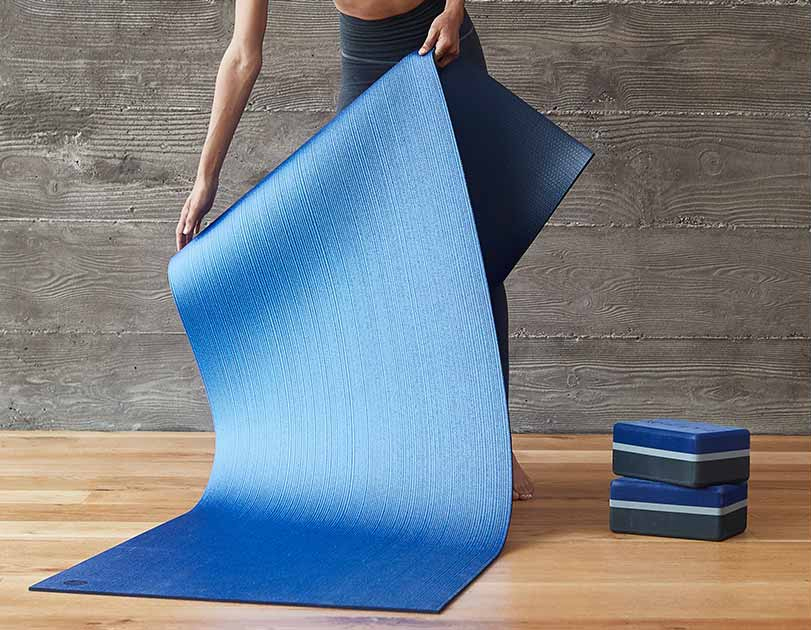
Use a stable exercise surface for floor work. A quality exercise mat can make a home workout more comfortable, but it is not a safe substitute for a firm floor beneath a dumbbell cradle. Never place the cradles on a thick, unstable mat where a selected dumbbell can wobble during adjustment. Keep the lift area clear, return weights deliberately, and follow the maker’s instructions for the selector mechanism.
Adjustable dumbbells need a different kind of care
Fixed dumbbells are simple slabs of metal, rubber, or urethane. Adjustable dumbbells add selector pins, cradles, plates, rails, dials, or locks. That complexity is the reason they save space, and it is also why basic care matters. Return each dumbbell to its own cradle before changing weight. Make sure the weight setting is identical on both sides. Keep the mechanism free of sweat, grit, and loose objects. Look over the plates, pins, and handles from time to time instead of discovering a problem halfway through a set.
Avoid dropping them. That is true even for models built with steel plates and robust-looking frames. A dropped adjustable dumbbell can damage a selector or create an unsafe mismatch between the handle and plate stack. Lower the weight to the floor under control, and use a bench or exercise choice that does not require dumping dumbbells at the end of a set. If you train in a way that repeatedly requires dropped weights, spend the money on fixed dumbbells or a barbell setup designed for it.
Keep expectations reasonable around noise, too. Plates and mechanisms may make some sound when a dumbbell is moved or reset. That alone is not a failure. A persistent rattle, a selector that does not seat properly, visible damage, or a change in how the plates lock should prompt you to stop using the dumbbell and consult the manufacturer’s instructions. Do not attempt an improvised repair on a weight-bearing mechanism.
Build a useful small home-gym routine around the pair
A pair of adjustable dumbbells can cover a lot: presses, rows, hinges, squats, lunges, carries, curls, triceps work, and controlled floor exercises. They do not replace every tool. A treadmill serves a different need entirely, and our treadmill guide can help if regular walking or running is the priority. A simple training setup should match the kind of consistency you can keep, not copy a commercial gym one piece at a time.
Recovery products can be helpful, but they are supporting gear. A foam roller may make a short mobility routine easier to keep, but it does not fix poor technique or replace sensible load progression. The dumbbells themselves should be the focus: learn the adjustment system, choose movements that feel stable, track what you lifted, and add weight gradually when your form and program support it.
When fixed dumbbells or another setup make more sense
Choose fixed dumbbells if you need several pairs available at once, train in a household where multiple people will switch weights constantly, or plan to use them in ways that involve dropping. They take more space and cost more as a collection, but they are fast to grab and simple to maintain. They also make sense for a trainer who needs several clients using different weights during the same session.
Consider a barbell, rack, and plates if heavy lower-body work is the core of your plan and you have the space and budget for a safe setup. Adjustable dumbbells can still be valuable alongside it, but no pair of compact weights has to pretend to be the complete answer for every goal. Home equipment works best when each piece has a clear job.
How we researched this guide
We compared current manufacturer weight ranges, adjustment mechanisms, stated dimensions, expansion compatibility, handle details, warranty coverage, safety instructions, and Amazon availability. We did not perform hands-on drop testing, durability testing, or claim personal lifting experience with these sets. The recommendations are organized around distinct needs: a simple 5–50 pound dial pair, an expandable system that reaches 90 pounds, and a premium compact pair that reaches 80 pounds.
Our recommendation
Buy the Core Home Fitness set if a simple 5–50 pound range covers your plan. Choose the PowerBlock Elite USA 90 if you want smaller adjustments and a verified path from 50 to 70 and 90 pounds with the correct expansion kits. Buy the NÜOBELL 80 if you need a compact 5–80 pound pair and can justify its premium cost and care requirements. The best adjustable dumbbells are the pair whose range, shape, and changing process make you more likely to train tomorrow.