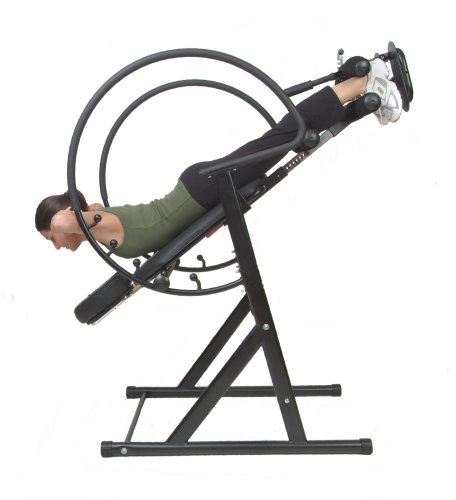
An inversion table is not a sensible default purchase for back pain. Hanging head-down changes the pressure in your body, the evidence for durable relief is limited, and the equipment can be dangerous when it is poorly adjusted or used by the wrong person. Start with a clinician or physical therapist if back symptoms are new, persistent, or changing. If you have been specifically cleared to use inversion and understand the limits, then the table matters: ankle security, easy entry, controlled angle settings, size limits, and the room required to use it safely all deserve more attention than add-on accessories.
If your goal is a lower-risk way to build trunk strength at home, compare the simpler options in our home core exercise equipment guide before buying a large inversion frame.
For that narrower buyer, we would choose the Teeter FitSpine LX9 when its easy-entry frame and micro-adjusting ankle system are worth the premium. The Teeter FitSpine X3 is the less expensive alternative for the same published height and weight range with many of the same comfort and control features. The Teeter ComforTrak EP-560 is the value-oriented pick, but its simpler T-pin ankle closure is a meaningful compromise, not a small cosmetic difference.
This guide does not promise that any table will treat a condition, fix a disc, or replace an evaluation of back pain. It explains which equipment features affect safe, controlled use and which buyers should leave the category alone.
Quick decisions
- For most people with new or unexplained back pain: do not buy an inversion table yet. Get medical advice first. Inversion is not appropriate for everyone, and it should not delay evaluation of serious symptoms.
- For a medically cleared buyer who wants the easiest entry and ankle adjustment: Teeter FitSpine LX9. Teeter lists a raised boarding platform, a micro-adjusting EZ-Reach ankle lock with a secondary gravity lock, 20/40/60-degree tether markings, and a 300-pound / 4-foot-8-to-6-foot-6 user range. It is expensive and needs a large clear operating area. Check the Teeter FitSpine LX9 on Amazon.
- For a lower-cost Teeter with the deluxe ankle closure: Teeter FitSpine X3. It has the same published height and weight limits and a similar tether, ankle system, backrest, and folding design, but lacks the LX9’s raised platform and LX-specific frame details. Check the Teeter FitSpine X3 on Amazon.
- For the value buyer who accepts a simpler closure: Teeter ComforTrak EP-560. It folds, has a 300-pound published limit, and includes the basic angle tether, but uses a T-pin ankle closure rather than the X3 and LX9’s micro-adjusting EZ-Reach system. Check the Teeter ComforTrak EP-560 on Amazon.
- For anyone with cardiovascular concerns, glaucoma or another eye disease, pregnancy, or a history of stroke or brain injury: ask a qualified clinician before considering any table. A product page cannot make that decision for you.
First question: should you invert at all?
Do not turn a shopping guide into a diagnosis. Back pain has many causes, and an upside-down stretching device is not a way to identify them. Mayo Clinic’s published guidance says inversion therapy does not provide lasting relief for back pain and that the head-down position can be risky for people with high blood pressure, heart disease, or glaucoma. Cleveland Clinic likewise advises talking with a physician before use and identifies high or low blood pressure, heart conditions, glaucoma and other eye disease, acid reflux, pregnancy, stroke, and brain injury among the situations that call for professional guidance.
That is not a list to self-screen against casually. A clinician who knows your health history, current medication, and reason for considering inversion can tell you whether this type of traction is appropriate. The right answer may be a different kind of movement, supervised physical therapy, a change in how you work or sleep, or further evaluation. A table is heavy, expensive, and unusually awkward to return. Take the medical decision before the delivery decision.
Seek prompt medical care rather than an inversion table if severe back pain follows a significant fall, collision, or other trauma, or if pain comes with fever, new weakness, numbness or tingling in one or both legs, or new bowel or bladder problems. Those are not “work through it” signals. They are reasons to be assessed. The same applies when pain is rapidly worsening or feels unlike your usual symptoms.
Even a person cleared for inversion should treat it as an optional, limited part of a broader plan, not a substitute for care. The possible short-term feeling of stretching is different from proof that a table has corrected a structural problem. If pain worsens, dizziness appears, or you feel unwell, stop and get advice rather than changing the angle or buying another accessory.
Why we favor a controlled ankle system over a bargain frame
Every inversion table does the same basic job: it holds your ankles while a hinged bed rotates. That makes the ankle mechanism and balance adjustment the important parts. You should be able to secure both ankles snugly without leaning, twisting, or guessing whether the latch caught. You should also be able to return upright slowly and deliberately. Foam thickness and a free head pillow are far less important than that control.
Read the manual before ordering, not while waiting for the box to arrive. Check the stated user height and weight limits, the adjustment method for your height, the type of ankle lock, the angle limiter or tether, and the folded and in-use dimensions. A listed maximum is not a target to exceed; it is a boundary. If you are close to a height or weight limit, have mobility limitations, or cannot comfortably reach the lock, this is a poor category for “it will probably be fine.”
There is also a practical setup issue. The Teeter models discussed here fold upright, but they still need unobstructed floor space for entry, full movement, and a controlled exit. The LX9’s published maximum in-use dimensions are about 81.7 by 32 by 86.5 inches. That tall arc and the user’s body need room away from shelves, low ceilings, doors, pets, and anyone walking through the area. Measure before buying. A folded-storage measurement does not tell you whether a table fits in use.
Be especially skeptical of generic listings that name a large weight capacity but do not publish a manual, model number, height range, warranty, or clear replacement-parts path. Inversion puts your full body weight on moving joints and ankle restraints. A discounted price does not make missing documentation a reasonable risk.
Best premium pick: Teeter FitSpine LX9
The FitSpine LX9 is the one to choose only if you have been cleared for inversion and want the most help getting on, locking in, and making small adjustments. Teeter’s current specifications list an LX ergonomic arched frame and raised boarding platform, a FlexTech backrest with an eight-point floating suspension system, an EZ-Angle tether marked at 20, 40, and 60 degrees, and a Deluxe EZ-Reach ankle lock. The ankle lock is described as micro-adjusting with a secondary gravity-lock mechanism; the table also has wrap-around ankle supports and a comfort dial.
Those details are not a promise of better medical results. They are reasons it may be easier to operate deliberately than a stripped-down model, particularly for a buyer who finds bending to a short handle difficult. It is also listed for users from 4 feet 8 inches to 6 feet 6 inches and up to 300 pounds. It folds for upright storage, but at 73.6 pounds it is not a casual one-hand move between rooms.
The compromise is price, size, and complexity. The LX9 includes extra handholds, stretch handles, a storage caddy, a lumbar bridge, acupressure nodes, and a head pillow. Those features are secondary to a correctly adjusted frame and a secure ankle closure. Do not spend more because you expect a passive accessory to solve back pain. Spend more only if the entry and adjustment features make the equipment demonstrably easier for you to use safely, after medical clearance.
Teeter says the LX9 is UL safety-certified, FDA-registered as a Class I medical device, and carries a five-year full warranty. Those are useful support details, but they do not remove the need to follow the user guide or make the table appropriate for every body or condition.
Best balance of features and cost: Teeter FitSpine X3
The FitSpine X3 keeps most of the features that matter in the LX9 and gives up the LX-specific entry and storage details. Teeter lists the same 4-foot-8-to-6-foot-6 height range, 300-pound weight capacity, marked 20/40/60-degree tether, micro-adjusting Deluxe EZ-Reach ankle lock, wrap-around ankle supports, balance adjustment, flexible backrest, and folding storage. Its published product weight is 65.8 pounds, lighter than the LX9 but still substantial.
This is the model for a cleared buyer who wants the nicer ankle closure and controlled-angle features but does not need the raised boarding platform or the LX9’s arched frame and caddy. It is not “the same table for less.” Getting in and out is a safety consideration, and that premium entry design can be meaningful for someone with limited mobility. If you can try each version in person or watch the manufacturer’s current assembly and use material before choosing, do that.
The X3 also comes with the lumbar bridge, acupressure nodes, and head pillow in Teeter’s current comparison. Treat them as optional comfort features, not a treatment system. The table must first balance correctly for your height and hold your ankles securely. Never use accessories, weights, resistance bands, or improvised attachments unless the exact manufacturer manual permits them.
See current FitSpine X3 listings on Amazon.
Best value pick: Teeter ComforTrak EP-560
The ComforTrak EP-560 is the sensible lower-price option only for a buyer who understands what it leaves out. Teeter lists the same 4-foot-8-to-6-foot-6 height range and 300-pound limit, a folding frame, a 59-pound product weight, an angle tether, adjustable balance, wrap-around ankle supports, and a full-inversion lockout. It has a five-year full warranty in the maker’s current comparison.
The key trade-off is the T-pin ankle closure. It is a simpler design than the micro-adjusting EZ-Reach system on the X3 and LX9. That may be perfectly adequate for a person who can reach, set, and verify it without strain, but it is not the right place to economize if ankle comfort, dexterity, or ease of entry is already a concern. A cheaper table that you cannot lock with confidence is not a value.
It also does not include the X3 and LX9’s listed Stretch Max and EZ-Stretch handles, nor the raised boarding platform unique to the LX9. Its maximum in-use dimensions are approximately 84 by 28.8 by 86 inches, so it is not a small-apartment purchase merely because it folds. Confirm both the open and folded space in your home before placing an order.
See current ComforTrak EP-560 listings on Amazon.
What we did not recommend
We left out no-name inversion tables with vague specifications, changing marketplace sellers, or a product page that could not be matched to a current manual. This equipment needs a clear model name, instructions, height and weight range, safety warnings, and support for parts or questions. A generic “heavy duty” label does not provide any of those things.
We also left out the Innova ITX9600 as a lead pick. Its publicly available manual lists a 300-pound maximum and a 4-foot-10-to-6-foot-6 height range, but it directs prospective users to obtain physician approval and states that body weight puts pressure on feet and ankles while inverted. Without a current manufacturer product page that makes support and feature comparison as transparent as Teeter’s current lineup, we would not elevate it above the verified models here. It may be a valid option for a medically cleared buyer who reads its complete current manual and confirms exact seller support; it is not the default recommendation.
Finally, we did not recommend inversion chairs or boots as an easy alternative. Changing the shape of the device does not remove the cardiovascular, eye-pressure, balance, or ankle-security questions. If full inversion is not appropriate, choose a different clinician-approved activity rather than a different way to hang upside down.
Safe setup and first-use rules
Assemble the exact model according to its official manual on a level, unobstructed surface. Do not skip fasteners, swap parts, or use a damaged frame. Recheck the height setting, hinge or balance setting, tether, and ankle closure every time before you get on. Wear footwear that does not interfere with the locking mechanism; Teeter’s manual specifically warns against footwear with thick soles or boots that interfere with its ankle lock.
Have another adult nearby for the first use if possible. Start at a shallow angle and a short duration only after a clinician has said inversion is safe for you and the manual’s directions are clear. Return upright slowly. Do not use aggressive swinging, hold weights, attach exercise bands, or attempt inverted exercises because a video makes them look routine. A loss of control when you are upside down can become an injury quickly.
Stop immediately for dizziness, new or worsening pain, unusual headache, visual changes, chest symptoms, shortness of breath, or any feeling that concerns you. Do not try to troubleshoot a physical reaction by setting a steeper angle or longer duration. Get medical advice. Keep children, pets, and bystanders out of the operating space; the manufacturer manuals make the same point because moving hinges and an inverted body are not a safe play area.
Plan for ownership, not just the first session
An inversion table is a large piece of equipment with a more demanding return and storage story than a foam roller or yoga mat. Confirm the delivery path, the place where the carton can be opened, and whether another adult can help move and assemble the frame. Do not assume a 59- to 74-pound product can be safely handled alone because it folds. Once assembled, it needs a stable home where its locking mechanisms stay dry, visible, and free from loose clothing, toys, and pet hair.
Read the return terms before buying, especially if you are ordering online. Keep the model number, manual, proof of purchase, and customer-support contact information. Inspect the hardware periodically and stop using the table if a latch, tether, hinge, ankle support, or frame appears worn, bent, loose, or damaged. Do not replace a missing part with a similar-looking bolt or an improvised strap. The manufacturer should identify the correct replacement part and whether the table is still safe to use.
If you want a gentler way to make a regular movement habit, a clinician or physical therapist can help identify appropriate exercises for your situation. A clear patch of floor and a supportive yoga mat may be the more useful purchase for someone who has not been cleared for inversion, has limited space, or simply wants a routine that does not require hanging upside down. That is not a substitute for diagnosis either, but it is often a more flexible piece of equipment to own.
How we researched this guide
We reviewed current medical guidance on inversion’s limits and risks, including information from Mayo Clinic and Cleveland Clinic, alongside current manufacturer specifications, manuals, height and weight limits, warranty terms, and support material. We did not test inversion tables, and we do not treat marketing claims or user reviews as proof that a device will improve a particular person’s symptoms. Our recommendations prioritize documented adjustment and ankle-lock features for people who have already been medically cleared to use this type of equipment.
Amazon links on SuperGrail may earn us a commission. That does not change the medical cautions, product boundaries, or recommendation criteria in this guide.