Most people looking for a sleep aid do not need a more complicated bedtime routine. They need to solve one specific interruption: a streetlight on the pillow, traffic that rises and falls all night, a partner who turns on a lamp, or a room that starts glowing at 5 a.m. Buy for that interruption first.
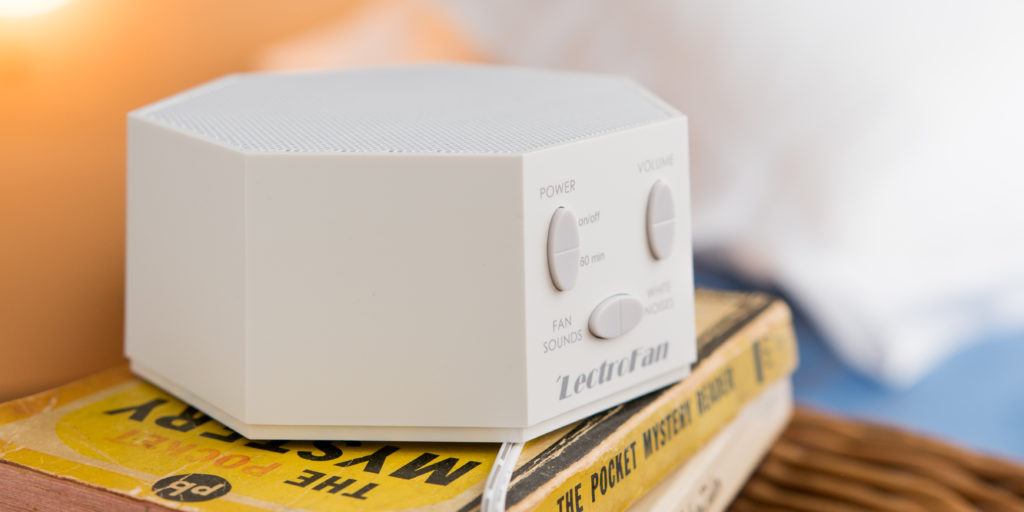
For light, the Manta Sleep Mask is the pick. Its movable eye cups and adjustable strap make it easier to fit than a flat elastic mask, especially if ordinary masks press on your lashes or leave a bright gap beside your nose. For inconsistent outside noise, choose the LectroFan EVO; it has 22 non-looping fan, noise, and ocean-style options, so you can settle on a sound that fades into the room instead of a loop you start anticipating. If the whole bedroom is bright, put the money into a properly sized blackout-curtain setup before buying another small bedside product.
None of these products treats insomnia, sleep apnea, pain, depression, a medication side effect, or another medical condition. They are ordinary bedroom tools. That boundary matters. An eye mask can block a lamp. It cannot explain why someone is exhausted every day. If poor sleep is frequent, affects driving or other daytime safety, or comes with loud snoring, gasping, choking, unusual movements, or unplanned daytime sleep, talk to a qualified clinician instead of building a larger cart of sedating products.
Quick picks
| Need | Pick | Why it fits | Main compromise |
|---|---|---|---|
| Light in a shared room, hotel, or early sunrise | Manta Sleep Mask | Adjustable, deep eye cups give a flat mask more room to work. | Bulkier and more expensive than a simple fabric mask. |
| Traffic, neighbors, or a partner on a different schedule | LectroFan EVO | Many non-looping sound choices and simple physical controls. | It needs power and will not make a loud environment safe or silent. |
| A bedroom that is bright every morning | NICETOWN blackout curtains | An affordable starting point for covering the whole window. | Fit, rod placement, and side gaps matter as much as the fabric. |
| One steady, fan-like sound with no menus | Yogasleep Dohm Classic | A mechanical fan design with adjustable tone and volume. | Fewer sound choices, corded power, and not designed for international voltage. |
Start by naming what is actually waking you
“I need a sleep aid” is a broad request. It can mean light at the wrong time, a delivery truck that arrives before dawn, a room that feels stuffy, a racing mind, an irregular work schedule, pain, or a sleep disorder. The right next step changes with the cause. Before spending money, keep a short note for several nights: when you got into bed, what woke you, what was happening in the room, and how you felt the next day. It is not a clinical diary. It is a way to avoid buying a solution for the wrong problem.
If a neighbor’s door or traffic is the disruption, an eye mask does nothing. If the room is bright at sunrise, a sound machine does nothing. If you are reaching for your phone for an hour before bed, an expensive pillow is unlikely to change that pattern. The useful purchase is the smallest one that removes a repeatable obstacle.
Make one change at a time. A new curtain, a new sound machine, three supplements, a warmer blanket, and a different bedtime all at once gives you no way to tell what helped or what made the room worse. Use a simple tool for several nights, adjust it, then decide whether it earns a permanent place.
Best for light: Manta Sleep Mask
The Manta Sleep Mask is the right purchase when light is local or temporary: a partner reads later, a hotel has thin curtains, you travel on an overnight flight, or summer daylight reaches the bedroom before you want to wake. Manta’s original model uses detachable, positionable eye cups and a hook-and-loop head strap. The cups create space around the eyes, which is the feature worth paying for if flat masks rest on your eyelids or squash longer lashes.
The fit is adjustable in more than one direction. You can move the cups across the inner strap, change the strap tension, and reposition the mask at the bridge of the nose. That is more useful than a generic claim of “blackout,” because every mask fails at the places your face does not match its shape. A person who sleeps on their back may be happy with a basic cloth mask; a restless side sleeper or a person sensitive to eye pressure has more reason to choose this style.
The trade-off is size. The cups are deeper and the mask costs more than the thin travel masks sold in multipacks. It can also feel too warm, too tall at the temples, or too prominent against a pillow for some sleepers. Do not force a mask that makes you tense your face or readjust it all night. Return it and try a flatter design. A sleep mask should remove a distraction, not become one.
Use an audible alarm you know you can hear, and do not use a mask when you need to respond visually to a child, a medical need, or another urgent responsibility. Wash it as the maker directs and let it dry fully. For a broader look at fabrics, cup designs, and fit, see our guide to sleep masks.
Best for inconsistent noise: LectroFan EVO
The LectroFan EVO makes sense when the problem is changeable noise: cars that arrive at random, a neighbor’s door, an apartment elevator, or a partner who starts work before you do. Its manufacturer lists 22 non-looping sound options, including fan sounds and different noise profiles. That selection is not a reason to hunt for the mathematically perfect color of noise. It is useful because ears differ. One person finds a low fan sound unobtrusive; another notices it immediately and prefers a brighter, softer hiss.
Start low. Place the machine at a normal bedside distance and raise the volume only enough to make abrupt changes in the room less noticeable. A sound machine cannot cancel noise in the active-noise-control sense, and it should not be used so loudly that it obscures an alarm, a smoke detector, or an important call for help. Its purpose is a steady background, not a private nightclub.
The EVO is a better fit than a phone for people who do not want their bedtime sound source to double as a message feed. It has physical controls, does not require an app, and can play through the night or use a timer. The compromise is that it takes an outlet and a little nightstand space. Travelers who want a tiny battery-powered device should look elsewhere; people who use a sound machine nightly usually benefit more from controls they can use half-asleep than from extra smart features.
For a room where you prefer a single mechanical rush of air rather than a menu of recordings, the Yogasleep Dohm Classic is the simpler alternative. It creates its sound with an internal fan, has two speeds, and lets you alter the tone by rotating its outer housing. Its fan-like sound is not a universal preference, but the lack of tracks, Bluetooth, or an app is exactly the appeal for someone who wants one setting and no decisions. It is a corded U.S./Canada product, so it is not a universal travel adapter companion.
Neither machine is a cure for insomnia and neither is appropriate as a way to ignore an unsafe noise situation. If you are buying for a baby or child, follow current pediatric and product-safety guidance rather than applying adult bedroom advice. Our white-noise machine guide compares more of the choices and their control styles.
Best room-level purchase: blackout curtains that fit the window
A sleep mask is easy to pack. Curtains are the better answer when the light is built into the room: a streetlamp, a bright neighboring building, a very early sunrise, or a shift-work schedule that requires daytime sleep. The NICETOWN blackout-curtain range is a reasonable budget place to start because it comes in many panel lengths and widths. The brand name is less important than measuring correctly.
Measure the rod, the window, and the distance from the top of the rod to the floor before ordering. A panel that exactly matches the glass width leaves bright seams at either side. A rod mounted too low or too narrow creates gaps the fabric cannot fix. Wider panels with some fullness, a rod that extends beyond the window, and enough height above it generally matter more than a marketing label. If light is leaking from above the curtain, beside an air conditioner, or around a blind, identify that path before upgrading fabric.
For renters, a tension rod or removable rod hardware may be the realistic first step. For homeowners, a wider rod and room-darkening lining can be a better long-term purchase. Check the care label as well: washable panels are easier to keep in a bedroom than heavy fabric that needs specialty cleaning. Curtain purchases become surprisingly expensive when the needed rod, brackets, extra panels, and installation are ignored. Plan the whole opening rather than buying one low-priced panel and hoping it behaves like a custom shade.
Blackout fabric makes a dark room; it does not adjust a wake schedule, treat a disorder, or make daytime sleep identical to night sleep. It is still one of the most durable improvements for a room that is consistently too bright, because it addresses the condition every evening without charging, refilling, or replacing anything.
What we would buy before a pill or supplement
We do not recommend a “best” over-the-counter sleep medicine, melatonin gummy, CBD product, herbal blend, or proprietary powder in this guide. Those products can have side effects, interactions, quality differences, and circumstances where they are a poor fit. “Natural” does not mean compatible with every medication or safe for every person. A product label and a pharmacist or clinician are better sources for an individual medicine decision than a general shopping guide.
Be especially cautious with products that promise to sedate you rapidly, cure chronic insomnia, or replace care. Do not combine a sedating product with alcohol or pile several nighttime products together without checking the active ingredients. Next-day impairment can matter as much as the first night’s result. Pregnancy, breastfeeding, older age, chronic health conditions, and prescription medicines are all reasons to ask a pharmacist or clinician before treating a sleep problem with something from a supplement aisle.
Long-term difficulty falling asleep or staying asleep deserves a different kind of attention. Cognitive behavioral therapy for insomnia (CBT-I) is commonly used as an initial treatment approach for chronic insomnia; a curtain or sound machine cannot substitute for an evaluation. The point is not to turn a rough week into a medical emergency. It is to recognize when a bedroom product has reached the edge of what it can reasonably do.
Build a bedroom that asks less of you at midnight
The familiar advice to make a bedroom dark, quiet, and comfortable is useful because it is concrete. The mistake is treating it as a perfection contest. Parents, caregivers, shift workers, travelers, and people living in small apartments cannot always control their sleep window or surroundings. Choose the levers that are actually available.
- For light: turn off or cover the little LEDs, place the phone face down or outside reach, and decide whether a mask or curtain solves the remaining light leak.
- For sound: close the window if the temperature permits, use a steady low sound if abrupt noise is the problem, and keep the volume low enough for alarms.
- For temperature: adjust bedding, airflow, and sleepwear before buying a specialized cooling gadget. A room that feels stuffy may only need a fan pointed away from the bed or a lighter layer.
- For routine: keep the last part of the evening simple enough to repeat on an ordinary work night. A phone charger outside arm’s reach can matter more than another sleep app.
A regular wake time is often easier to maintain than an elaborate bedtime program. If you travel, bring the piece of your routine that solves a known problem: a mask for hotel light, a compact sound source if noise is predictable, or a familiar layer if the room runs cold. Pack the tool because it is useful, not because it makes a promise about sleep quality.
How to decide among the four picks
Choose the Manta mask when the disturbance is light and you need a portable answer. Choose the LectroFan EVO when your room is quiet enough most of the time but sudden noises keep grabbing your attention. Choose the Dohm Classic when a single adjustable fan-like sound is more appealing than a selection of recordings. Choose blackout curtains when the source is daylight or a fixed outside light and you want the entire room darker.
There is no prize for owning all four. A dark curtain plus a mask can be redundant in a room that is already dark. A sound machine is a poor use of money if the real issue is an uncomfortable mattress, a hot room, or a loud situation that needs a safety or housing solution. Buy one practical tool, set it up before you are tired, and keep it only if it makes the specific interruption easier to manage.
How we researched this guide
We reviewed current manufacturer information for the mask and sound machines, including their fit systems, sound options, controls, power requirements, and care details. We also checked current public health guidance on creating a dark, quiet, comfortable bedroom and on when persistent sleep symptoms deserve professional attention. We did not conduct hands-on product testing or make medical treatment claims. Product availability, colors, and sale prices can change, so check the exact Amazon listing before ordering.
Questions before buying a sleep aid
Should I buy a sleep mask or blackout curtains?
Buy a mask for a portable or shared-room problem. Buy curtains when the whole bedroom is bright most nights. If you need to sleep during the day regularly, measure the window and improve the room first; a mask can still be a useful backup for travel.
Is a sound machine safe to leave on all night?
Use the product according to its instructions, place cords safely, and keep the volume modest enough that you can hear alarms and urgent sounds. A steady background sound is the goal. If it becomes loud enough to dominate the room, turn it down or reconsider whether it is solving the right problem.
What should I do if I keep waking up exhausted?
Do not assume a consumer sleep product is the answer. Daytime impairment, loud snoring, gasping or choking during sleep, and persistent insomnia are good reasons to seek professional advice. That conversation can identify causes a blackout curtain or supplement cannot address.
For most buyers, start with the interruption you can name. The Manta Sleep Mask is the practical choice for unwanted light, and the LectroFan EVO is the flexible choice for inconsistent noise. If dawn or a streetlight fills the room, spend the effort on a correctly fitted blackout-curtain setup. Those are modest purchases with a clear job, which is exactly what a sleep-aid guide should help you find.