SuperGrail may earn a commission from qualifying Amazon purchases. Our recommendations are based on current manufacturer documentation and decision-focused editorial research, not hands-on testing.
The short answer
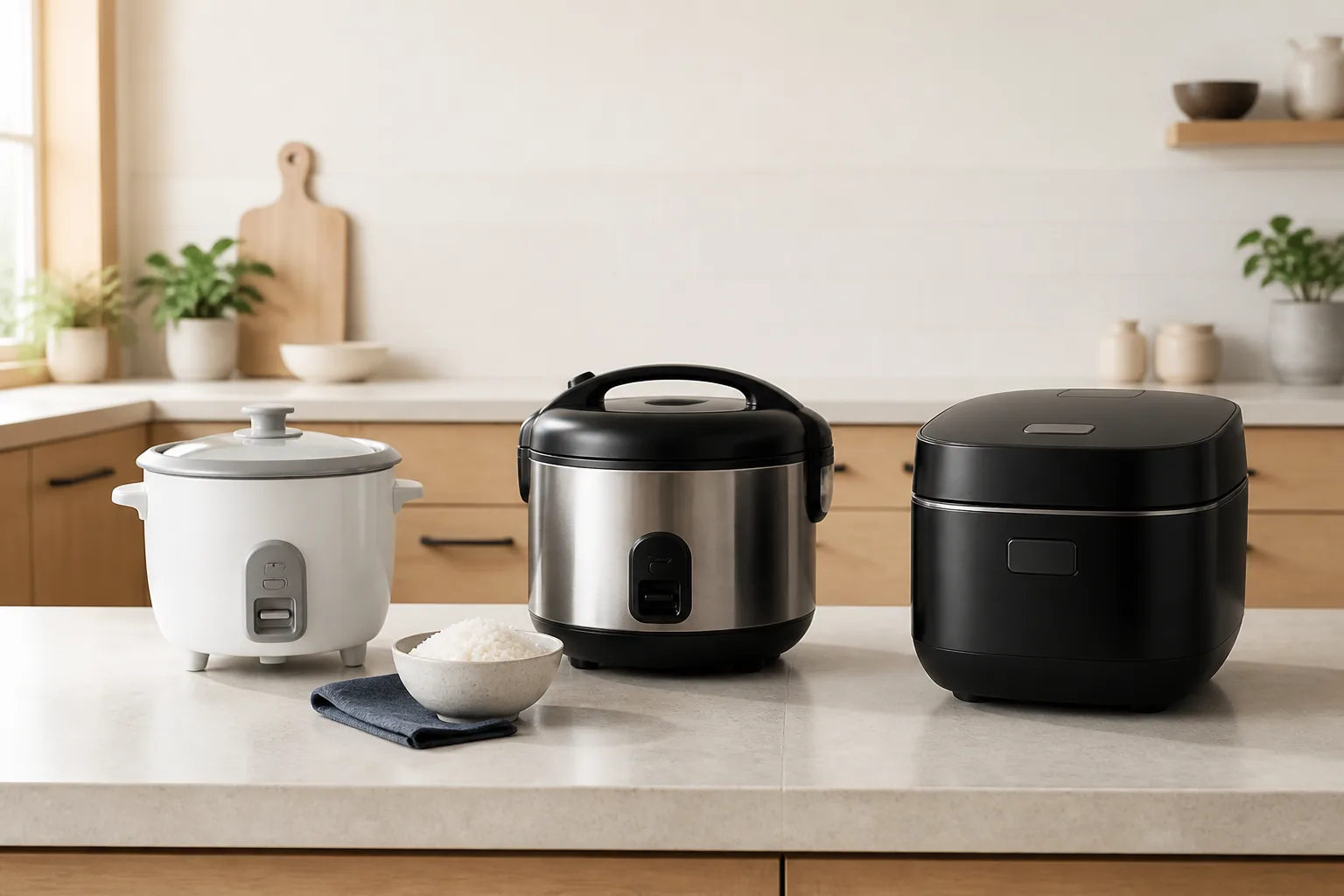
Choose the Zojirushi NS-ZCC10 if rice is a frequent part of dinner and you want a machine that adjusts cooking through Neuro Fuzzy logic instead of relying on a single fixed heating cycle. The 5.5-cup model offers white, mixed, porridge, sweet, semi-brown, brown, rinse-free, and quick settings, plus keep-warm and two delay timers. It cooks more slowly than the cheapest switch cookers and its inner pan should be treated carefully. For occasional rice, the Aroma ARC-914SBD is the rational budget choice. Cuckoo’s CR-0655F suits cooks who want more menu control without moving to a pressure model.
A rice cooker handles the starch while another appliance manages dinner. An air fryer can cook a small protein or crisp vegetables, while an electric griddle covers larger batches. Our kitchen category collects the rest of the planning tools.
Quick picks
| Pick | Best for | Defining facts | Main compromise |
|---|---|---|---|
| Zojirushi NS-ZCC10 Neuro Fuzzy 5.5-Cup | best for consistent everyday rice | 5.5 Japanese-cup uncooked capacity; spherical inner pan; Neuro Fuzzy control; white, mixed, porridge, sweet, semi-brown, brown, rinse-free, and quick menus; keep-warm, extended keep-warm and reheating; dual timers | occasional users, pressure-cooker shoppers, and anyone likely to scratch a nonstick inner pan |
| Aroma ARC-914SBD Digital Rice Cooker | best budget cooker | compact digital cooker commonly rated for 4 cups uncooked and 8 cups cooked; white-rice, brown-rice, steam, and flash-rice functions; delay timer and keep-warm | texture perfectionists, large households, and cooks wanting a durable heavy inner pot |
| Cuckoo CR-0655F 6-Cup Micom Rice Cooker | best flexible midrange pick | 6-cup uncooked capacity; computerized Micom control; menus for glutinous, GABA/brown, mixed, porridge and more; warming and timer functions; removable inner lid | buyers wanting pressure cooking, a plain English-only interface, or the fewest cleaning parts |
| Tiger JBV-S10U Micom Rice Cooker | best for rice plus a synchronized dish | 5.5-cup uncooked capacity; Micom control; Tacook synchronized cooking plate; white, brown, synchro-cooking and slow-cook functions | cooks concerned about aroma transfer, people making large entrées, and those wanting extensive grain programs |
| Instant Pot Duo 6-Quart | best if pressure versatility matters more than rice specialization | electric pressure multicooker with pressure cook, slow cook, sauté, steam, yogurt, rice, and warming programs; stainless-steel inner pot | rice enthusiasts seeking delicate texture control, nonstick convenience, or a light pot |
The alternate cookers suit different batch sizes and levels of control. A small simple machine can beat the top pick for one or two people because it wastes less space and rice; a pressure or induction model asks more money for broader adjustment. Choose around the batch you cook most often.
1. Zojirushi NS-ZCC10 Neuro Fuzzy 5.5-Cup: best for consistent everyday rice
Best for: households cooking white and brown rice several times a week and willing to wait for a tuned cycle. Skip it if: occasional users, pressure-cooker shoppers, and anyone likely to scratch a nonstick inner pan.
The NS-ZCC10’s value is correction. Its controller can adjust time and heat as the cook progresses, giving it more room to cope with ordinary measuring or temperature variation than a one-switch cooker. The interface looks dated and the melody may be unnecessary, though it can be changed. The 5.5-cup figure uses the supplied rice cup, not a US measuring cup.
The relevant specification set is 5.5 Japanese-cup uncooked capacity; spherical inner pan; Neuro Fuzzy control; white, mixed, porridge, sweet, semi-brown, brown, rinse-free, and quick menus; keep-warm, extended keep-warm and reheating; dual timers. Together, those details explain why this model is the default without pretending that it wins every contest. Its advantage applies across the broadest share of the intended routine, and its drawbacks are visible before purchase rather than hidden in a subscription or unusual consumable.
Use the Zojirushi NS-ZCC10 Neuro Fuzzy 5.5-Cup Amazon search to match the complete model number and included parts. Similar-looking bundles may omit an accessory or carry different seller-backed support.
2. Aroma ARC-914SBD Digital Rice Cooker: best budget cooker
Best for: students, small families, and occasional rice eaters who want automatic cooking and a steamer tray. Skip it if: texture perfectionists, large households, and cooks wanting a durable heavy inner pot.
Aroma delivers the functions most buyers actually use at a modest tier. It can steam food above rice when timing aligns, but vegetables and rice do not always finish together. The lightweight nonstick pot and simpler control logic demand more careful ratios and washing than the Zojirushi. “Eight cup” marketing refers to cooked yield and should not be confused with eight cups dry.
Its case rests on compact digital cooker commonly rated for 4 cups uncooked and 8 cups cooked; white-rice, brown-rice, steam, and flash-rice functions; delay timer and keep-warm. That is a different proposition from the main pick, aimed at a buyer with a firmer preference. Compare the alternate on that preference first. A prettier finish or a temporary discount should not outweigh the physical constraint it is meant to solve.
Before ordering, compare current variants in the Aroma ARC-914SBD Digital Rice Cooker Amazon results. Check the manufacturer name, model suffix, voltage, and warranty eligibility rather than relying on the thumbnail.
3. Cuckoo CR-0655F 6-Cup Micom Rice Cooker: best flexible midrange pick
Best for: cooks rotating among short-grain white, brown, mixed rice, and porridge who want detailed menus. Skip it if: buyers wanting pressure cooking, a plain English-only interface, or the fewest cleaning parts.
Cuckoo’s 6-cup model offers a useful step up from basic heat-and-switch operation. It is especially relevant to households cooking Korean-style short-grain rice and mixed grains. Menus and voice or labeling vary by market, so check the exact US model. The detachable inner lid makes thorough cleaning possible, but it adds a part that must be reseated correctly.
The specialist value comes from 6-cup uncooked capacity; computerized Micom control; menus for glutinous, GABA/brown, mixed, porridge and more; warming and timer functions; removable inner lid. Pay for it only if the matching task appears often enough to shape the week. Used outside that niche, the same design can be less convenient than a plainer general-purpose model, particularly when storage and cleanup enter the calculation.
The Cuckoo CR-0655F 6-Cup Micom Rice Cooker search may show several sizes or generations. Select only the version whose specifications match this guide, and treat add-on bundles as separate value decisions.
4. Tiger JBV-S10U Micom Rice Cooker: best for rice plus a synchronized dish
Best for: small families who want rice below while a modest entrée steams above. Skip it if: cooks concerned about aroma transfer, people making large entrées, and those wanting extensive grain programs.
Tiger’s Tacook plate is more than a token steamer basket: it is designed to keep the upper dish’s liquid from dropping into the rice. The concept works best for appropriately sized recipes with compatible cooking times. It does not turn a rice cooker into a full multicooker, and the upper tray reduces vertical room. For plain rice alone, the Zojirushi provides more specialized programs.
The budget equation includes 5.5-cup uncooked capacity; Micom control; Tacook synchronized cooking plate; white, brown, synchro-cooking and slow-cook functions. It preserves the central job and accepts clearer compromises in materials, controls, or long-term convenience. That is a sound exchange for light or shared use; it is false economy when the omitted refinement affects every session.
Marketplace stock for Tiger JBV-S10U Micom Rice Cooker can mix current and older packages. Verify the model on the product label, what is in the box, and who handles a return before choosing the lowest listing.
5. Instant Pot Duo 6-Quart: best if pressure versatility matters more than rice specialization
Best for: small kitchens that need beans, stews, stock, and rice from one appliance. Skip it if: rice enthusiasts seeking delicate texture control, nonstick convenience, or a light pot.
The Duo makes credible rice and excels when dinner includes pressure-cooked beans or braised food. Its broad stainless pot can be sticky with short-grain rice, and the generic Rice program is not a substitute for grain-specific fuzzy-logic menus. Pressure adds a sealing ring, valve, and lid channels to clean. Buy it because you need the other modes, not because more buttons guarantee better rice.
This outlier is defined by electric pressure multicooker with pressure cook, slow cook, sauté, steam, yogurt, rice, and warming programs; stainless-steel inner pot. Its unusual form or feature set can be exactly right for the stated buyer, yet it deserves more scrutiny than the default. Confirm ergonomics, compatibility, and service parts because a distinctive design tends to magnify both delight and irritation.
Confirm color, size, and regional version in the Instant Pot Duo 6-Quart search. Those choices can affect fit or included components even when the family name stays the same.
How to choose without overbuying
Start with the physical job, frequency, and ownership burden. Features that do not change those three things are usually distractions. The criteria below are the ones most likely to alter the recommendation.
Capacity labels use a small rice cup
Dedicated cookers usually measure uncooked capacity with an approximately 180-milliliter supplied cup. That is smaller than a 240-milliliter US cup. Use the included cup and the matching water lines; mixing systems is a common cause of dry or mushy rice.
Make “capacity labels use a small rice cup” an elimination test. If the product cannot meet the routine on an ordinary day, extra modes will not rescue the purchase. Verify the exact model in the current manual because retailer summaries often collapse related versions.
A basic thermostat can still make good white rice
Simple cookers switch to warm when free water has been absorbed or evaporated and pot temperature rises. They are inexpensive and fast to understand. Fuzzy-logic machines vary heat and time, adding tolerance and specialized grain curves, but their cycles may be longer.
Translate the maker’s cup count into your household’s cooked-rice needs. The supplied measuring cup may not equal a US cup, and minimum batches matter as much as maximum capacity. A large pot is inconvenient if the household usually cooks one or two small servings.
Brown and mixed grains need real menu support
Bran slows water absorption. A dedicated brown-rice or GABA-brown program can soak and cook longer than white rice. If the manual offers no matching mode, use its grain-specific instructions instead of guessing from the white-rice line.
Read the grain, water-line, and keep-warm instructions for the exact model. Some cycles are calibrated for particular rice types, quick modes may trade time for texture, and extended warming can dry small batches. Pressure models add lid-sealing and release steps that simple cookers do not require.
Pressure changes both speed and ownership
Pressure models cook at a higher temperature and can produce satisfying short-grain texture, beans, and stews. They also require seals, valves, and stricter fill rules. A non-pressure fuzzy cooker is easier to open, inspect, and maintain.
A shared kitchen benefits from a clearly marked inner pot, controls that show the active stage, and removable parts that are difficult to reassemble incorrectly. Menu depth is useful for an interested cook. For everyone else, a dependable white-rice button and obvious cleaning routine may be the stronger design.
Keep-warm is useful within limits
Better cookers manage low heat to reduce drying and odor, but no warm mode preserves fresh texture indefinitely. Fluff promptly, avoid repeatedly opening the lid, and refrigerate leftovers safely. Extended-warm claims are not permission to ignore food-safety guidance.
Account for replacement inner pots, steam caps, gaskets, and the space the cooker occupies between meals. A higher-priced machine can be sensible when it handles several grains used weekly. Paying for pressure, induction, or app controls is wasteful when the household wants straightforward white rice.
The inner pot is a consumable surface
Nonstick pots release rice easily but scratch under metal utensils and abrasive pads. Replacement cost and availability matter. Stainless steel tolerates utensils better but rice can adhere unless ratios, resting, and serving technique are dialed in.
When two models appear equal here, prefer the one with clearer documentation and obtainable parts. Published instructions make correct use repeatable, and serviceability matters after the return window closes.
Setup, care, and ownership
A good purchase can become frustrating through poor placement, a skipped manual step, or neglected cleaning. These practices protect performance and make the limitations visible before they become failures.
- Measure rice with the supplied cup and water with the pot line for the selected menu. A kitchen scale can improve repeatability once you establish a preferred ratio.
- Rinse only as the rice producer and cooker manual recommend. Some enriched rice should not be rinsed; other varieties benefit from several gentle water changes.
- Dry the outside and bottom of the inner pot before inserting it. Water or grains on the heater plate interfere with contact and can damage surfaces.
- After cooking, rest for the specified time if the cycle does not include it, then fluff from the bottom with the supplied paddle to release steam evenly.
- Wash the inner lid, steam vent, condensation collector, and gasket areas after use. Starch film creates odor and can interfere with sealing.
- Never wash rice directly in a nonstick inner pot unless the maker permits it. Grains and rings can score the coating.
- Cool leftovers promptly in shallow containers. A keep-warm button is not a substitute for local food-safety limits.
Use the supplied cup and pot markings as directed, keep the heater plate free of grains, and dry the pot exterior before insertion. Pressure-cooker lids and valves need their specified cleaning checks. Replace a damaged nonstick pot or gasket, and stop using a cooker with a frayed cord, steam leak, or unreliable latch.
Credible competition
Zojirushi’s NS-TSC10 adds a more modern display, a steaming basket, and a cake setting; it is worth comparing when versatility matters, though the NS-ZCC10’s established spherical-pan design remains the cleaner rice-first recommendation. The NP-HCC10 and other induction or pressure-induction Zojirushi models offer more even heating and advanced control at a steep premium. For many households, grain quality differences will not justify that cost. The inexpensive Aroma one-touch models are even simpler than the ARC-914SBD but give up a brown-rice program and delay control. Cuckoo’s pressure models can produce a chewier short-grain result and run sophisticated programs, but seals, steam release, price, and cleaning make them a specialist upgrade. Pars or Panasonic commercial cookers make sense for high volume, not for a two-person weeknight portion.
A sale on a similarly named cooker can conceal a different capacity, voltage, menu set, or inner-pot construction. Compare the full model number and available replacement parts. Imported versions may not match local power or warranty coverage even when the housing looks identical.
How we researched
We reviewed current rice-cooker manuals, stated capacities, cycle lists, inner-pot construction, keep-warm guidance, cleaning steps, and warranty terms. The comparison centers on batch range and operating complexity. We did not cook rice or score texture.
Terms such as fuzzy logic and induction describe control or heating methods, not a guaranteed meal. Documented features explain who gains from these systems; temporary price quotes were excluded. Confirm the capacity, regional voltage, and exact suffix in the Amazon listing before checkout.
Frequently asked questions
What does 5.5-cup capacity mean?
It usually means 5.5 of the supplied 180-milliliter cups of uncooked rice. Cooked yield varies by grain. A 5.5-cup machine is comfortable for small portions through a family batch; filling below or above marked limits can compromise results.
Is fuzzy logic worth paying for?
It is worthwhile when you cook rice frequently, alternate grain types, use timers, or value tolerance for small measuring differences. If you make basic white rice twice a month, a simple thermostat cooker can be the better purchase.
Why is rice dry on top and wet below?
Likely causes include a wrong cup-to-line combination, an uneven counter, debris under the pot, insufficient resting, or an oversized or undersized batch. Verify the manual method before changing the ratio. Then adjust water in small repeatable increments.
Can I leave rice on warm overnight?
Some manufacturers provide extended keep-warm modes, but quality declines and safe duration depends on maintained temperature and the manual. Follow the cooker’s instructions and public-health guidance. When uncertain, cool and refrigerate promptly.
Can I cook quinoa or steel-cut oats?
Only if the manual supplies a suitable method and respects foaming and fill limits. Porridge programs can behave differently from a simple boil. Oats may foam into a vent, especially in a pressure cooker, so do not improvise above stated limits.
Do expensive rice cookers cook faster?
Often they do not. Soak phases, gentle heating, and rests can make premium cycles longer. Quick modes trade some texture optimization for time. Buy an advanced cooker for control and repeatability, not an assumption of speed.
Final recommendation
Zojirushi NS-ZCC10 Neuro Fuzzy 5.5-Cup is the default for households cooking white and brown rice several times a week and willing to wait for a tuned cycle because 5.5 Japanese-cup uncooked capacity; spherical inner pan; Neuro Fuzzy control; white, mixed, porridge, sweet, semi-brown, brown, rinse-free, and quick menus; keep-warm, extended keep-warm and reheating; dual timers. Skip it when occasional users, pressure-cooker shoppers, and anyone likely to scratch a nonstick inner pan; that is precisely why the alternatives above exist. Verify the model number and plan for the stated care before ordering.