SuperGrail may earn a commission from qualifying Amazon purchases. Our recommendations are based on current manufacturer documentation and decision-focused editorial research, not hands-on testing.
The short answer
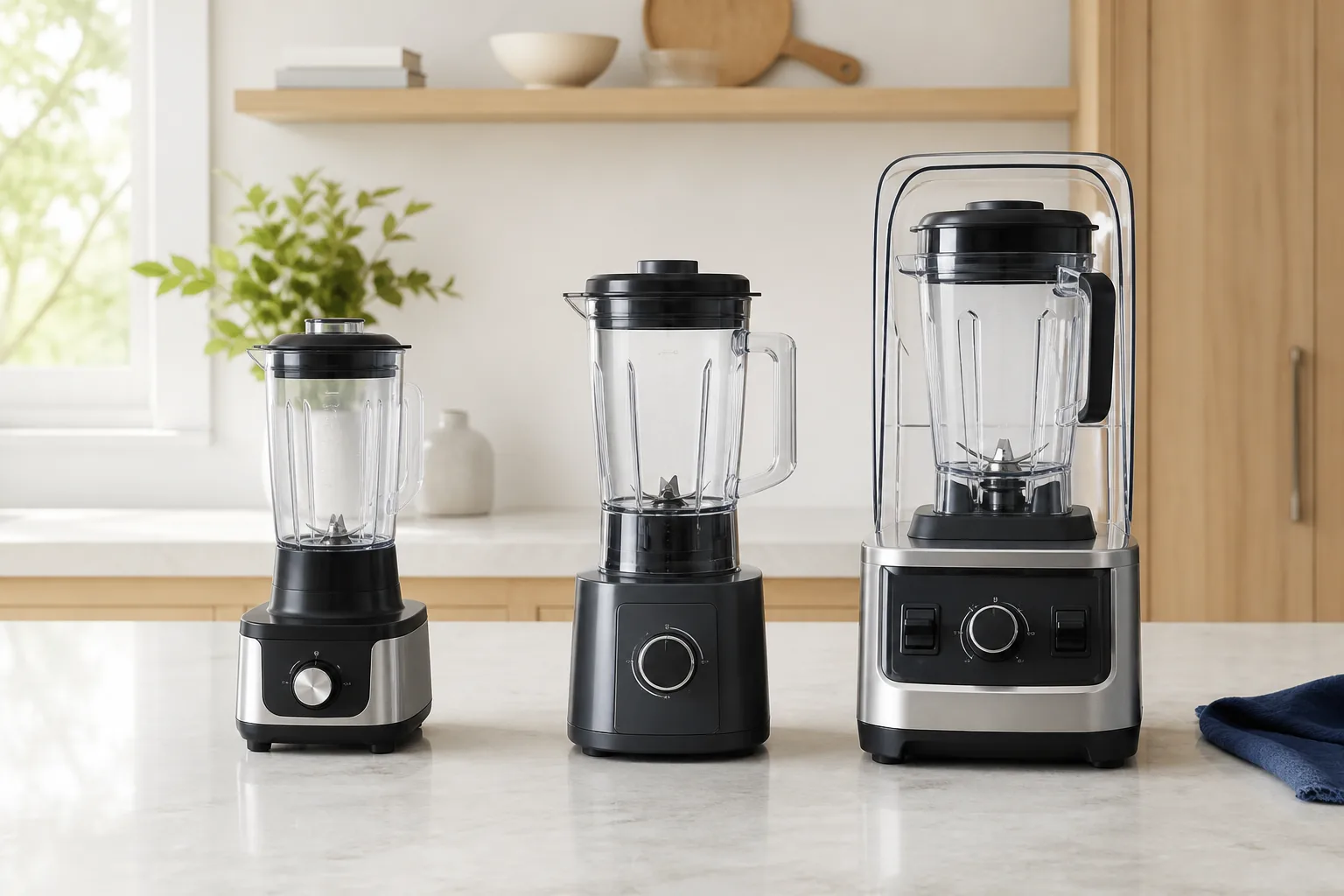
Buy the Vitamix 5200 if you want one blender for years of smoothies, sauces, nut-based mixtures, and hot-soup preparation and you have room for its tall 64-ounce container. Its manual variable-speed dial, High switch, tamper, thermal protection, and seven-year full warranty form a durable, understandable package. The tall jar may not clear upper cabinets, and there are no one-touch programs. The Ninja Professional Plus BN701 costs less and offers presets, while the NutriBullet Pro 900 is the better answer for one or two cold drinks rather than family batches.
A blender is only one route to fast weeknight food. For crisp food with less oil, see our air-fryer guide; for pancakes and batch breakfasts, our electric-griddle picks solve a different problem. More appliance advice lives in the SuperGrail kitchen category.
Quick picks
| Pick | Best for | Defining facts | Main compromise |
|---|---|---|---|
| Vitamix 5200 | best all-purpose blender | 2-horsepower motor; 64-ounce tall container; manual variable speeds plus High; tamper; radial cooling fan and thermal protection; seven-year full warranty | small kitchens, preset devotees, and people mainly blending a single travel cup |
| Ninja Professional Plus Blender with Auto-iQ BN701 | best value for large cold batches | 72-ounce total-capacity pitcher with a lower maximum liquid capacity; stacked blade assembly; three Auto-iQ programs; 1,400-peak-watt motor | cooks who prioritize the silkiest small batch, hot blending, or a simple low-mounted blade |
| NutriBullet Pro 900 | best compact personal blender | 900-watt motor base; twist-on extractor blade; cup-based blending and drinking system | families, hot-soup makers, and anyone wanting variable speed or a tamper |
| Blendtec Classic 575 | best for programmed simplicity | 1,560-watt motor; WildSide+ jar; Smoothie and Clean cycles; timed 60- and 90-second cycles; five incremental speeds and pulse; two-year warranty | people comparing warranty length with Vitamix or blending very small quantities in a broad jar |
| Breville the Super Q | premium pick for quieter, feature-rich operation | high-power motor, sound-reducing enclosure design, multiple one-touch programs, personal blending cup, and a large jug | minimalists, tight counters, and shoppers expecting silence from a powerful motor |
Each alternate targets a different blending routine. A personal cup is convenient for one cold drink but poor for family batches; a large high-power jar handles thicker mixtures and asks for more money, space, and cleanup. Pick the machine whose least convenient trait you can live with every day.
1. Vitamix 5200: best all-purpose blender
Best for: frequent cooks who want direct control and make both fluid and thick recipes. Skip it if: small kitchens, preset devotees, and people mainly blending a single travel cup.
The narrow-bottomed classic container can handle modest quantities while still holding a large batch. Starting low and quickly ramping to high establishes circulation; the tamper helps thick mixtures without stopping to scrape. The 20.5-inch assembled height is the practical catch. The jar often needs to live beside, not beneath, a low cabinet. Like every powerful blender here, it is audible at full speed.
The relevant specification set is 2-horsepower motor; 64-ounce tall container; manual variable speeds plus High; tamper; radial cooling fan and thermal protection; seven-year full warranty. Together, those details explain why this model is the default without pretending that it wins every contest. Its advantage applies across the broadest share of the intended routine, and its drawbacks are visible before purchase rather than hidden in a subscription or unusual consumable.
Use the Vitamix 5200 Amazon search to match the complete model number and included parts. Similar-looking bundles may omit an accessory or carry different seller-backed support.
2. Ninja Professional Plus Blender with Auto-iQ BN701: best value for large cold batches
Best for: families making frozen drinks and smoothies who want push-button programs. Skip it if: cooks who prioritize the silkiest small batch, hot blending, or a simple low-mounted blade.
The stacked blades attack ingredients at several heights and make frozen drink batches straightforward. They also create more parts to handle and clean, and the central blade column is sharp when the pitcher is emptied. Follow Ninja’s hot-liquid restrictions; this is fundamentally a cold-blending machine. The broad pitcher favors larger quantities over a spoonful of dressing.
Its case rests on 72-ounce total-capacity pitcher with a lower maximum liquid capacity; stacked blade assembly; three Auto-iQ programs; 1,400-peak-watt motor. That is a different proposition from the main pick, aimed at a buyer with a firmer preference. Compare the alternate on that preference first. A prettier finish or a temporary discount should not outweigh the physical constraint it is meant to solve.
Before ordering, compare current variants in the Ninja Professional Plus Blender with Auto-iQ BN701 Amazon results. Check the manufacturer name, model suffix, voltage, and warranty eligibility rather than relying on the thumbnail.
3. NutriBullet Pro 900: best compact personal blender
Best for: one- or two-person households making cold smoothies, shakes, and sauces with minimal counter use. Skip it if: families, hot-soup makers, and anyone wanting variable speed or a tamper.
The Pro 900 earns its place by reducing friction. Load a cup, attach the blade, blend, replace the blade with a lid, and leave. That convenience is also its boundary: there is no speed dial, large pitcher, or safe route for hot pressurized contents. Tough leafy or seeded blends may need liquid and a pause to shake the cup.
The specialist value comes from 900-watt motor base; twist-on extractor blade; cup-based blending and drinking system. Pay for it only if the matching task appears often enough to shape the week. Used outside that niche, the same design can be less convenient than a plainer general-purpose model, particularly when storage and cleanup enter the calculation.
The NutriBullet Pro 900 search may show several sizes or generations. Select only the version whose specifications match this guide, and treat add-on bundles as separate value decisions.
4. Blendtec Classic 575: best for programmed simplicity
Best for: buyers who prefer a wide jar and timed cycles over a tamper-centered workflow. Skip it if: people comparing warranty length with Vitamix or blending very small quantities in a broad jar.
Blendtec’s blunt-blade, squared-jar approach is distinct. The panel is easy to wipe, the timer shows remaining cycle time, and programs let a user step away briefly. Thick recipes can require stopping and scraping because the Classic 575 does not build its identity around a tamper. The two-year warranty is notably shorter than the 5200’s seven-year coverage.
The budget equation includes 1,560-watt motor; WildSide+ jar; Smoothie and Clean cycles; timed 60- and 90-second cycles; five incremental speeds and pulse; two-year warranty. It preserves the central job and accepts clearer compromises in materials, controls, or long-term convenience. That is a sound exchange for light or shared use; it is false economy when the omitted refinement affects every session.
Marketplace stock for Blendtec Classic 575 can mix current and older packages. Verify the model on the product label, what is in the box, and who handles a return before choosing the lowest listing.
5. Breville the Super Q: premium pick for quieter, feature-rich operation
Best for: households willing to pay for presets, accessories, and somewhat more civilized high-speed blending. Skip it if: minimalists, tight counters, and shoppers expecting silence from a powerful motor.
The Super Q bundles the conveniences the 5200 deliberately omits: programs, a personal cup, and more electronic control. Breville designs the motor housing to reduce operating noise, but no countertop blender at this power level becomes quiet. More accessories also mean more storage and gasket surfaces to inspect. Buy it for the complete system, not for a promise of inaudibility.
This outlier is defined by high-power motor, sound-reducing enclosure design, multiple one-touch programs, personal blending cup, and a large jug. Its unusual form or feature set can be exactly right for the stated buyer, yet it deserves more scrutiny than the default. Confirm ergonomics, compatibility, and service parts because a distinctive design tends to magnify both delight and irritation.
Confirm color, size, and regional version in the Breville the Super Q search. Those choices can affect fit or included components even when the family name stays the same.
How to choose without overbuying
Start with the physical job, frequency, and ownership burden. Features that do not change those three things are usually distractions. The criteria below are the ones most likely to alter the recommendation.
Match the jar to the smallest regular batch
Large stated capacity does not guarantee good performance with a half-cup of dressing. Wide jars generally need enough ingredients to cover the blade zone; narrow jars establish circulation sooner. Personal cups excel at one drink but cannot safely replace a vented full-size jar for warm preparations.
Make “match the jar to the smallest regular batch” an elimination test. If the product cannot meet the routine on an ordinary day, extra modes will not rescue the purchase. Verify the exact model in the current manual because retailer summaries often collapse related versions.
Hot soup requires explicit permission
Some full-size blenders can process hot ingredients because their lids vent and their manuals provide a safe procedure. Sealed personal cups can build dangerous pressure. Never infer hot-liquid capability from motor power. Read the exact manual and observe fill limits.
Compare your smallest weekday portion with your largest normal batch. A wide full-size jar may struggle to circulate a spoonful of dressing, while a compact cup cannot safely hold soup for several people. Jar capacity is useful only after allowing room for ingredients to move without reaching the lid.
A tamper is a workflow, not a defect
Very thick hummus, frozen dessert, and nut mixtures may form an air pocket above spinning blades. A manufacturer-designed tamper safely moves food inside the running jar while stopping above the blades. Without one, expect to stop, unplug, scrape, and restart.
Read the temperature and fill limits for every included vessel. Many sealed personal cups are intended only for cold ingredients, and some full-size jars restrict hot liquids or require venting. Those rules affect what the blender can safely make, regardless of motor wattage or program names.
Peak wattage does not predict the whole result
Blade geometry, jar shape, speed control, recipe order, and load size change circulation. Published motor figures help separate a personal unit from a full-size machine, but they do not rank texture by themselves.
Shared-household use puts extra weight on simple controls, a lid that seats clearly, and parts everyone will clean correctly. A complicated tamper routine or hand-wash-only assembly may be reasonable for an enthusiast and frustrating for several rushed users. Choose the process the household will actually follow.
Warranty and replaceable parts affect lifetime cost
Check whether the warranty covers shipping, labor, containers, and household use. Also inspect current pricing for replacement jars, lids, blade assemblies, and seals. A sound motor is less useful if a damaged proprietary jar is unavailable.
Look beyond the base price to replacement jars, blade assemblies, cups, seals, and any accessories needed for dough or small batches. A durable platform can justify a higher initial cost when parts remain available. An inexpensive blender loses its advantage if one cracked vessel requires replacing the whole machine.
Controls should match the cook
A dial makes mid-blend correction immediate and remains legible years later. Presets help households repeat familiar smoothies. Touch panels wipe clean but can make simple tasks menu-dependent. Neither approach is inherently more capable.
When two models appear equal here, prefer the one with clearer documentation and obtainable parts. Published instructions make correct use repeatable, and serviceability matters after the return window closes.
Setup, care, and ownership
A good purchase can become frustrating through poor placement, a skipped manual step, or neglected cleaning. These practices protect performance and make the limitations visible before they become failures.
- Read the load order in the manual. Many full-size jars circulate best with liquids and soft foods low, frozen items and ice higher.
- Seat removable blade assemblies and gaskets exactly as directed; a misaligned seal can leak into the motor base.
- Use the self-clean cycle or low-speed soap-and-water method promptly, then rinse. Dried chia, nut butter, and protein powder are much harder to remove.
- Do not submerge the motor base. Wipe it only after unplugging, and keep vents free of flour and crumbs.
- Stop if you smell overheating or the machine shuts down. Remove part of an overly thick load and allow the thermal protection system to reset according to the manual.
- Avoid metal utensils inside a mounted jar. Unplug before scraping, and use a flexible spatula after the blade has fully stopped.
Never reach into a mounted jar, and disconnect the base before working around the blades. Follow the stated hot-liquid and maximum-fill rules, let the motor cool after an overload, and replace cracked vessels or damaged seals. Persistent burning smells, leaking beneath the jar, or erratic controls call for service rather than another cycle.
Credible competition
The Vitamix Explorian E310 is easier to fit under cabinets because of its 48-ounce container and can be the better Vitamix for a small household; the 5200 wins here because its narrow 64-ounce jar spans more batch sizes and its warranty is longer. Vitamix’s Ascent models add wireless container recognition and programs on some versions, but compatibility and electronics raise the price without improving every basic blend. The KitchenAid K400 offers a sturdy metal base and graduated controls, though its broad jar is less compelling for tiny recipes. Beast’s compact blender is handsome and convenient for drinks, but proprietary vessels and personal-blender limits prevent it from replacing a full-size machine. Immersion blenders remain the right cheap tool for puréeing soup directly in a pot; they do not duplicate a countertop machine’s frozen-drink texture.
Sale bundles often mix useful jars with accessories that will live in a cabinet. Compare the exact motor base, vessel material, usable capacity, warranty, and replacement-part catalog with the pick you prefer. A retired model can be cheap while compatible jars and seals become harder to find.
How we researched
We reviewed current blender manuals, vessel specifications, program descriptions, included-part lists, hot-liquid rules, and warranties. Our comparison focuses on batch range, control, cleanup, and ownership support. We did not blend food, measure noise, or time processing cycles.
Motor wattage and preset counts are not direct measures of texture quality, so we did not rank machines by those figures alone. Prices were treated as tiers because promotions move. Confirm the exact base-and-jar bundle at Amazon, especially when a listing combines several capacities under one name.
Frequently asked questions
Can a blender replace a food processor?
Only partly. A blender is built to create a vortex and progressively reduce food, especially with liquid. A processor’s wide bowl and slicing or shredding discs handle dough, chopped vegetables, and grated cheese with more control. Thick dips overlap, but neither machine fully replaces the other.
Is more horsepower always better?
No. Adequate power matters, yet jar and blade design determine whether ingredients reach that power. Controls, cooling, and recipe technique also affect results. Treat horsepower as one specification, not a texture score.
Why does my smoothie stop circulating?
The load may be too thick, too frozen, incorrectly ordered, or too small for the jar. Start with the manual’s order, add a modest amount of liquid, ramp speed as directed, and use only the supplied tamper. Never push a utensil into moving blades.
Can I grind coffee in my main jar?
Some makers permit dry grains or sell a dedicated dry container. Coffee oils and hard particles can cloud plastic and leave aroma. A burr grinder gives more controlled coffee particle size and keeps the blender available for food.
Are blender jars dishwasher safe?
It depends on the exact jar, lid, and blade assembly. High heat can age seals or cloud plastic even when a component is listed as dishwasher safe. Follow the manual and use prompt self-cleaning when you want the gentlest routine.
How long should a smoothie blend?
Use the machine’s recipe as a baseline and stop when circulation is uniform and the target texture is reached. Extra time adds heat and noise. With a 5200, Vitamix directs users to ramp rapidly to high for many smooth blends rather than lingering at low speed.
Final recommendation
Vitamix 5200 is the default for frequent cooks who want direct control and make both fluid and thick recipes because 2-horsepower motor; 64-ounce tall container; manual variable speeds plus High; tamper; radial cooling fan and thermal protection; seven-year full warranty. Skip it when small kitchens, preset devotees, and people mainly blending a single travel cup; that is precisely why the alternatives above exist. Verify the model number and plan for the stated care before ordering.