SuperGrail may earn a commission from qualifying Amazon purchases. Our recommendations are based on current manufacturer documentation and decision-focused editorial research, not hands-on testing.
The short answer
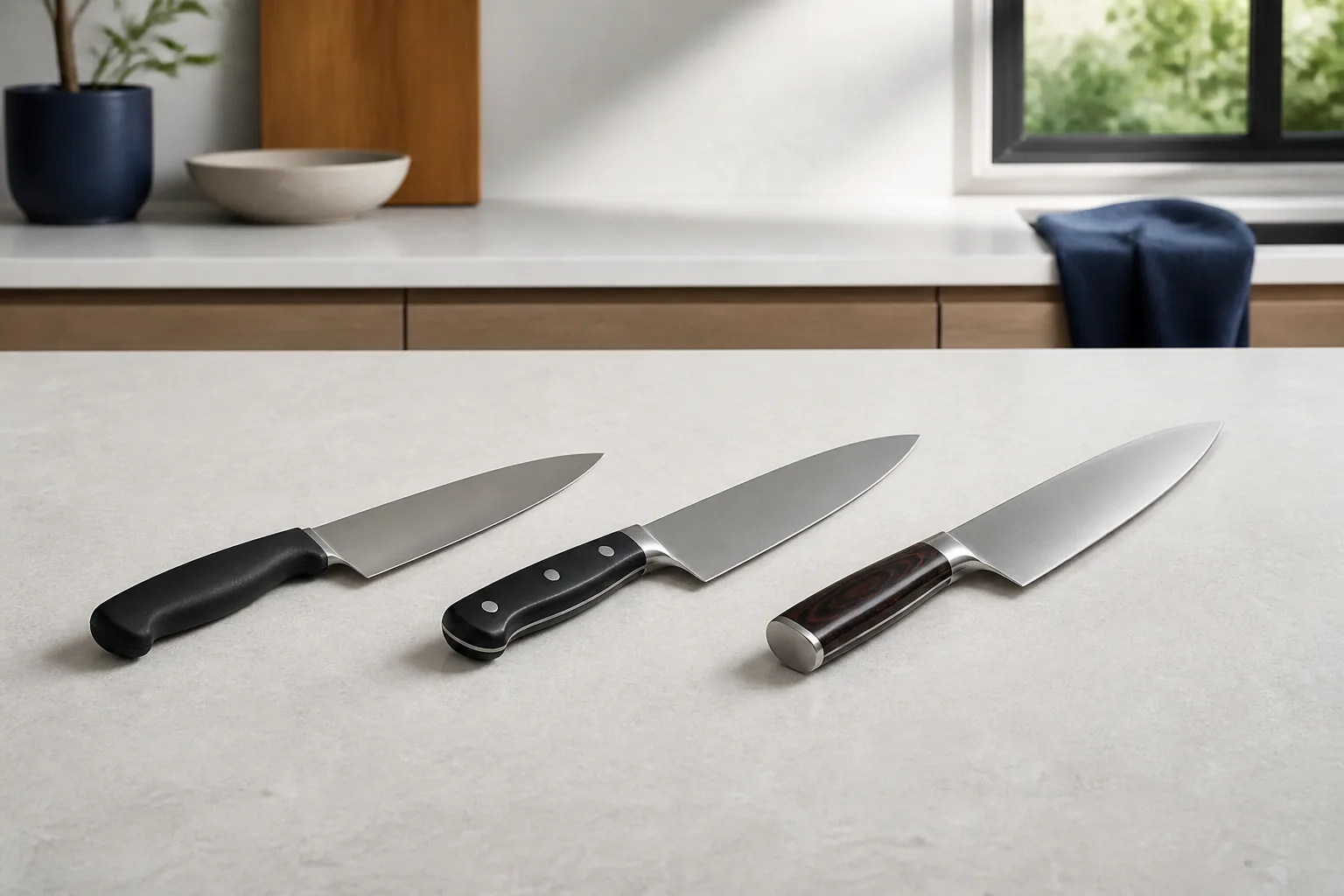
For most home kitchens, the Victorinox Fibrox 8-inch is the sensible first chef’s knife. Its stamped 7.9-inch blade, light 6.4-ounce build, and textured thermoplastic handle make it forgiving when hands are damp and easy to steer through a long prep session. It is not an heirloom-looking knife, and its edge needs ordinary maintenance, but it puts money into function instead of polish. A cook who prefers a heavier, forged German knife should move to the Wüsthof Classic 8-inch. Anyone who makes fine vegetable cuts and is willing to use a gentler technique should consider the thinner MAC MTH-80.
A chef’s knife earns its keep across almost every savory recipe, including prep for dishes made on one of our favorite electric griddles. Keep the edge away from the sink and wash it with a mild option from our dish-soap guide; the kitchen hub has the rest of our countertop and cookware advice.
Quick picks
| Pick | Best for | Defining facts | Main compromise |
|---|---|---|---|
| Victorinox Fibrox 8-Inch Chef’s Knife | best practical pick | 7.9-inch stamped straight-edge blade; 6.4 ounces; textured TPE handle; Swiss made; lifetime warranty against material and workmanship defects | a refined handle, forged construction, or substantial blade weight |
| Wüsthof Classic 8-Inch Chef’s Knife | for a substantial forged knife | forged in Germany; full tang; 8-inch blade; 58 HRC; approximately 1.9-inch blade width; limited lifetime warranty | buyers seeking a light laser-like blade or easy sharpening behind a full bolster |
| MAC Professional MTH-80 | upgrade for precise vegetable work | approximately 8-inch blade with a thin profile, dimples above the edge, and a Western-style handle | people who twist through joints, cut frozen food, or leave knives loose in a sink |
| Mercer Culinary Millennia 8-Inch Chef’s Knife | budget and first-apartment pick | stamped high-carbon stainless blade; textured ergonomic handle; protective finger points | buyers who want premium fit, a balanced forged feel, or a knife bought for decades of sharpening |
| Global G-2 8-Inch Cook’s Knife | for a slim all-metal handle | one-piece visual design with stainless-steel handle, dimpled grip, and an approximately 8-inch blade | anyone who finds metal handles slippery, prefers a pronounced bolster, or has not tried this grip shape |
The alternate knives solve different handling problems. A shorter blade gives up board reach for control, while a heavier German profile favors force and durability over a laser-like feel. Choose the geometry and maintenance burden that suit your cooking, even when that means passing on the nominal top pick.
1. Victorinox Fibrox 8-Inch Chef’s Knife: best practical pick
Best for: home cooks who value control, grip security, and low replacement anxiety. Skip it if: you want a refined handle, forged construction, or substantial blade weight.
The broad blade gives useful knuckle clearance, while the low mass makes repeated chopping less tiring. The Fibrox handle looks commercial and can feel oversized to very small hands, but its texture is useful when working quickly. Victorinox says it is dishwasher safe; hand washing remains the better ownership habit because a dishwasher exposes an edge to knocks, heat, and aggressive detergent.
The relevant specification set is 7.9-inch stamped straight-edge blade; 6.4 ounces; textured TPE handle; Swiss made; lifetime warranty against material and workmanship defects. Together, those details explain why this model is the default without pretending that it wins every contest. Its advantage applies across the broadest share of the intended routine, and its drawbacks are visible before purchase rather than hidden in a subscription or unusual consumable.
Use the Victorinox Fibrox 8-Inch Chef’s Knife Amazon search to match the complete model number and included parts. Similar-looking bundles may omit an accessory or carry different seller-backed support.
2. Wüsthof Classic 8-Inch Chef’s Knife: for a substantial forged knife
Best for: cooks who like a planted, handle-forward feel and a durable all-purpose profile. Skip it if: buyers seeking a light laser-like blade or easy sharpening behind a full bolster.
The Classic feels more deliberate than the Victorinox. Its curved belly supports rocking cuts, and the weight can help through dense squash and large root vegetables. The traditional bolster and thicker geometry are less nimble for very fine slices; the bolster also complicates sharpening near the heel as the blade wears. Hand wash and dry immediately, as Wüsthof directs.
Its case rests on forged in Germany; full tang; 8-inch blade; 58 HRC; approximately 1.9-inch blade width; limited lifetime warranty. That is a different proposition from the main pick, aimed at a buyer with a firmer preference. Compare the alternate on that preference first. A prettier finish or a temporary discount should not outweigh the physical constraint it is meant to solve.
Before ordering, compare current variants in the Wüsthof Classic 8-Inch Chef’s Knife Amazon results. Check the manufacturer name, model suffix, voltage, and warranty eligibility rather than relying on the thumbnail.
3. MAC Professional MTH-80: upgrade for precise vegetable work
Best for: confident cooks who use a push-cut or controlled rocking motion and want less wedging in firm produce. Skip it if: people who twist through joints, cut frozen food, or leave knives loose in a sink.
The MTH-80 is the choice when clean passage through onions, carrots, and herbs matters more than a heavy German feel. Its thin edge rewards an accurate stroke and a suitable board. The dimples may reduce contact on some sticky foods, but they do not make slices fall away in every circumstance. Treat it as a precision tool rather than a small cleaver.
The specialist value comes from approximately 8-inch blade with a thin profile, dimples above the edge, and a Western-style handle. Pay for it only if the matching task appears often enough to shape the week. Used outside that niche, the same design can be less convenient than a plainer general-purpose model, particularly when storage and cleanup enter the calculation.
The MAC Professional MTH-80 search may show several sizes or generations. Select only the version whose specifications match this guide, and treat add-on bundles as separate value decisions.
4. Mercer Culinary Millennia 8-Inch Chef’s Knife: budget and first-apartment pick
Best for: students, occasional cooks, and households that need a capable spare without an upgrade price. Skip it if: buyers who want premium fit, a balanced forged feel, or a knife bought for decades of sharpening.
Mercer’s Millennia keeps the decision simple. The handle is grippy, the blade profile is familiar, and replacing it is less painful if several people share a kitchen. The compromise is finish: the spine, balance, and handle transitions are utilitarian. It is a good platform for learning a pinch grip and basic honing without treating every scratch as a crisis.
The budget equation includes stamped high-carbon stainless blade; textured ergonomic handle; protective finger points. It preserves the central job and accepts clearer compromises in materials, controls, or long-term convenience. That is a sound exchange for light or shared use; it is false economy when the omitted refinement affects every session.
Marketplace stock for Mercer Culinary Millennia 8-Inch Chef’s Knife can mix current and older packages. Verify the model on the product label, what is in the box, and who handles a return before choosing the lowest listing.
5. Global G-2 8-Inch Cook’s Knife: for a slim all-metal handle
Best for: cooks whose hands suit the narrow handle and who want a light, visually minimal knife. Skip it if: anyone who finds metal handles slippery, prefers a pronounced bolster, or has not tried this grip shape.
The G-2 is polarizing in a useful way: its handle immediately tells you whether it belongs in your hand. The seamless metal form is easy to wipe clean, and the blade is lively. Yet the narrow, dimpled handle offers less cushioning than molded or riveted alternatives. If possible, hold one before buying; handle fit matters more here than small differences in published steel specifications.
This outlier is defined by one-piece visual design with stainless-steel handle, dimpled grip, and an approximately 8-inch blade. Its unusual form or feature set can be exactly right for the stated buyer, yet it deserves more scrutiny than the default. Confirm ergonomics, compatibility, and service parts because a distinctive design tends to magnify both delight and irritation.
Confirm color, size, and regional version in the Global G-2 8-Inch Cook’s Knife search. Those choices can affect fit or included components even when the family name stays the same.
How to choose without overbuying
Start with the physical job, frequency, and ownership burden. Features that do not change those three things are usually distractions. The criteria below are the ones most likely to alter the recommendation.
Geometry matters more than prestige
A thinner blade moves through carrots and potatoes with less wedging, but it gives you less margin for twisting and lateral force. A thicker German-style profile tolerates general work and often supports rocking, though it can split dense produce before the edge completes the cut. Neither is universally superior. Match geometry to technique.
Make “geometry matters more than prestige” an elimination test. If the product cannot meet the routine on an ordinary day, extra modes will not rescue the purchase. Verify the exact model in the current manual because retailer summaries often collapse related versions.
Eight inches is the useful middle
An 8-inch blade spans most onions, cabbage wedges, and roasts without becoming awkward on an ordinary board. A 6- or 7-inch knife can suit small hands and cramped kitchens. A 10-inch knife adds reach for bulk prep but needs more board and better tip awareness.
List the foods you cut every week. Someone mostly trimming herbs, citrus, and boneless meat may prefer a compact blade; frequent cabbage, squash, and melon prep rewards more length and knuckle clearance. That ordinary workload is a better sizing tool than the largest ingredient you cut once a year.
Handle fit cannot be reduced to a measurement
A pinch grip places much of the control at the blade, yet handle circumference, texture, and the transition behind the heel still affect comfort. Full bolsters can feel reassuring but reduce usable heel area and complicate sharpening. Metal handles clean easily but are not automatically secure for every hand.
Blade steel and edge angle do not tell the whole story. Check the maker’s sharpening guidance, corrosion warnings, handle-care instructions, and whether the knife belongs in a dishwasher. A thin, hard edge can stay keen yet tolerate less twisting or contact with bones than a tougher, thicker grind.
Steel numbers have limits
Hardness and alloy influence edge retention, toughness, and sharpening, but heat treatment and blade geometry also matter. A harder, thinner edge may stay keen longer while being less tolerant of impacts. For a shared household, easy maintenance can be worth more than maximum theoretical retention.
A shared kitchen changes the recommendation. If knives are likely to land loose in a sink or drawer, prioritize a forgiving edge and add a sheath or block. A more delicate Japanese-style knife makes sense only when every regular cook will use a board, hand-wash it, and avoid prying.
Plan for sharpening before buying
A honing rod realigns a fatigued edge on suitable knives; it does not replace removed steel or repair chips. Eventually every working knife needs sharpening. Choose a local service, guided system, whetstones, or manufacturer service that you will actually use.
Budget for a suitable cutting board and periodic sharpening, not a drawer full of specialty blades. A well-maintained chef’s knife can handle most prep. Paying more is worthwhile when the handle, balance, and blade profile fit; decoration and an oversized set add little to the cut.
Setup, care, and ownership
A good purchase can become frustrating through poor placement, a skipped manual step, or neglected cleaning. These practices protect performance and make the limitations visible before they become failures.
- Use wood, quality plastic, or a suitable rubber board; glass, stone, and ceramic boards dull edges rapidly.
- Wash the blade soon after use and dry it from spine toward edge. Never leave it hidden in cloudy sink water.
- Store it in a fitted sheath, block slot, drawer insert, or magnetic strip that does not bang the edge against metal.
- Cut with forward, backward, or rocking motion. Do not scrape the board with the sharp edge; turn the knife over and use the spine.
- A chef’s knife is not for bones, frozen blocks, jar lids, or prying. Use a cleaver, saw, or appropriate tool.
Wash and dry a chef’s knife soon after use, store the edge where it cannot strike other utensils, and follow the maker’s sharpening angle. Retire a knife with a loose handle, deep crack, or badly damaged edge until it can be professionally assessed. A honing rod realigns some edges but does not replace removed steel.
Credible competition
The Tojiro DP Gyuto remains a credible path into a thin Japanese-style blade, but its harder edge and less forgiving finish make it a more technique-dependent first purchase than the Fibrox. Shun’s Classic 8-inch offers polished presentation and a distinctive D-shaped handle, yet left-hand fit and a higher replacement cost narrow its audience. Zwilling’s Pro 8-inch is a serious forged German alternative; its curved bolster may appeal to a pinch grip, though buyers should compare its weight and profile directly with the Wüsthof. Made In and Misen sell attractive Western chef’s knives, but neither displaces the Victorinox on utilitarian value or the MAC on thin-blade precision in this lineup.
A discount on another knife matters only if its blade length, profile, handle, and care requirements still fit the cook. Confirm the exact series because similarly named lines can use different steels or construction. Also check that sharpening support and warranty service remain available for an older model.
How we researched
For this guide, we compared current maker specifications, care directions, construction details, blade dimensions, and warranty language. The recommendations distinguish handle and edge trade-offs from advertised sharpness. We did not cut food with these knives or measure edge retention.
Steel labels and hardness numbers can suggest behavior, but they do not prove comfort or cutting performance on their own. We avoided short-lived prices and treated subjective maker terms as descriptions, not test results. Use the Amazon search link to confirm the exact blade length and series before ordering.
Frequently asked questions
Should a first chef’s knife be German or Japanese?
Choose by behavior, not nationality. A moderately thick Western profile is usually more tolerant of rough shared-kitchen use. A thinner Japanese-style gyuto can cut produce with less resistance but deserves a straight stroke, a forgiving board, and no twisting. The Victorinox occupies a friendly middle ground.
How often should I sharpen it?
There is no honest calendar answer. Frequency depends on board material, technique, steel, and use. Sharpen when the knife slips on tomato skin, crushes herbs, or requires unsafe force after appropriate honing. A frequently used home knife may need professional sharpening a few times a year; light use may stretch much longer.
Can I put a chef’s knife in the dishwasher?
Even when a maker labels a knife dishwasher safe, hand washing protects the edge and handle from collisions, harsh detergent, and prolonged moisture. It also prevents someone reaching into a machine near an exposed blade.
Is a granton or dimpled blade nonstick?
No. Hollows can reduce contact with certain slices, but moist potatoes, cheese, and squash may still cling. Blade thinness, surface finish, food moisture, and cutting motion all influence release.
Do I need a knife set?
Usually not. A chef’s knife, paring knife, and serrated bread knife cover most home tasks. Spend on the knife you use every day and add specialist shapes only after a recurring job exposes a real gap.
Final recommendation
Victorinox Fibrox 8-Inch Chef’s Knife is the default for home cooks who value control, grip security, and low replacement anxiety because 7.9-inch stamped straight-edge blade; 6.4 ounces; textured TPE handle; Swiss made; lifetime warranty against material and workmanship defects. Skip it when you want a refined handle, forged construction, or substantial blade weight; that is precisely why the alternatives above exist. Verify the model number and plan for the stated care before ordering.