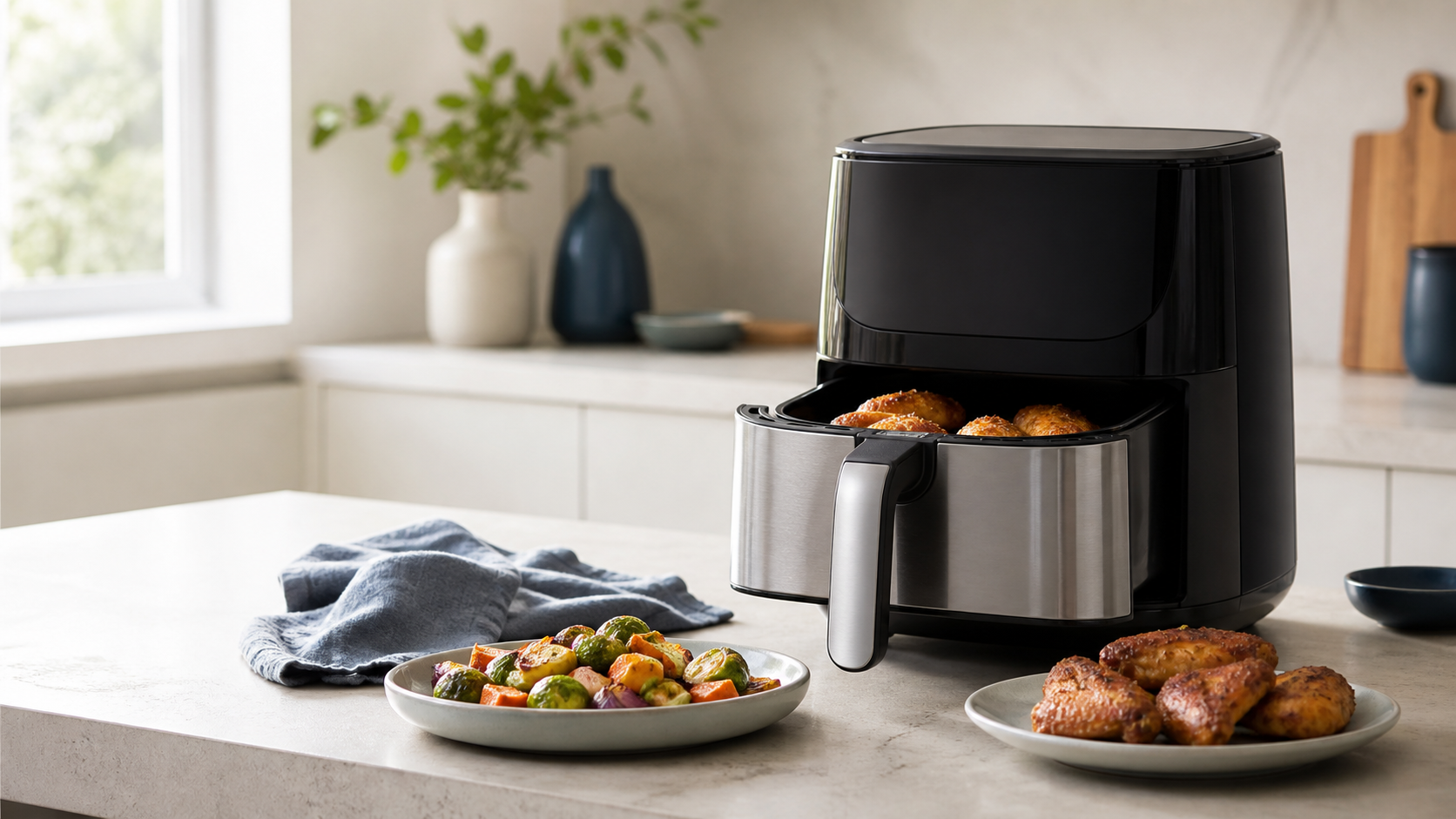
A good air fryer is a compact convection oven with a useful trick: its basket keeps food in the path of hot moving air. That makes it excellent for small batches of vegetables, frozen snacks, reheating, and crisping without waiting on a full-size oven. For most people, the Instant Vortex Plus 6-quart ClearCook is the sensible place to start. It has the capacity most one- to four-person kitchens can use, a window that helps prevent needless basket-opening, and a straightforward set of cooking modes. Its compromise is equally straightforward: one basket means sides and mains still have to take turns.
If dinner often involves two foods with different temperatures or finish times, the Ninja Foodi DZ201 DualZone is the better fit. Its two four-quart drawers can run independently, then use Smart Finish to bring both foods to the table together. It earns that convenience with a larger footprint and more parts to clean. For a single-basket model with a broader temperature range, the Cosori TurboBlaze 6-quart is worth the higher price when its 90°F–450°F range and additional programs suit the way you cook.
Quick picks
| Pick | Why it fits | Know before you buy |
|---|---|---|
| Instant Vortex Plus 6QT ClearCook Best for most kitchens | Six-quart basket, cooking window, 1700-watt heating system, and six useful functions without turning the controls into a project. | It is a single basket. A main and side must be cooked in sequence unless their temperatures and timing line up. |
| Ninja Foodi DZ201 DualZone Best for two foods at once | Two independent four-quart baskets, Match Cook for duplicate settings, and Smart Finish for different cook times. | It occupies more counter space and each side has less usable room than one wide basket. |
| Cosori TurboBlaze 6QT Best higher-heat single basket | Six-quart capacity, 90°F–450°F range, and a set of programs that includes air fry, roast, bake, broil, reheat, dehydrate, proof, frozen, and keep warm. | Extra modes are only an advantage if you will use them. It does not solve the single-basket timing problem. |
The right first air fryer is usually a six-quart basket
Most people do not need a miniature oven with a dozen accessories. They need something that can make a plate of vegetables, a modest batch of wings, a few portions of salmon, or a bag of frozen food without heating the whole kitchen. A six-quart basket hits that middle ground better than the tiny two- and three-quart machines that look tempting on a shelf. It is large enough to hold a real dinner component in a reasonably shallow layer, yet it is still easier to find a home for than an oven-style model with doors and trays.
That is why the Instant Vortex Plus 6QT ClearCook is our pick for most buyers. Instant lists a six-quart capacity, six cooking functions—air fry, roast, broil, bake, reheat, and dehydrate—and 1700 watts of power. The feature that changes day-to-day use is less glamorous: the ClearCook window and interior light. You can check browning before pulling the basket out. That matters because every unnecessary peek slows the cook and interrupts the hot airflow that makes this style of appliance useful.
The controls are a better match for a first air fryer than a screen covered in vague presets. You can choose a mode, set a temperature and time, and use a preset when it happens to match the food. The basket and tray are dishwasher-safe, though a quick soak and a non-abrasive sponge are often kinder to a nonstick surface than treating the dishwasher as the only cleaning plan. The appliance measures about 14.9 by 11.8 by 13 inches, so measure the depth of your counter before assuming that a six-quart model is small.
Its limitation is not a flaw; it is the point of the design. A single basket works best when the meal is one thing at a time or when components can share the same temperature. If you are feeding two people, that often means crisping vegetables while a protein rests, or doing the protein first and holding it briefly while the side finishes. If that rhythm sounds irritating, skip this pick and go directly to a two-basket machine. Buying an air fryer that matches your actual dinner sequence is more important than buying the one with the most functions.
Choose the Ninja DZ201 when two baskets will change dinner
The Ninja Foodi DZ201 is for a more specific problem: you want to cook a main and side at the same time, but they need different temperatures or different cook lengths. The machine has two independent four-quart baskets for eight quarts total. Ninja’s DualZone system includes Smart Finish, which coordinates different settings so both baskets finish together, and Match Cook, which copies the first basket’s settings to the second when you are making a larger quantity of the same food.
Those controls make a practical difference on a weeknight. A tray-style basket cannot make asparagus and breaded chicken finish at the same moment without a little coordination. Separate drawers can. The benefit is clearest for households that repeatedly cook a protein and a vegetable, parents making a plain component alongside a seasoned one, or anyone who wants frozen fries and something else ready at once. The six functions—air fry, air broil, roast, bake, reheat, and dehydrate—cover the same core work as the Instant. The reason to spend more is not the mode count. It is the ability to split a meal.
There are two costs. First, the body is broad. Leave clearance around the rear and sides as the manual directs, and do not buy one based only on its total capacity. Second, each basket is smaller than a six-quart single basket. Two baskets are more flexible, but a large flat item can be easier to arrange in one wide drawer. A couple cooking one vegetable and one protein will likely appreciate the Ninja. Someone who mostly reheats leftovers, roasts one bag of vegetables, or cooks for one may find that two drawers simply create twice the cleanup.
It is also worth being honest about capacity language. “Eight quarts” describes the combined volume, not one uninterrupted cooking surface. That is ideal for separate foods. It is less useful when you want to lay out a broad layer of one item. Think about your most common dinner, not the largest party meal you imagine making once. If your answer is chicken on one side and potatoes on the other, the DZ201 earns its place. If it is a single batch of crispy tofu, a single basket is usually the calmer choice.
The Cosori TurboBlaze makes sense for cooks who use the range
The Cosori TurboBlaze 6-quart is the upgrade single-basket choice for someone who will use more than the air-fry button. Cosori specifies a 90°F–450°F range, which adds a lower setting for drying and proofing and a higher ceiling for browning-oriented cooking. Its listed programs include air fry, roast, bake, broil, dehydrate, proof, frozen, reheat, and keep warm. That is a useful set when you already treat a small convection appliance as part of your cooking routine.
The 450°F maximum is a reason to look at this model, but it should not be treated as a guarantee that every recipe will become better. Basket shape, food size, crowding, coating, and the amount of moisture on the food still decide a lot. The extra range gives you more control; it does not repeal the basic rule that food browns when air can reach it. A buyer who just wants frozen snacks and quick vegetables may not need to pay for controls they will ignore.
Pick the TurboBlaze if you expect to make use of the extra modes, like the idea of a higher maximum temperature, and still prefer one generously sized basket. Do not pick it because it sounds more advanced. The Instant is easier to recommend to a person who wants a simple first machine, while the Ninja is the better answer for different foods on different schedules. Those are more consequential distinctions than a few additional labels on a control panel.
Capacity is really about surface area and dinner habits
Air-fryer capacity is the most misunderstood specification. The number of quarts tells you how much the basket can hold, but it does not tell you how much food can brown well at once. Air frying depends on moving hot air. When a basket is packed tightly, the food steams against itself and the exposed pieces brown faster than the buried ones. A larger machine helps, but only if its shape gives food room to sit in a fairly open layer.
For one or two people, a four- to six-quart single basket is normally enough. A six-quart machine is the safer bet if you want leftovers or make vegetables regularly. For a family, choose between a larger single basket and a dual basket by looking at what you cook together. A large single basket is useful for one component in a wider layer. Dual baskets are useful for two components with different settings. Neither replaces a full oven for a sheet-pan dinner, and neither is especially good at cooking enough food for a crowd without working in rounds.
Do not buy an air fryer to replace every pan in your kitchen. It is a specialist that earns its counter space through repetition: crisp vegetables without warming the house, efficiently reheated pizza, small batches of protein, and the freezer foods that otherwise tempt you to use the oven for too long. If you are building a practical kitchen from scratch, our kitchen setup guide can help decide which appliances deserve permanent space and which are better kept optional.
Basket, oven-style, or dual zone?
For most readers, a basket-style air fryer is the best starting point. The basket is direct, heats quickly, and makes it easy to shake or turn small foods. It also usually has fewer trays and accessories to wash. A single-basket machine is the least complicated version; a dual-zone machine adds timing flexibility.
Oven-style air fryers use a front door and racks. They can be useful for toast, a small pizza, or multiple shallow trays, but their larger cavity may take longer to heat and their tray arrangement can make rotating food more fiddly. They are worth considering when you specifically want a countertop oven first and an air fryer second. They are a poor default when your goal is a fast basket for weeknight components.
Dual-zone models are neither automatically better nor simply larger. They solve a timing problem. If you keep imagining two foods that must finish together, they are easy to justify. If you generally make one large component, they can divide useful space into two smaller compartments. This is the choice that benefits most from a simple thought exercise: name the last five things you cooked. If those meals regularly had two components at different temperatures, pick two baskets. If not, keep the machine simpler.
What matters more than presets
A basket you can actually clean
Every air fryer will become unpleasant if grease and crumbs are allowed to bake on between uses. Look for a removable crisper plate, a basket with uncomplicated corners, and instructions that make clear which parts can go in the dishwasher. A dishwasher-safe label is useful, but cleanup is often fastest when the basket is rinsed or soaked shortly after dinner. Avoid metal utensils and harsh scouring pads on nonstick parts. If a coating is badly damaged, check the maker’s support information for replacement parts rather than treating the appliance as disposable.
Real counter clearance
Measure width, depth, and the room above the appliance before ordering. Do not slide an air fryer under a cabinet and assume its footprint is the whole story. It needs ventilation clearance, and the handle adds reach when the basket is open. A compact-looking machine can also be heavy enough that moving it in and out of a cupboard becomes a chore. The air fryer that stays accessible is the one that gets used.
Controls you will not resent
Presets are not recipes. They are starting points with a name attached. Temperature and time adjustments, a readable display, and a clear pause function matter more. A viewing window is genuinely helpful if it prevents repeated opening. Dual baskets need controls that make it obvious which drawer you are adjusting. Fancy connectivity is low on our list because it does not change the basic need to season, arrange, shake, and check food properly.
Temperature range with a purpose
Most air fryers reach the temperatures needed for their core job. A wider range can be useful for dehydrating or proofing, and a higher maximum can help with a particular style of browning. It is not a substitute for space around food. When comparing two otherwise similar models, choose the better basket shape and controls before chasing a few degrees at the top end.
How to get better results from any air fryer
Dry the surface of fresh food when a recipe calls for browning. Add a little oil when it helps a coating or vegetable crisp, but do not pour oil into the bottom of a basket. Arrange food with some open space, cook in batches when needed, and shake or turn pieces midway through. Those small habits matter more than the difference between most midrange machines.
Use parchment liners cautiously. A loose liner can lift into the heating element if it is not weighed down by food, so follow the appliance manual and do not preheat with an empty liner. Perforated liners are generally more compatible with airflow than a solid sheet, but they still reduce how much air reaches the underside. A bare crisper plate is often the best starting point.
For meat and poultry, treat an air fryer like any other cooking appliance: use a food thermometer and cook to the appropriate safe internal temperature. Poultry should reach 165°F at the thickest part. Do not judge doneness by color alone, and keep raw food and the finished food separate during prep. Those rules matter far more than a preset labelled chicken.
An air fryer also shines as a supporting appliance. Make pancakes or breakfast sandwiches on an electric griddle, then use the basket for potatoes or bacon. It can make a dessert garnish or warm a small accompaniment while a crepe pan or maker handles the main event. That is a more realistic way to use it than trying to make every course inside one drawer.
When an air fryer is not the right purchase
Skip an air fryer if your kitchen has no spare counter space, if you mainly cook large pans of food, or if you already own a convection toaster oven that you use happily. You may get more value from a reliable skillet, a well-chosen sheet pan, or a sharp knife. An air fryer is particularly poor at dishes that need a deep pot, a lot of liquid, or a wide surface for stirring.
It is also not a magic way to avoid washing dishes. You will still clean the basket, tray, utensils, and any splatter around the cooking area. If cleanup is the thing that keeps you from using appliances, make the decision based on basket design and where you will store it. Once it is in the kitchen, a good dish soap and a short post-meal rinse will do more for longevity than any special accessory bundle.
Other air-fryer directions to consider
A compact air fryer can make sense in a studio apartment or for a solo eater with very limited space. The drawback is that the smallest baskets force frequent batches, which can turn a supposedly quick dinner into a sequence of small cooks. Buy compact only when storage is the deciding constraint, not because you expect a two-quart basket to behave like a six-quart one.
Large oven-style models can be appealing to a household that wants a countertop toaster oven with an air-fry mode. They are better at toast and some tray-based jobs, but they are more complicated to clean and can lose the immediate simplicity that makes basket air fryers worthwhile. If you are comparing them, decide first whether you want an oven replacement or a crisping tool. The answer will narrow the field quickly.
There are also models with integrated probes, rotating baskets, windows, and elaborate accessories. Those features can be useful in a particular kitchen, but they should follow the core decision: basket size, layout, controls, and cleanup. A machine you understand and use three times a week beats an elaborate one whose accessories live in a drawer.
How we researched this guide
We compared current manufacturer specifications, manuals, warranty terms, product availability on Amazon, and the practical constraints that determine whether an air fryer works in a home kitchen: basket layout, temperature range, cleaning process, counter footprint, and the ability to coordinate a meal. We did not perform hands-on laboratory testing or claim a personal cooking trial. Recommendations favor models with a clear role and published specifications rather than a long list of indistinct alternatives.
Our recommendation
Buy the Instant Vortex Plus 6QT ClearCook if you want one dependable basket for regular small meals and do not mind cooking components in sequence. Buy the Ninja DZ201 if synchronized main-and-side cooking is the reason you are shopping. Choose the Cosori TurboBlaze if you know you will use its wider temperature range and extra programs. The most useful air fryer is not the largest or most feature-packed model. It is the one whose basket layout matches the meals you make on an ordinary Tuesday.