For an extra dining chair that spends most of its life in a closet, buy the IKEA GUNDE. It folds to a slim profile, arrives assembled, locks open, and is light enough to carry with one hand. It is not the chair to put out for a four-hour dinner. For guests who will sit longer, the solid-beech IKEA FRÖSVI is the better indoor-looking option, though its unpadded seat still has limits. Outdoor chairs are a different decision: choose the GCI Outdoor Freestyle Rocker for relaxed patio or campsite sitting, and the REI Co-op Flexlite Camp Chair when the chair has to fit in a car trunk, a pannier, or a compact storage bin.
The phrase “folding chair” covers four very different things: an occasional guest seat, a dining chair that needs to disappear after dinner, a lawn chair, and a small backpacking chair. Start by deciding which job you need. Then measure the folded chair against the closet, under-bed gap, trunk opening, or balcony wall where it will live. A comfortable chair that will not fit its storage spot becomes clutter immediately.
Quick picks
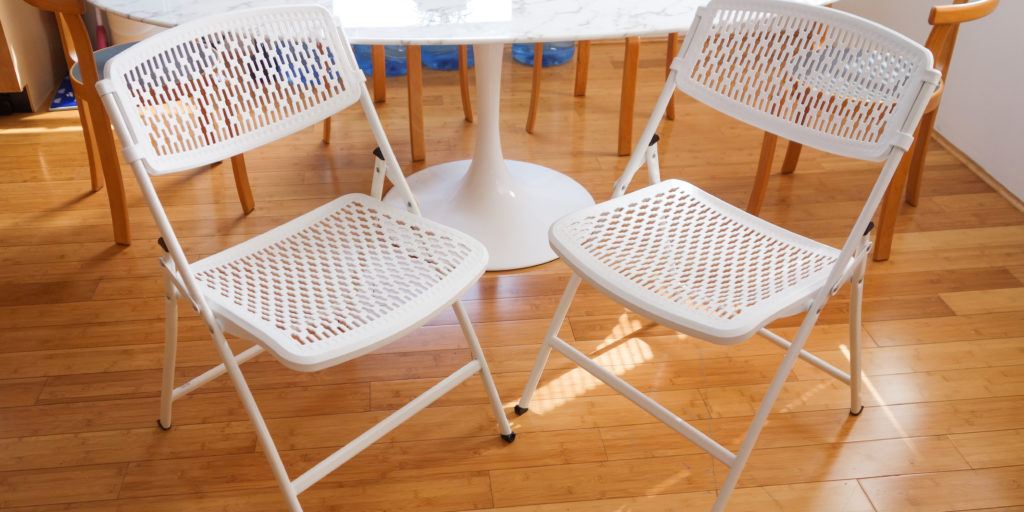
- Best low-cost chair for occasional guests: IKEA GUNDE. A 4-pound-13-ounce indoor chair with a galvanized-steel frame, polypropylene seat and back, open-position lock, and a 220-pound tested limit. It is the space-saving pick for short meals and extra guests. Check the IKEA GUNDE on Amazon.
- Best folding chair that looks at home indoors: IKEA FRÖSVI. A solid-beech chair with a 243-pound tested limit, a conventional dining-chair height, and a wall-hanging hole. It is more presentable than a plastic guest chair but not cushioned. Check the IKEA FRÖSVI on Amazon.
- Best for a patio, tailgate, or campsite: GCI Outdoor Freestyle Rocker. This 11.8-pound steel chair folds flat, has a carry handle and cup holder, and uses a spring-action rocker on firm ground. It is for comfort after arrival, not tiny closets. Check the GCI Freestyle Rocker on Amazon.
- Best when packed size matters: REI Co-op Flexlite Camp Chair. A 1-pound-11-ounce, 250-pound-capacity chair that packs to 4.5 by 15 inches. Its low 11-inch seat is excellent for camp and poor for a dining table. Check the REI Co-op Flexlite Camp Chair on Amazon.
Buy the IKEA GUNDE when storage and price are the whole point
The GUNDE makes sense for the common problem: you have a table for two, occasionally host six, and do not want six chairs visible all year. IKEA lists the chair at 16 1/8 inches wide, 17 3/4 inches deep, and 30 3/4 inches high when open. The packed thickness is 2 3/4 inches, and the chair weighs 4 pounds 13 ounces. That thin folded profile makes a few of them much easier to keep beside a refrigerator, behind a door, in a hall closet, or on wall hooks than a conventional upholstered chair.
The details are simple but appropriate. Its galvanized-steel frame supports a polypropylene seat and back. A cutout in the backrest works as a carry handle, and the chair locks in the open position so it does not fold when a guest shifts their weight. IKEA tests it to 220 pounds and specifies it for indoor use. It comes assembled. All of that is exactly what an occasional chair should offer: quick setup, plain cleaning, and no parts to lose.
Its limitation is equally clear. The seat is 14 5/8 inches wide and 13 3/8 inches deep, with no padding or arms. That is enough for a meal, a card game, or a spare work seat, but it is not a long-evening lounge chair. The 220-pound tested limit also means it should not be presented as a one-size-fits-all guest solution. If a chair will be used weekly or if comfort for a wider range of guests matters more than the lowest cost, move to the FRÖSVI or a sturdier conventional folding chair.
Use floor protectors on hardwood or tile, particularly if the chairs are pulled out in a hurry. Keep the hinges free of crumbs and store the chairs dry. The GUNDE is not elegant enough to be the permanent seating in a formal dining room, but it is much better than buying flimsy event chairs that wobble after a few uses. For a small home, unglamorous competence is a real advantage.
The IKEA FRÖSVI is the better pick for a dining room or kitchen
The FRÖSVI answers a different question: how do you keep extra chairs without making the room look like a community hall? It has a solid-beech frame, a 243-pound tested limit, and dimensions closer to an ordinary dining chair. IKEA lists a 17 3/8-inch width, 20 1/8-inch depth, 30 3/8-inch height, and an 18 1/8-inch seat height. The folded chair weighs 6 pounds 6 ounces, so it is still easy to move, while the wood construction gives it a more considered appearance than molded plastic.
It also folds and has a hole in the seat for wall storage. That feature matters when a closet is already full; a row of folded chairs can hang on robust hooks in a utility area rather than lean against a wall. Since the chair is intended for indoor use, that hanging spot should stay dry and away from the door swing. The classic proportions make it a better match for a dining table than the GUNDE, particularly when a guest will be sitting through a meal rather than stopping by for ten minutes.
There is no magic in solid wood. The FRÖSVI is not padded, and its 13-inch seat depth is still relatively short. People who need generous thigh support, armrests, or an especially wide seat will not find that in a compact folding chair. A thin chair pad can soften it, but a pad adds bulk, has to be stored somewhere, and may slide. Choose the FRÖSVI for the owner who values a cleaner indoor look and wants a chair that can work at a dining table. Choose the GUNDE when the chair exists mainly for unexpected guests and must take up as little room as possible.
Before buying a set, try this simple check: mark a 17-by-20-inch rectangle on the floor behind the table, pull it out, and leave room for someone to pass. A chair may fit when tucked in but still make a small room awkward once every guest is seated. Folding chairs solve storage, not circulation. A narrow table or fewer permanent chairs can make the room more usable than a larger chair collection.
Use the GCI Freestyle Rocker for outdoor comfort after you arrive
The GCI Outdoor Freestyle Rocker is a folding camp chair for people who do not plan to carry it far. GCI lists a powder-coated steel frame, padded armrests, a nylon mesh back, a beverage holder, a carry handle, and a 250-pound capacity. It weighs 11.8 pounds and folds to 5.5 by 25 by 34.8 inches. Those folded dimensions are flat enough to slide beside camping gear or hang in a garage, but its nearly 35-inch length is a poor match for an under-bed storage plan.
Its appeal is the spring-action rocking mechanism. On firm, reasonably level ground, the chair can provide a relaxed motion that conventional quad chairs do not. The seat height and armrests make it easier to get in and out of than a low camping chair. That is useful around a fire pit, at a campsite, beside a trailer, or on a patio. Pair it with a cooler sized for the group rather than bringing one huge, overloaded box. The carry handle makes the walk from car to lawn manageable, but 11.8 pounds is still a lot if you are hauling chairs down a long beach or through a crowded festival.
The rocker is not an all-purpose chair. Rocking works best on a stable surface with enough clearance behind the seat. Uneven ground, deep sand, loose gravel, or a cramped balcony reduce its appeal. The chair's 24.4-inch width and 25-inch depth also need real floor space. Do not buy it for a tiny urban balcony just because it folds flat; a compact bistro chair or the FRÖSVI may leave more room to move.
For people who enjoy outdoor meals and long conversations, this chair is worth considering because it solves the comfort problem directly. For a household that wants six guest chairs stored inside, it is the wrong category entirely. Folding does not make every chair small. It only changes its shape.
The REI Co-op Flexlite Camp Chair goes places the other chairs cannot
The Flexlite Camp Chair is built around a pole-and-hub aluminum frame and a ripstop polyester seat. REI lists a packed size of 4.5 by 15 inches, a 1-pound-11-ounce weight, a 250-pound capacity, and an 11-inch seat height. It packs into a drawstring bag and is closer in size to a water bottle than to a household chair. If storage means a small hatchback, a gear tote, a bike bag, or a closet shelf, that difference is meaningful.
Its compromise is the reason it packs so well. The chair sits low, the fabric suspension is more relaxed than a dining seat, and setup requires inserting poles into fabric pockets. That is normal for a camp chair, but it is less convenient for a guest arriving for dinner or anyone who has trouble standing from a low seat. The 25-by-20-by-20-inch open footprint is compact, yet it needs all four feet on reasonably stable ground. On soft sand or mud, small feet can sink; a groundsheet or wider feet can help, but that is another item to carry.
This is the pick for people who have decided they will actually bring a chair. It makes a lunch break, campsite, outdoor concert, or park afternoon more comfortable without adding a bulky tube-shaped bag to the car. It is not a substitute for an indoor folding chair. If your main use is a board-game night or holiday meal, a normal-height GUNDE or FRÖSVI will be kinder to knees and will sit at the right height for the table.
Decide by folded size, seated height, and the time spent sitting
Measure the chair while it is closed
Open dimensions tell you whether the chair fits at the table. Folded dimensions tell you whether it belongs in your home. Measure the narrowest dimension of the closet, behind-door gap, storage bench, or under-bed clearance. Account for the number of chairs, too. Four chairs that are 3 inches thick create a 12-inch stack before you allow any room to grab one. Wall hooks can be useful for chairs with an appropriate hanging hole, but use hardware rated for the wall type and load.
Match the seat height to the activity
Dining and desk seating normally needs a height near a standard chair, around 17 to 19 inches from floor to seat. The GUNDE is 17 3/4 inches and the FRÖSVI is 18 1/8 inches, so both make sense at a table. The Flexlite's 11-inch seat belongs at camp, in the park, or around a low fire. A low chair can be comfortable in the right setting and inconvenient for an older guest or someone with limited mobility. Do not ask guests to solve an ergonomics problem because a chair packs beautifully.
Look at the seat, not only the stated weight limit
A weight rating is important, but the seat width, depth, arms, and edge shape affect how welcome a chair feels. A short plastic seat can be acceptable for an hour and unpleasant through a long dinner. A high-back rocker can feel supportive but monopolize patio space. A sling-style camp chair uses fabric tension rather than a flat seat. When possible, choose one sample and sit in it before buying a matching set. If buying online, compare the open dimensions against a chair you already know is comfortable.
Choose the frame for the setting
Galvanized or powder-coated steel makes sense for basic indoor chairs and rugged outdoor chairs, but check for damage to the coating after storage or wet use. Wood looks better at a dining table and can last well indoors, yet it should not live on an uncovered patio. Aluminum lowers weight for a portable camp chair but relies on a different setup and fabric-seat design. No frame material wins across all uses. The best choice is the one that matches where the chair will stay and how often it will move.
Do not pay for features that work against your space
Oversized “zero-gravity” chairs, wide director's chairs, and padded recliners can be pleasant, but they are poor answers to a storage problem. They take up more space closed, weigh more, and often need a dedicated corner. A cheap multi-pack of metal event chairs can be sensible for a community table or a large family gathering, but it may be needlessly harsh for a small apartment where the chairs will become regular seating.
Likewise, a folding chair with a cup holder is not automatically a better chair. Cup holders and side pockets help outside, where a drink has nowhere else to go. At a dining table, they add bulk without helping. Rocking mechanisms feel pleasant on a patio yet require clearance. Pick a feature because it changes the way you use the chair, not because it has been added to a product comparison.
Care and safety notes
Open each chair fully until its lock or frame is seated before anyone sits down. Keep fingers clear of hinges while folding. On smooth floors, add protective pads to chair feet and replace them when they wear through. Wipe food and grit from joints before storing chairs; debris causes squeaks and can scratch paint. Dry outdoor chairs after rain, especially around folding hardware and fabric seams.
Inspect folding chairs before a large gathering. Look for loose rivets, cracked plastic, bent tubing, frayed fabric, or a lock that no longer engages. Retire a chair with a damaged structural part instead of saving it for a lighter guest. Stated capacity is not a substitute for a sound frame, and a chair should always sit on all of its feet on level ground.
How we researched
We compared current manufacturer specifications for open and folded dimensions, seat height, weight, material, stated capacity, setup, and intended use. We selected different categories rather than pretending that a kitchen guest chair, an outdoor rocker, and a backpacking chair are interchangeable. Product prices and color availability move often, so compare the current listing and measure your storage space before ordering. We have not represented manufacturer ratings or descriptions as hands-on testing.
Folding chair questions answered
How many folding chairs should a small apartment keep?
Keep enough for the number of extra guests you genuinely host. For many homes, two to four extra chairs are more useful than a large stack. Factor in the table’s size and the walkway around it. A dining room that can seat eight on paper may be more comfortable for six once people need room to stand and pass plates.
Can folding chairs be used every day?
They can, but an occasional folding chair is rarely as comfortable or adjustable as a dedicated dining or office chair. The FRÖSVI is more appropriate for regular table use than the GUNDE because of its conventional wooden-chair form, while the GUNDE is better as a backup seat. For daily work, choose a chair designed for that task instead of relying on a folding model.
Are rocking camp chairs good on sand?
They can be used on firm sand, but the rocking action is more predictable on level, compact ground. Deep or loose sand can make a chair unstable or stop it from rocking smoothly. A low chair with wider feet or a groundsheet is often better for a beach day, especially if the chair must be carried any distance.
What is the easiest folding chair to store?
The easiest chair to store is one whose folded thickness and length match a real space in your home. The IKEA GUNDE is especially easy to stack or hang because it is thin and light. The REI Flexlite packs much smaller, but it requires assembly and sits low. Choose based on storage and use together; the smallest folded package is not always the most practical guest seat.