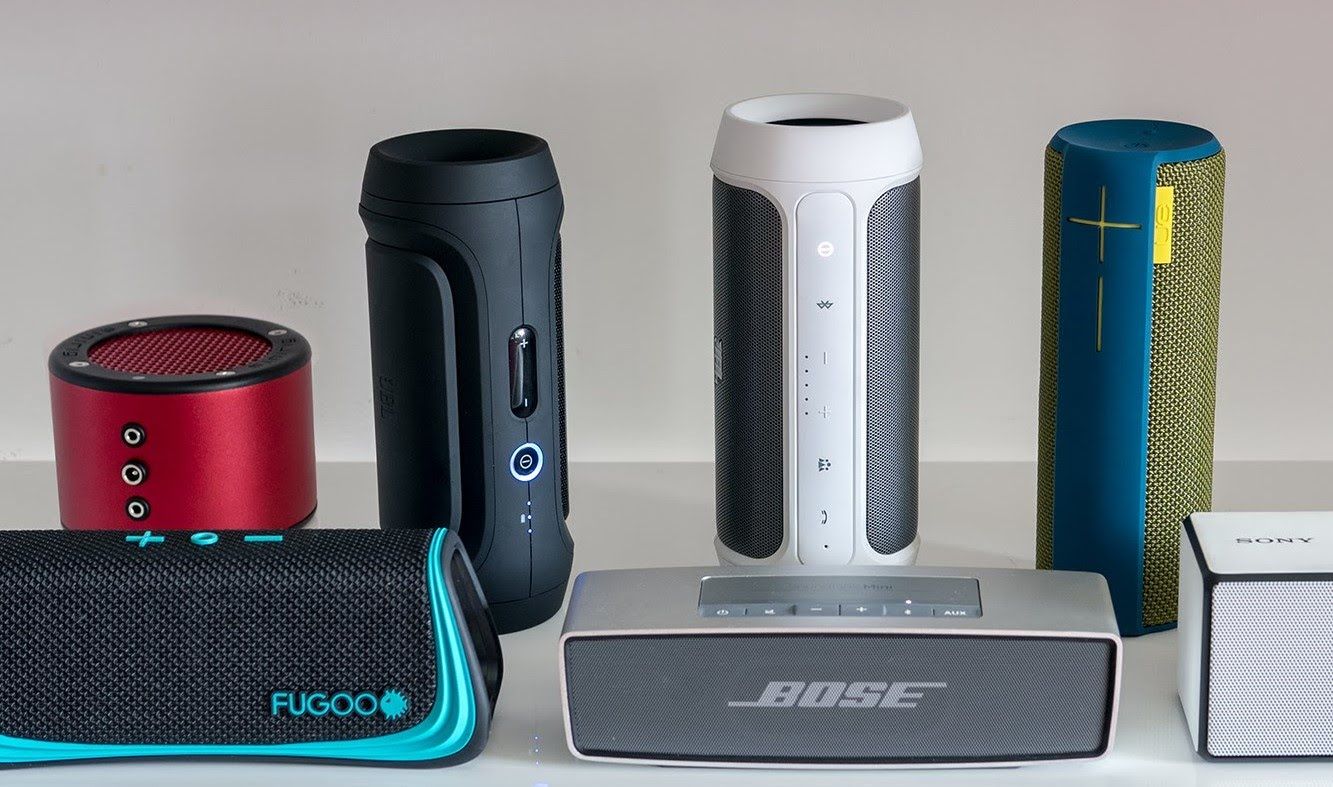
A portable Bluetooth speaker is one of those purchases that looks simple until you use the wrong one for a week. The small speaker that fits neatly in a jacket pocket can be great at a desk and disappointing at a picnic. The big battery-powered speaker that makes a patio feel lively can become dead weight in a carry-on. Start with where it will live, how far it needs to project, and how often you want to carry it.
For most people, the JBL Flip 7 is the sensible middle ground. It is small enough to bring along without much thought, has an IP68 rating, and is designed for the kind of casual listening that moves from kitchen counter to park blanket. If you regularly listen outside with a group, the JBL Charge 6 earns its extra size with more output, a much larger stated battery reserve, and a power-bank function. The Bose SoundLink Flex (2nd Gen) is the better fit for someone who values a compact, polished home-and-travel speaker with multipoint pairing. The JBL Go 4 is the inexpensive, genuinely small choice for a hotel room, desk, or personal listening—not a substitute for the larger models.
All of these speakers use Bluetooth, all charge by USB-C, and all make more sense than hauling a full-sized speaker into daily life. Their differences are not subtle, though. The right choice comes down to scale, battery expectations, water exposure, and the ecosystem you already use.
Our picks at a glance
| Pick | Best for | Why it stands out | Know before buying |
|---|---|---|---|
| JBL Flip 7 | Most people | Compact size, IP68 protection, and a useful balance of carryability and sound. | Its stated playback is up to 14 hours, not a promise at every volume. |
| JBL Charge 6 | Patios, parks, and longer days out | More power, an IP68 rating, a built-in power bank, and a much larger stated battery reserve. | At roughly 3 pounds, it is more bag item than pocket companion. |
| Bose SoundLink Flex (2nd Gen) | Home, travel, and easy device switching | Compact shape, IP67 protection, multipoint pairing, and orientation-aware playback. | It is not the long-battery, high-output option for a large outdoor group. |
| JBL Go 4 | Small budgets and very small bags | It weighs well under a pound, has IP67 protection, and is easy to keep on hand. | It is for close-range listening; physics limits its bass and outdoor reach. |
Best portable Bluetooth speaker for most people: JBL Flip 7
The JBL Flip 7 is the right starting point if you want one speaker that is comfortable at home and easy to throw in a bag. JBL lists it at about 1.82 pounds and 7.2 inches long, so it has enough cabinet volume to sound more substantial than a miniature speaker without becoming awkward on a train, at a campsite, or on a kitchen shelf. It is the size class that makes sense for most ordinary use.
JBL rates the Flip 7 IP68. In practical terms, that is reassuring for rain, a wet poolside table, and a speaker that occasionally gets dropped on a dirty patio. It is still worth treating the USB-C port with some common sense: let it dry before charging, keep sand out of it, and do not use a water-resistance rating as a reason to leave electronics submerged. A rating describes a test condition, not a lifetime guarantee against every kind of water, salt, detergent, or impact.
The Flip 7 uses a 25-watt woofer and 10-watt tweeter, according to JBL, and supports Auracast for compatible multi-speaker playback. That does not make it a replacement for a living-room stereo. It does make it a useful speaker for a few people sitting nearby, a small backyard meal, a garage project, or background music while cooking. Keep expectations tied to the room. Outdoors, where there are no walls to reinforce sound, every portable speaker seems smaller than it did at home.
JBL says the Flip 7 can provide up to 14 hours of play time. Treat that as a ceiling rather than a schedule. Loud playback, bass-heavy music, a weak Bluetooth connection, and cold weather all ask more of a battery. If you need a speaker to last from breakfast through a full day away from an outlet, charge it the night before and leave some reserve rather than planning around the marketing number.
This is not the pick for someone who wants to recharge a phone from the speaker or supply music to a large, noisy gathering. For that, move up to the Charge 6. But for the buyer who wants a speaker they will actually carry and use often, the Flip 7 has the most useful proportions.
Best for longer outdoor days: JBL Charge 6
The JBL Charge 6 makes sense when the main problem is not portability in the abstract but keeping a group entertained for a long stretch. JBL lists a 30-watt woofer and 15-watt tweeter, and the speaker is substantially larger than the Flip 7 at about 3 pounds. That added size is the point: it has more room for battery capacity and more authority in an open space.
JBL rates the Charge 6 IP68 and lists up to 24 hours of playback, with up to four additional hours through its Playtime Boost mode. The best reading of that claim is “potentially excellent endurance,” not “28 hours no matter what.” Battery-saving modes can change the listening experience, and volume remains the largest variable. Still, if you regularly take a speaker to a park, patio, campsite, team practice, or full-day cookout, the Charge 6 has the margin that the smaller models lack.
The other practical advantage is its power-bank feature. A speaker is not the most efficient thing to carry solely for phone charging, but it is genuinely useful when the speaker is already coming along. You can top up a phone or another small USB device, then continue listening. Bring a proper cable: JBL’s current product information says a USB-C charging cable is not included. If your cable drawer is a mess, our guide to the best USB-C cables is a better place to solve that problem than relying on the thin cable that happened to ship with an old device.
The Charge 6 is also the version to choose if you know that you routinely turn music up. It cannot overcome traffic, wind, or a dozen people talking at once, and no portable speaker sounds its best at maximum volume. Yet the larger enclosure gives it more breathing room before that point. Put it near the group, not at the far edge of the yard. A speaker placed at table height close to listeners usually feels more satisfying than one turned up across a large space.
Skip the Charge 6 if it will spend most of its time in a small bedroom, on a desk, or in a personal-item bag. You are paying for capacity and output you may not need. The Flip 7 is less of a commitment to carry; the Bose is a cleaner choice when compact multipoint pairing matters more than maximum endurance.
Best compact speaker for home and travel: Bose SoundLink Flex (2nd Gen)
The Bose SoundLink Flex (2nd Gen) is for the person whose speaker moves through ordinary rooms as much as it travels. Bose lists it at 1.291 pounds, with a slim, grab-friendly body, a nylon utility loop, USB-C charging, and an IP67 rating. The shape makes it easy to stand upright, lay flat, or tuck onto a shelf without making the space feel like an event setup.
Bose’s PositionIQ feature is designed to adjust playback based on orientation. That is helpful because portable speakers rarely sit in laboratory-perfect positions; they end up on a counter, a towel, a windowsill, or a hotel bedside table. It does not eliminate the effect of the room, but it reduces the penalty for using the speaker in a practical way instead of a precious one.
Multipoint pairing is the feature that makes this speaker especially easy to live with. It can remain connected to two devices, so switching between a laptop and phone does not always mean opening Bluetooth settings and starting from scratch. There is also a speakerphone function and the ability to pair compatible Bose speakers for party or stereo playback. These are convenience features, not reasons to buy a complicated system; they matter if you will use the speaker every day.
Bose lists up to 12 hours of battery life and a four-hour charging time. That is enough for most single-day use, but it is not the Charge 6’s long-haul proposition. The Flex is a better choice when your listening is typically a few hours at a time and you value a compact, flexible speaker that feels at home inside. Its IP67 rating is plenty for rain and the occasional splash, but use the same care around a wet charging port that you would with any USB-C device.
Pick the SoundLink Flex if you want a speaker that is simple to pick up, pleasant to use in a smaller room, and less fussy about switching devices. If your regular setting is a beach, a busy park, or an outdoor event, choose the larger Charge 6 instead. More speaker in the right place is better than elegant portability in the wrong one.
Best tiny speaker: JBL Go 4
The JBL Go 4 answers a different question: what can I bring when I do not want to make room for a speaker? JBL lists it at 0.69 pounds and only 3.7 inches wide. It includes a small loop, charges by USB-C, carries an IP67 rating, and is small enough to live in a day bag, desk drawer, or hotel packing cube.
JBL says the Go 4 can play for up to seven hours, with Playtime Boost offering up to two additional hours. That makes it appropriate for a short work session, an afternoon in a hotel room, or a personal soundtrack while getting ready. It is not the choice for a party, a film night with several people, or a windy picnic. A small driver cannot move the same amount of air as the drivers in a Flip 7 or Charge 6, and advertising cannot change that.
The Go 4 supports Bluetooth 5.3, multipoint connectivity, and Auracast. Those are unusually useful features for something so small, but do not buy it for specifications alone. Buy it because the smallest speaker is often the one that gets used. It is a thoughtful low-cost gift, a good backup for a laptop with weak sound, or a reasonable way to bring music on a trip without adding real bulk.
Keep the included USB-C cable in the same pouch if you travel with it. A tiny speaker is easy to misplace, and the cable is usually what turns it from a useful thing into a dead thing at the bottom of a bag. For international trips, check the rest of your charging kit before you leave; a reliable travel adapter matters more than an extra speaker feature when the local outlet does not fit your plug.
How to choose a portable Bluetooth speaker
Choose the size class before comparing specifications
Most speaker shopping goes wrong at this first step. Think about the job:
- Personal and close-range listening: A tiny speaker such as the Go 4 is enough for a desk, bathroom, hotel room, or one person outside.
- Everyday portable listening: A mid-size model such as the Flip 7 has the best balance for cooking, a few friends, a small room, and day trips.
- Outdoor groups and long stretches away from power: A larger model such as the Charge 6 is worth carrying when you need more volume and battery margin.
- Small rooms and multiple devices: A compact home-friendly model such as the SoundLink Flex is a strong fit when convenience and placement matter more than outdoor scale.
Do not select by wattage alone. Manufacturers measure and present power in different ways, while the speaker’s enclosure, tuning, driver layout, and room all affect what you hear. Weight and dimensions are often more honest clues to the role a speaker can play.
Read water-resistance ratings as useful protection, not permission to be careless
IP67 and IP68 are both meaningful ratings. The first digit refers to protection from solids such as dust; the second refers to water under defined test conditions. An IP68 speaker is not automatically the better beach speaker if salt, sand, sunscreen, and an open charging port are part of the story. Wipe the speaker down, keep the connector clear, let it dry before charging, and follow the maker’s care instructions.
A water-resistant speaker is worth paying for even if you never plan to dunk it. Weather changes, drinks spill, and speakers get set down on wet surfaces. The rating buys some resilience in real life. It does not make a portable speaker disposable.
Battery estimates are comparisons, not guarantees
Use the stated play time to compare classes of speaker, then give yourself a cushion. At low or moderate volume indoors, a speaker can often get closer to its rated maximum. Turn it up outdoors, ask it for more bass, or use it in cold weather and the number can fall. Battery health also changes as a product ages.
For a casual home speaker, 10 to 14 stated hours is comfortable. For a long weekend away from outlets, look for a larger battery or bring a charging plan. A speaker with a power-bank function is handy, but it is still better to pack a dedicated power source when your phone is essential for navigation, tickets, or safety.
Pairing features matter only if you will use them
There are three different ideas that product pages tend to blur together. Multipoint means one speaker can stay connected to two source devices. Stereo pairing means two compatible speakers can play left and right channels. Multi-speaker systems such as Auracast can extend playback across compatible speakers. None of these features has a universal version; compatibility can vary by brand, model, and software support.
Buy one good speaker first. Add a second matching speaker only after you know you have a real reason for it. A paired setup can be excellent in a room, but two speakers do not make much sense if you usually listen alone in a park or carry only one bag.
Wi-Fi speakers solve a different problem
A Wi-Fi-capable portable speaker can be appealing at home because it may work with a multiroom system and use protocols such as AirPlay. The trade-off is setup, an app, and sometimes a stronger tie to one ecosystem. The Sonos Roam 2, for example, is worth considering only if you already use Sonos or specifically want Wi-Fi and AirPlay 2 in a small portable speaker. It is not automatically better than a straightforward Bluetooth speaker for travel.
When you are on the move, Bluetooth is usually the simpler choice: turn on the speaker, connect the phone, and play. That simplicity is easy to undervalue until you are trying to share music in a rental, a park, or a friend’s kitchen.
Set it up so it sounds better
Placement changes a portable speaker more than most people expect. Put it close to the listeners rather than trying to fill a whole open area from across the room. On a countertop or sturdy table, a speaker will usually sound fuller than it does on a soft couch cushion or the ground. A wall behind it can add a sense of bass, but a corner can make some tracks feel boomy. Move it a few inches before reaching for an equalizer.
For outdoor listening, aim the speaker toward the group and keep it at roughly ear or table height. Do not place it directly next to a pool edge or where it can be kicked over. A small hook or loop is useful for carrying, but hanging a speaker from a swinging bag can make the sound inconsistent and creates an easy drop risk.
Use a charging cable that is in good condition, especially if the speaker will travel. USB-C is convenient because one cable may serve a phone, tablet, headphones, and speaker, but only if it is dependable. Do not force a connector into a wet or dirty port. Give the speaker time to dry and inspect the port first.
When you should not buy a portable speaker
A portable Bluetooth speaker is not the answer to every sound problem. If you need clear dialogue from a television across a room, a soundbar or dedicated TV audio setup is usually more appropriate. If you need music at high volume for a large outdoor event, look at larger powered speakers and consider your neighbors, venue rules, and access to electricity. If you need private listening on a flight, commute, or shared office, a good pair of headphones is the better tool.
It is also fine to decide that a phone or laptop speaker is enough. A portable speaker becomes worthwhile when it fixes a recurring annoyance: weak sound while cooking, no music at a picnic, awkward device switching at a desk, or a travel setup that feels too quiet. Buying the smallest model that fixes that annoyance is usually the move you will be happiest with.
How we researched portable Bluetooth speakers
We reviewed current product documentation from JBL and Bose for the specific speaker generations named here, including dimensions, weight, ingress-protection ratings, charging connections, stated battery limits, stereo-pairing requirements, and supported app features. We treated manufacturer battery figures as best-case claims because volume, temperature, content, and device age change real runtime. We did not conduct listening or durability tests, so the recommendations focus on documented size, ownership needs, placement, and the compromises between portability, output, and battery capacity.
Questions worth answering before you buy
Is a larger Bluetooth speaker always louder?
Usually, a larger speaker has more room for drivers and battery capacity, which helps it play more comfortably in a larger space. That does not mean every large speaker is better, and loudness alone is not sound quality. Choose the size that matches the place you will listen.
Can I use a portable Bluetooth speaker in the shower?
A water-resistance rating can make an occasional splash less worrying, but a shower creates steam, soap residue, and repeated moisture exposure. Keep the charging port closed and dry, avoid charging until the speaker is fully dry, and follow the maker’s instructions. A shelf outside the direct spray is the safer place for it.
What is the difference between IP67 and IP68?
Both ratings include dust protection. The water portion indicates testing under specified conditions, with IP68 generally describing a higher level of immersion protection set by the manufacturer. Neither rating covers every source of damage. Salt water, chemicals, drops, and a wet charging port are separate risks.
Should I get a speaker with a power bank?
It is useful if you already need the speaker and occasionally need to top up a phone. It should not replace a dedicated power bank for a trip where your phone is essential. Charging another device will reduce the speaker’s remaining play time.
Why does my speaker battery not match the advertised play time?
Playback time depends on volume, music, temperature, battery age, wireless connection, and any sound-enhancement mode. Manufacturer figures are normally measured under controlled conditions. Use them as a comparison point, then keep a buffer for a real outing.
What to buy
Buy the JBL Flip 7 if you want one portable speaker that is easy to carry and capable enough for the ways most people actually listen. Choose the JBL Charge 6 when longer days outdoors, a bigger group, and backup power matter more than travel weight. Pick the Bose SoundLink Flex (2nd Gen) for a compact speaker that works especially well moving between a desk, kitchen, and overnight bag. Choose the JBL Go 4 when the speaker must take up almost no space and you are honest about needing sound for yourself, not a crowd.
The best portable speaker is the one whose size fits your routine. Put your budget toward the right scale, charge it before you leave, and place it near the people listening. That gets you further than chasing a long feature list.