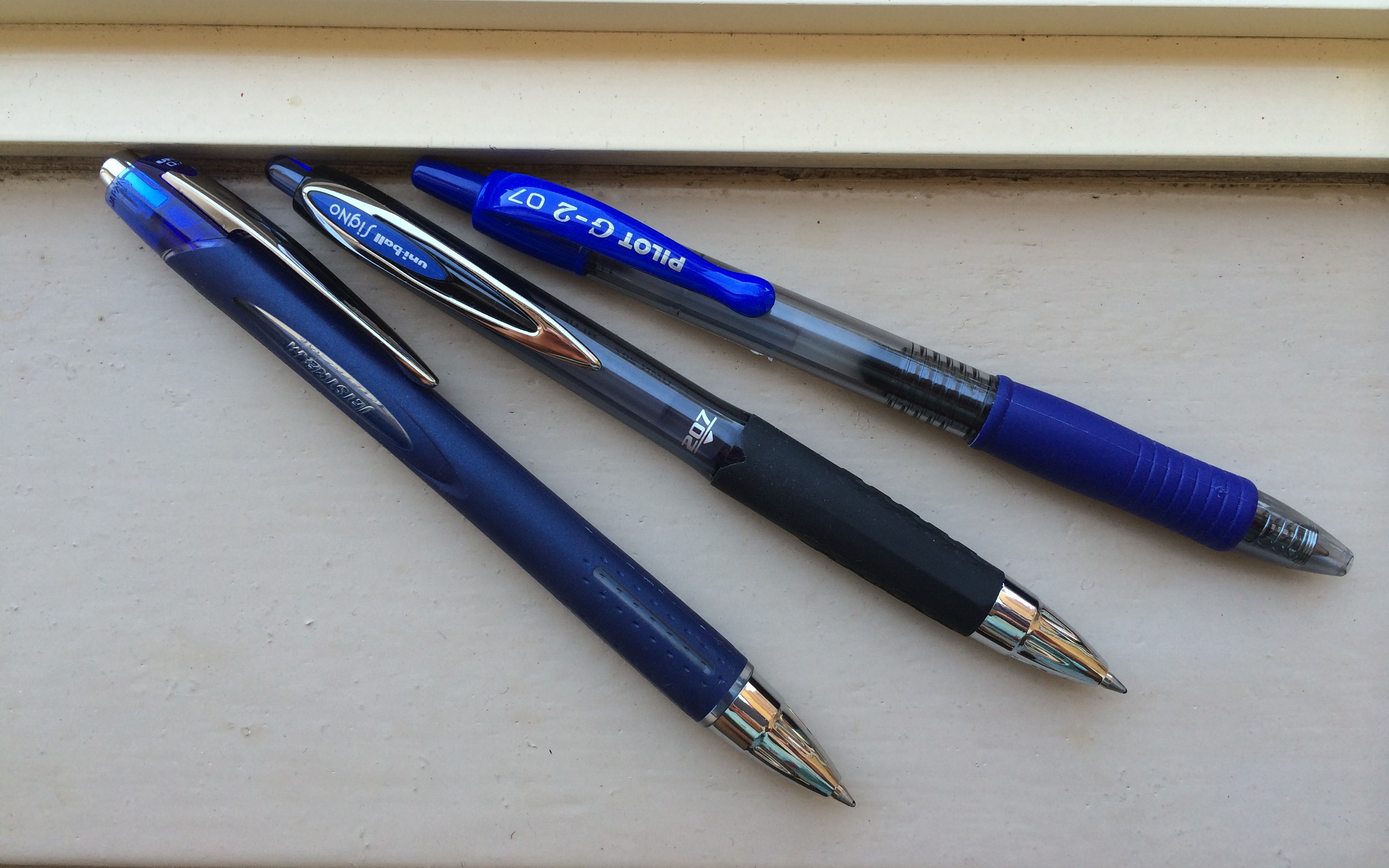
The right pen is the one that makes the page easier to use. For most people, that is a ballpoint that starts immediately, survives a bag or desk drawer, and does not turn a quick form into an ink-smear problem. Our general pick is the Uni-ball Jetstream. Its hybrid ballpoint ink feels closer to a gel pen than a typical office ballpoint, yet it dries quickly enough for everyday notes and paperwork.
If you write for longer stretches, buy a Pentel EnerGel RTX. Its 0.7 mm liquid-gel refill, comfortable grip, and broad refill availability make it a better fit for lecture notes, planning, and journaling. The Sharpie S-Gel is the pick for a bold line and a simple all-purpose gel pen; it comes in several point sizes, including 0.38 mm, 0.5 mm, 0.7 mm, and 1.0 mm. The important distinction is the ink system. A pen that is perfect for a signature can be frustrating for a left-handed writer or dense planner page.
Quick picks
| Pick | Best for | Main trade-off |
|---|---|---|
| Uni-ball Jetstream | Forms, office notes, pockets, and a dependable everyday pen | Less saturated line than a gel pen |
| Pentel EnerGel RTX | Fast long-form writing, planners, and readers who want refillable gel ink | Gel ink uses up faster than ballpoint ink |
| Sharpie S-Gel | Bold notes, color choices, and a comfortable medium-point gel pen | Paper and point size still affect dry time and show-through |
The Uni-ball Jetstream is the pen to keep within reach
The Uni-ball Jetstream is the right default because it removes the little annoyances that make people abandon a pen. A traditional oil-based ballpoint can feel sticky on the page. A gel pen can put down a satisfying dark line but may smudge before a hurried hand or facing notebook page reaches it. Jetstream’s hybrid ink is designed to sit in the useful middle: low writing resistance, a crisp enough line for notes, and a ballpoint’s practical drying behavior.
Buy the 0.7 mm version first. It is the balanced point size for ordinary paper, meeting notes, address labels, schoolwork, and forms. A 0.5 mm point is worth considering if your handwriting runs small or you write in a compact planner grid. A 1.0 mm point creates a broader, darker line but can make a narrow ruled page feel crowded. Point size is not a quality hierarchy. It is line width, and the page tells you which width it needs.
What the Jetstream gives up is some of the theatrical pleasure of gel ink. It will not make every stroke look as black or saturated as a broad gel pen, and it is not the pen to buy chiefly for colorful journaling. The exchange is worthwhile for a pen you want to lend, toss in a bag, or use on forms without worrying about a soft, wet line. For a workplace drawer or a household spot where many people will use it, reliability is the feature.
Get a small multipack only after you confirm the point size suits you. Pens disappear because they get moved between rooms and bags, not because every writing surface needs a different barrel. Jetstream refill options are available on Amazon for compatible refillable models; check the exact barrel before ordering because the line includes several body styles.
Choose Pentel EnerGel RTX for a smoother, refillable gel pen
The Pentel EnerGel RTX is the better everyday gel pen for someone who writes several pages at a time. Pentel’s 0.7 mm EnerGel refill uses liquid-gel ink and a metal tip. The company offers its standard 0.7 mm refill in a large color range, and that refill fits its refillable EnerGel pens. That matters because a good pen should not become waste simply because the ink is gone.
The RTX has a latex-free grip and a retractable format, so it is easy to use at a desk or in a notebook without looking for a cap. Its quick-drying ink is the central reason to buy it. Gel ink commonly offers more fluid, darker-looking writing than a ballpoint, and faster drying makes that benefit available to left-handed writers and people who move quickly down a page. It is not a guarantee that any paper, ink color, or broad point will never transfer. Thin paper and a heavily inked line can still show through. But the EnerGel family is a strong starting point when smearing is your usual gel-pen complaint.
The 0.7 mm version is a medium line. It is friendly to ordinary notebooks and makes headings legible without turning all notes into display type. If you use a small-grid planner, try an EnerGel needle-tip or a finer 0.5 mm variant. If you annotate printouts or prefer a more visible line, stay with 0.7 mm. Refill color is a real advantage here: black and blue are practical defaults, while colored refills let a single familiar barrel work for a simple note-taking system.
Gel ink spends faster than ballpoint ink. That is the cost of the writing feel, so do not compare a cheap disposable ballpoint and a refillable gel pen by first purchase price alone. Compare the way you actually write. Someone who makes brief notes and signs delivery slips will get more practical value from the Jetstream. Someone filling a notebook every week will notice the EnerGel’s smoother movement and refill support. See Pentel EnerGel 0.7 mm refill options on Amazon.
Sharpie S-Gel is a good pick for a bold line
Sharpie S-Gel is the useful third choice because its range makes it easy to match the pen to the job. Sharpie lists 0.38 mm ultra-fine, 0.5 mm fine, 0.7 mm medium, and 1.0 mm bold versions. The standard models have a contoured rubber grip, and the medium refill is available separately. Those details are more useful than the marketing language around a single “best” pen: choose the point first, then decide whether you want the more durable metal-barrel version or a simple plastic multipack.
We would choose the 0.7 mm S-Gel for clear meeting notes, household labels on paper, or anyone who likes a bolder visual line than a hybrid ballpoint provides. A 0.5 mm pen is the better fit for compact handwriting. A 1.0 mm pen looks satisfying on a card or broad notebook page but is a poor match for a tightly ruled planner. Sharpie describes the S-Gel line as no-smear and no-bleed. Treat that as a product goal, not an excuse to ignore the paper: absorbent paper, a very heavy hand, and immediately closing a notebook can still create transfer.
The S-Gel is not permanent ink. It belongs on paper, notes, and ordinary documents, not on materials that require a permanent marker or on a check where you specifically need a pen marketed for fraud resistance. This is a common source of bad buying advice: “Sharpie” is a brand, not a single ink chemistry. The gel pen should be judged as a water-based gel pen.
Consider the refillable Copper or metal-barrel versions only if you value the feel of the barrel and will keep using the same pen. A heavier body does not make the ink better. It can make a familiar pen feel more balanced in the hand, but a basic S-Gel delivers the same general writing system for less. Find compatible Sharpie S-Gel medium refills on Amazon if you choose a refillable version.
How to choose a pen without overthinking it
Pick the ink type from the task. Ballpoint ink is the sensible default for forms, quick notes, bags, and surfaces where a fast dry time matters. Hybrid ballpoint ink offers a smoother feel without moving fully into gel-pen behavior. Gel ink is for people who want a fluid, dark line and are willing to be slightly more deliberate about paper, point size, and refills. Rollerballs and fountain pens can be excellent writing tools, but they ask more of the paper and owner; they are not the default answer for a household desk.
Point size determines the line that lands on the page. Use 0.5 mm for small handwriting, narrow columns, detailed annotation, and compact planners. Use 0.7 mm for everyday notes; it is the safest place to begin. Use 1.0 mm when a bold, easy-to-read line is genuinely helpful and the paper has room. It is tempting to call a fine point “more precise,” but a finer point can feel scratchier on rough paper and may not suit a large, relaxed hand. The right size is the size that makes your normal handwriting legible without crowding.
Grip shape matters only when you write enough to notice it. A soft or contoured grip can help during long note-taking sessions, but it will not rescue a point size you dislike. If your hands tire, use a wider barrel and a relaxed hold before buying an expensive pen. A pen that encourages you to press hard is usually a poor match for your paper or ink type.
Refills are worth considering for a pen you use every day. The convenience is not merely environmental. A refilled pen lets you retain a barrel that fits your hand and a point size you already know. But do not buy an elaborate refill system for a pen that will be shared around the house or lost in a month. Multipacks make more sense for communal spots; refills make more sense for a personal work or school pen.
Paper changes the answer
Even a good pen cannot repair flimsy paper. Thin, absorbent paper is more likely to show gel ink on the reverse side. Coated or glossy paper can delay dry time. A cheap notepad may make a fine point feel scratchy because its fibers are uneven. Try a pen on the paper you use most—your planner, office pad, lab notebook, or form stock—before committing to a large pack.
For notebooks and planners, use a darker gel pen only if the page has enough weight for it. A Jetstream or finer EnerGel is often the happier compromise in a compact calendar. For correspondence and long-form writing, the EnerGel or S-Gel’s more visible line can make a page easier to reread. If the bigger problem is organizing notes, a dependable pen works best alongside a notebook you will use; our guide to paper notebooks and journals can help with that decision.
What we skipped
We did not make an expensive metal pen the primary recommendation. A metal barrel can feel excellent, and it may be worthwhile as a personal object, but the refill and point determine most of the writing experience. A durable basic pen that writes cleanly is more useful to more people than a premium body with a mediocre refill.
We also did not recommend a fountain pen as an all-purpose household choice. Fountain pens can turn handwriting into a pleasurable ritual, but they need compatible paper, ink handling, and more attention to storage and cleaning. They are a good specialist purchase, not a substitute for a pen you hand to a coworker or use on a clipboard in the rain.
Markers, permanent pens, and archival or fraud-resistant pens solve separate problems. If you are labeling plastic storage bins, sending a check, or writing on a package, buy the ink that says it is made for that task. A pleasant gel pen is not a universal writing instrument.
Care, storage, and a simple desk setup
Keep the tip retracted or capped when the pen is not in use. Store a small set point-down only if the maker permits it; otherwise, horizontal storage is uncomplicated and avoids surprises. If a ballpoint skips after sitting, scribble a few loops on scrap paper before assuming it is dry. If a gel pen leaves a blot, do not shake it aggressively. Check for a damaged tip, paper fibers, or a pocket that has been left extended.
A good simple setup is two black everyday pens, one blue pen for forms or notes that need visual separation, and one color pen or highlighter for organization. Anything beyond that should earn a specific place in your work. Pairing a dependable pen with a clear label system is more useful than a cup full of random pens; our label-maker guide covers that adjacent decision.
Buy a small pack before making a pen system
It is easy to turn a basic stationery decision into a search for a perfect instrument. Resist that impulse. Buy a small pack or one pen in the point size you use, write a full page on your usual paper, and notice only three things: whether the line is easy to read, whether your hand has to press, and whether the ink remains clean when you turn the page. Those observations tell you more than a long list of product features.
Once you know the answer, standardize. Keep the same black pen in the places where you write most often, then add one specialist only when it solves a distinct problem. A fine-point gel pen can live with a compact planner. A 0.7 mm hybrid ballpoint can stay in a bag. A single brightly colored EnerGel can handle headings and annotations. This keeps your supplies understandable and makes a lost pen unremarkable instead of irritating.
Do not build a collection around discontinued special editions, unusual refill formats, or a pen that only feels good on premium paper. Everyday writing should be easy to replace. When a pen becomes a trusted tool, order a modest replacement pack or compatible refills while the exact line is still available. That is the practical difference between owning a pen you like and relying on one you cannot replace.
How we researched
We compared current manufacturer product information for point sizes, refill availability, grip and barrel designs, and stated ink behavior. We looked for choices with distinct practical roles instead of ranking near-identical pens. We did not claim laboratory testing or personal use. Paper, hand pressure, and writing speed materially change how any pen behaves, so the guide explains the trade-offs that remain useful across those variables.
Pen questions, answered
What pen point size should I buy?
Start with 0.7 mm for ordinary writing. Choose 0.5 mm for smaller handwriting and compact layouts. Choose 1.0 mm only when you want a broad, bold line and have room for it.
Are gel pens good for left-handed writers?
They can be, especially quick-drying formulas such as EnerGel. Dry time still depends on the paper, ink amount, and how quickly your hand follows the line, so test one before buying a large pack.
Is a refillable pen worth it?
Yes when you repeatedly use and keep track of the same pen. For common household pens that are often shared or lost, a straightforward multipack is more practical.
Should I use a gel pen for checks or official records?
Use the specific pen or ink type required by the institution or form. An ordinary gel pen is not automatically permanent, archival, or fraud-resistant.
Affiliate note: SuperGrail may earn a commission when you buy through an Amazon link. That does not affect our recommendations or the trade-offs we explain.